Skip to content

Macedonia Builds on Credit – Is the Housing Bubble Getting Ready to Burst?

1 min read
Share
Macedonia Builds on Credit – Is the Housing Bubble Getting Ready to Burst?
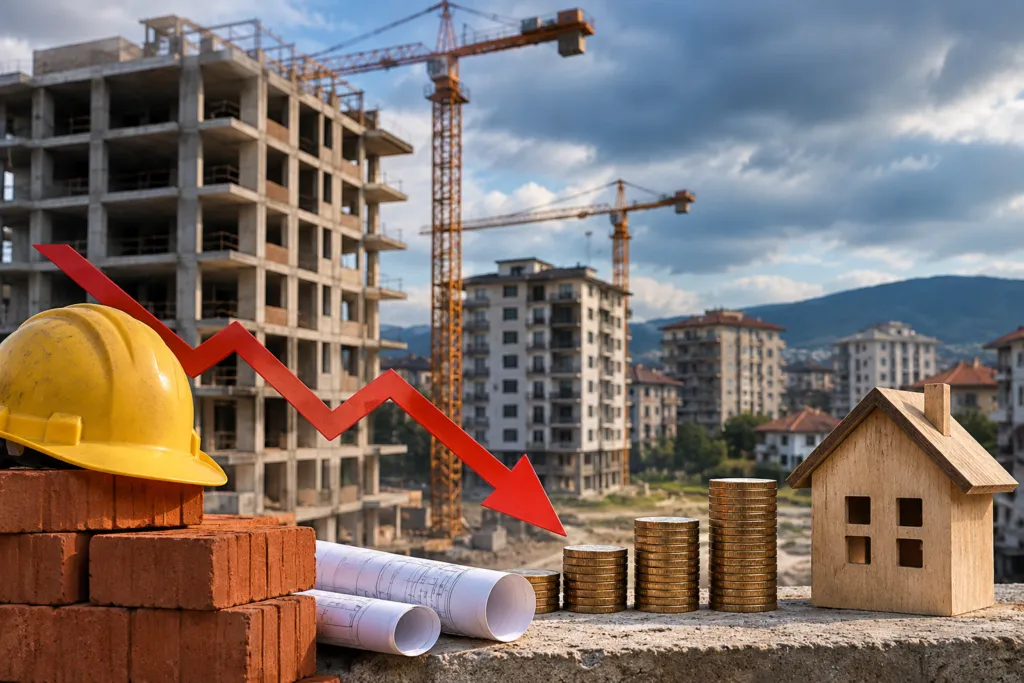
While new apartment buildings keep springing up in Macedonia, the price per square metre keeps rising, the population keeps shrinking, and people's purchasing power remains limited. Financial data available on CompanyWall show a significant rise in liabilities at some Macedonian construction companies. Four analysed companies – at the end of 2025 had total liabilities of around 97 million euros, compared with 66.5 million euros in 2023. In just two years, their liabilities grew by more than 45 percent. It is especially worrying when the growth in liabilities comes with falling revenues and profits. The world is already facing housing crises. In China, over-indebted construction companies, unsold flats and falling demand caused serious economic shocks. In Macedonia, intensive construction continues despite demographic decline, a low standard of living and growing household debt. But nobody gives a full answer to the key questions:
  • How indebted are Macedonian construction companies to the banks?
  • How many newly built flats remain unsold?
  • How many flats and buildings under construction are mortgaged?
  • How many construction companies could survive a 30 percent drop in sales?
  • How exposed is the banking sector to a possible construction crisis?
High liabilities on their own do not mean the companies are facing bankruptcy, nor that all liabilities are bank loans. But their growth, combined with a possible drop in sales, is a risk that deserves serious institutional analysis. If construction companies are forced to cut prices to secure liquidity, the consequences could spread to the banks, suppliers, workers and the economy as a whole. Macedonia builds as if it had more and more residents, sells as if it had European wages, and borrows as if economic growth were guaranteed.
Although total liabilities are not exclusively bank loans, their growth deserves serious attention.

What conditions lead to a housing crisis?

  • High indebtedness of construction companies – construction financed with borrowed money and dependent on continuous sales.
  • Overbuilding – the supply of flats exceeds real demand.
  • A large number of unsold flats – investors' capital stays locked up in property.
  • A low standard of living – people's incomes don't keep up with rising prices.
  • High interest rates – loans become out of reach for more and more people.
  • Demographic decline and emigration – the potential number of buyers is shrinking.
  • Excessive household debt – a growing share of wages goes on loan repayments.
  • Speculative buying of flats – property is bought on the expectation that prices will keep rising.
  • Low rental returns – rental income doesn't cover the cost of financing the investment.
Not all of these conditions need to be met for a crisis to start. It is enough for a few of them at once to cause a significant drop in demand and liquidity problems.

What happens if sales stop?

Construction companies will have to keep repaying loans and paying suppliers and workers, regardless of whether they are selling the flats. A lack of liquidity could force them to cut prices, halt construction or sell assets to meet their obligations. The consequences could be bankruptcies, unfinished buildings, layoffs, mortgages being called in, bank losses and slower economic growth. Such consequences are already visible in China, where the crisis of over-indebted developers grew into a wider economic problem.

Is Macedonia facing a housing crisis?

A shrinking population, low wages, rising property prices, intensive construction and growing liabilities at some construction companies – Macedonia is already showing several of the warning signs. Still, without full data on the sector's debt, unsold flats and banks' exposure, it cannot be stated categorically that the housing bubble is about to burst. That is why the National Bank, the Ministry of Finance and the other competent institutions should answer publicly how stable the Macedonian property market is. A housing crisis doesn't start when the building stops, but when the selling stops and the debts remain. The question is whether Macedonia will recognise the warning signs in time, or once again analyse the causes only after it has faced the consequences.