
The "Lottery" Trial: 231 Pieces of Evidence, and So Far Not a Single Message Between Grubi and Bajrami
24.09.2026


24.09.2026
24.09.2026

24.09.2026

24.09.2026

24.09.2026
24.09.2026
24.09.2026
23.09.2026
22.09.2026

24.09.2026

24.09.2026

23.09.2026

24.09.2026

24.09.2026

24.09.2026

24.09.2026

23.09.2026
22.09.2026

24.09.2026

24.09.2026

24.09.2026

24.09.2026

23.09.2026

23.09.2026

09.03.2026

27.02.2026

19.02.2026
24.09.2026

23.09.2026
22.09.2026

23.04.2026

23.04.2026

12.04.2026

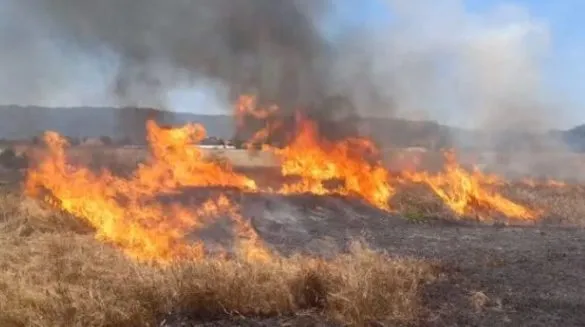
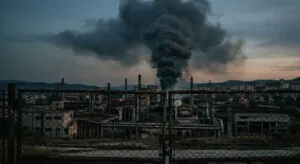
Fifteen open-air fires in a single day. That is what the Crisis Management Centre logged by 18:00 on Monday. Ten were put out, five stayed active. By evening the number had climbed to seven live hotspots across the country.
The worst of it is near Kavadarci. Between the villages of Raec and Ḱesendre, low woodland and dry grass are burning, and the same municipality has a second active fire at Kamen Dol, close to the quarry. Near Prilep the Trizla Teke landfill is alight and spreading in three directions - towards Markovi Kuli, towards the pass by the Bogorodica church and towards the Tri Bagremi site. There are also active fires at the landfill in Bukovo in the municipality of Ohrid, in the fields around the village of Jakrenovo near Kruševo, near the village of Sirkovo in Rosoman, and between the villages of Karbinci and Balvan.
Landfill, landfill, stubble
Read the list again and count how many times the word "landfill" appears. Prilep - landfill. Ohrid - landfill. Vasilevo - dry grass, stubble and an illegal dump. This is not a forest fire in untouched nature. This is waste burning, in places where waste should never have been.
Fires were extinguished in the municipalities of Butel, Šuto Orizari, Bitola, Veles, Brvenica, Kumanovo, Staro Nagoričane, Lipkovo and Makedonski Brod. So in one afternoon - from Bitola to Kumanovo, from Lipkovo to Veles. That is not a local accident. That is the state of an entire country on one August day.
The appeal that repeats every summer
The crisis centre is urging people to be careful and not to light fires in the open, on stubble, on waste or on dry vegetation. The appeal is accurate and necessary. It is also the only tool that ever appears in the press releases.
Firefighting crews are in the field battling the blaze. Near Kavadarci the work continues through the night. Those people are doing their part. The question is who does the part that comes before the fire - clearing the illegal dumps, mowing the stubble along the roads, watching over the sites where the same spot burns every summer. The Trizla Teke fire was not the first there this week.
Every summer the same list of municipalities, every summer the same appeal, every summer the same landfills. How many times does one and the same place have to burn before it stops being called an "unpredictable disaster"?
The latest 10 news from this category

The square metres and parking spaces were announced down to the last one. How many people will be hired and...

The mayors offered a "favourable business climate" and raw materials. The only concrete thing to come out of the meetings...
Home-address checks are being announced with the police as a partner, while the health minister admits that monitoring where sick...

The city has announced round-the-clock video surveillance against illegal dumps and vandals, and the cameras haven't even been bought yet....
Residents want the trucks serviced; the company wants better packaging. Meanwhile, 650 cubic metres of illegal dumps were cleared in...
According to the Crisis Management Center, a paint and varnish warehouse was on fire. That explains why the smoke was...
The union says staff have endured insults and threats from the court president for years. She says this is really...
The state audit found a system that responds well and plans badly. The reforms were demanded by the EU screening...
To fine a bar that is too loud, a citizen has to file a complaint at the municipal Registry. The...
In Montenegro the same offence costs up to 2,000 euros. But the fine is not the only problem: Skopje's municipal...
This site uses cookies - is that okay? Learn more
Be the first to know when Metla launches something new
Leave your email and we will write when there is a new guide or something new on Metla.