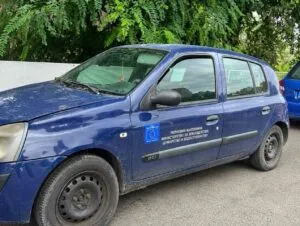
Food safety inspector detained in Skopje: a clean inspection report allegedly came with a price tag
25.09.2026


25.09.2026
25.09.2026
25.09.2026
25.09.2026

25.09.2026

25.09.2026
25.09.2026

24.09.2026
23.09.2026

25.09.2026
25.09.2026
24.09.2026
25.09.2026
25.09.2026

25.09.2026

25.09.2026

24.09.2026

23.09.2026

25.09.2026

25.09.2026
25.09.2026

25.09.2026

25.09.2026
24.09.2026

09.03.2026

27.02.2026

19.02.2026
25.09.2026
24.09.2026
23.09.2026

23.04.2026

23.04.2026

12.04.2026

Recycling guide
Rubbish doesn't disappear when you throw it away - it just moves. This guide is the first step: where the nearest container is, what goes in which colour, and which containers have been sitting full for days. We draw the map from Pakomak's public data and refresh it every day.
Pick what you're carrying and allow location access. You get the three nearest containers, with the distance and walking directions.
What are you carrying?
Without location access we can't find the nearest one. Allow it in your browser and try again, or look it up on the map below.
Your location is outside Macedonia, and Pakomak only has containers here.
Something went wrong. Try again in a moment.
The nearest one is farther than 800 metres. We keep count - how many people have no container nearby is a number somebody needs to see.
We don't store your location.
Loading the map...
Glass bottles from water, juice, beer and wine, jars of every size, small glass bottles from medicines, cosmetics and perfume.
Good to know
The green container is for glass packaging. Window glass, mirrors and ceramics are not packaging and don't belong in it. Careful with broken glass - don't cut yourself.
Plastic bottles from water and juice, beer and soft-drink cans, food tins, packaging from detergents, shampoos and cleaning products, film and plastic wrapping, plastic bags, plastic cups and plates.
Good to know
No need to rinse anything - packaging gets washed during processing, it only has to be empty. The label can stay on the bottle as well.
Cardboard boxes of every kind, pizza and egg boxes, Tetra Pak cartons from milk and juice, shoe and chocolate boxes, food packaging, newspapers, notebooks, letters, bills, flyers, posters and old calendars.
Good to know
Tetra Pak is a composite, but it goes in the blue one. Paper should be free of food leftovers, so empty the pizza box first. Flatten big boxes - that leaves room for everyone else.
Pakomak has sensors on its containers that measure how full they are every day. Its own system flags a container for emptying at just 40% for glass and 50% for plastic and paper. We count something much later: when a container passes 80% and stays there. A full container is an invitation for the rubbish to end up next to it.
Who empties them? In Skopje - the public utility JP Komunalna higiena, in Kumanovo - JP Čistota i zelenilo, and in the other municipalities collectors under contract with Pakomak. That is why each municipality below shows who is responsible for it.
Glass
25
containers are more than 80% full right now
Plastic and cans
39
containers are more than 80% full right now
Paper
20
containers are more than 80% full right now
| Where | Container | Above 80% |
|---|---|---|
| Branko Bogdanski Gucman, Kumanovo Kumanovo | Plastic and cans | 296 days |
| Ulica Todor Cipovski-Merdzhan Tetovo | Glass | 282 days |
| Maršal Tito Prilep | Plastic and cans | 282 days |
| Mateja Matevski, Skopje Karpoš | Glass | 234 days |
| Blagoj Iliev Gune, Kumanovo Kumanovo | Plastic and cans | 217 days |
| 1511 10, Skopje Kisela Voda | Plastic and cans | 217 days |
| Strašo Pindžur, Kavadarci Kavadarci | Paper | 217 days |
| Kaj 5 ti Noemvri, Star Dojran Dojran | Plastic and cans | 217 days |
| Ulica Marshal Tito 3 Pehčevo | Glass | 159 days |
| Štip Štip | Glass | 128 days |
| 11 ti Noemvri, Kumanovo Kumanovo | Paper | 124 days |
| 11-ti Noemvri, Kumanovo Kumanovo | Paper | 113 days |
| Ulica Biljanovska Kumanovo | Plastic and cans | 82 days |
| Ulica Joska Jordanoski 47 Prilep | Glass | 81 days |
| 11-ti Oktomvri, Kumanovo Kumanovo | Paper | 79 days |
| Moša Pijade, Kumanovo Kumanovo | Paper | 79 days |
| Goce Stojčevski Ambarče, Skopje Karpoš | Glass | 71 days |
| R1102 Veles | Paper | 66 days |
| Olimpiska pateka, Skopje Karpoš | Plastic and cans | 65 days |
| Bulevar Kočo Racin, Skopje Centar | Plastic and cans | 54 days |
| R1102 Veles | Plastic and cans | 54 days |
| Ulica Dimo Gavroski Kara 29 Karpoš | Glass | 50 days |
| 3 Makedonska Udarna Brigada 110, Kumanovo Kumanovo | Plastic and cans | 44 days |
| Bogovinje Bogovinje | Paper | 40 days |
| Strašo Pindžur, Kavadarci Kavadarci | Plastic and cans | 37 days |
| Bogovinje Bogovinje | Paper | 36 days |
| Partizanska, Ohrid Ohrid | Glass | 35 days |
| Štip Štip | Plastic and cans | 34 days |
| Dimitar Vlahov, Ohrid Ohrid | Plastic and cans | 33 days |
| M. Sokolovski, Štip Štip | Paper | 32 days |
Period: the last 12 months
Emptied by: a collector contracted by Pakomak · 11 containers
Emptied by: JP Čistota i zelenilo Kumanovo (city utility) · 40 containers
Emptied by: JP Komunalna higiena Skopje (city utility) · 10 containers
Emptied by: a collector contracted by Pakomak · 22 containers
Emptied by: a collector contracted by Pakomak · 22 containers
Emptied by: a collector contracted by Pakomak · 17 containers
Emptied by: JP Komunalna higiena Skopje (city utility) · 92 containers
Emptied by: a collector contracted by Pakomak · 62 containers
Emptied by: JP Komunalna higiena Skopje (city utility) · 109 containers
Emptied by: a collector contracted by Pakomak · 9 containers
Emptied by: a collector contracted by Pakomak · 19 containers
Emptied by: JP Komunalna higiena Skopje (city utility) · 65 containers
Emptied by: a collector contracted by Pakomak · 25 containers
Emptied by: a collector contracted by Pakomak · 100 containers
Emptied by: a collector contracted by Pakomak · 14 containers
We take the last reading of every day. If a sensor misses a day, the streak breaks - a dead sensor can't invent a full container. Sensors that jump straight from 0% to 100% and back, or show the same number for months, are left out of the rankings: that's a fault in the device, not the collector's failure. Municipalities are ranked by the share of days their containers spent above 80% over the last 12 months.
52 sensors with unreliable readings are left out of the rankings.
Everyone who presses "Find the nearest" tells us how far they are from a container. If the nearest one is more than 800 metres away - about ten minutes on foot with a full bag - we count it. We don't store the location, only the distance.
Glass
0
farther than 800 m
0 searches
Plastic and cans
0
farther than 800 m
0 searches
Paper
0
farther than 800 m
0 searches
Vending machines
0
farther than 800 m
0 searches
You can also return plastic bottles and cans to Pakomak's reverse vending machines in supermarkets. Download the free Ecomak app, scan your personal barcode on the machine and feed in the bottles and cans. You earn green points, which you can swap for supermarket discount vouchers, discounts on utility bills or donations.
Bottles go in cap-end towards the machine's opening. If a machine suddenly stops accepting them, its bag may simply be full - Pakomak admits as much itself.
103 vending machines · 96 locations
An old fridge, TV or phone doesn't go in any of the three containers. Nula Otpad collects e-waste for free from your doorstep, anywhere in the country: the appliance must be complete, disconnected from power and water, and easy to reach. Book a pickup on 070 236 000 or through the form at nulaotpad.com.mk. Elkolekt runs free drop-off points in primary schools and municipal depots, with a green line on 071 263 500.
When you buy a new appliance, the shop has to take the old one of the same type back for free, and if it delivers to your home, it must offer to take the old one away. Shops larger than 400 m² must accept small appliances up to 25 centimetres even if you buy nothing. In Skopje you can also take large household waste yourself to Komunalna higiena's recycling yards in Karpoš and Vardarište.
Batteries go neither in mixed rubbish nor in the yellow container. Nula Otpad is licensed for batteries and accumulators as well, so it takes them together with e-waste. Collect them in a jar at home and hand them over with your next old appliance.
Karpoš has containers for old clothes and textiles at all ten of its primary schools, at its kindergartens and outside the municipal building. By September 2026 they had collected 3,500 kilograms. Clothes that can still be worn are better given away.
The three colours are only the beginning. According to the State Statistical Office, Macedonia collected 639,668 tonnes of municipal waste in 2025, and 99.8% of it ended up in landfill.
Sorted waste takes a different road. Pakomak writes that the country has little capacity for recycling paper and plastic, and none at all for glass packaging, so most of the collected packaging waste is exported.
That's why it pays not to mix: one bag of mixed rubbish in the yellow container soils the plastic around it. And when a container sits full for weeks, even the best sorting doesn't help - which is why we track those too.
Press "Find the nearest" at the top of the page, pick a colour and allow location access. You'll get the three nearest containers with the distance and walking directions. All of them are on the map too.
No. According to Pakomak, packaging is washed during processing - it just has to be empty, with no liquid left inside.
No. The materials are separated during processing, so the label can stay. What matters most is that the bottle is empty.
In the blue container. Tetra Pak is a composite, but Pakomak collects it together with paper.
In the yellow container, together with the other plastic.
Don't leave your waste next to it - check the next nearest one on the map. Pakomak asks for container problems to be reported in writing with the exact location, while the mess around containers is the responsibility of the municipality's public utility company.
Container and vending machine data: Pakomak (public GIS map). Updated: 25.09.2026
This site uses cookies - is that okay? Learn more
Be the first to know when Metla launches something new
Leave your email and we will write when there is a new guide or something new on Metla.