
Father and son beat up a doctor and a nurse outside the Jane Sandanski clinic: the law provides up to five years in prison, and almost 70% of attacks aren't even reported
23.11.2026


23.11.2026

23.11.2026

23.11.2026

23.11.2026

23.11.2026

23.11.2026

23.11.2026

22.11.2026

22.11.2026

23.11.2026

23.11.2026

22.11.2026

23.11.2026
23.11.2026

23.11.2026

23.11.2026

22.11.2026

21.11.2026

23.11.2026

22.11.2026

21.11.2026

23.11.2026

23.11.2026

22.11.2026

23.04.2026

23.04.2026

12.04.2026


Wind, rain, sudden temperature changes, and then a hat, scarf and wool jumper rubbing against your hair all day. The result is familiar: hair standing in a halo around your head, full of static. The beauty industry has countless products for this. Experts have a better answer: frizz isn't an enemy to wage war on, but a sign that your hair is lacking moisture, nutrients and protection.
"With humidity and rain it's completely normal for frizz to appear," says Sol Santos, a hair educator and director of her own company, By Sol Santos. Frizz comes from dehydration: the strand separates and water escapes from it. That's why she recommends more hydrating products, finishing products that seal the cuticle when applied to dry hair, and as few heat tools as possible.
Pharmacist Roger Nebot, who specialises in hair and runs the company Gossyp, offers the most important tip in the whole story. "If we use a hairdryer, it's better for the temperature to be low or medium and for the air to flow from top to bottom," he says. The direction isn't random: air moving along the cuticle smooths it down instead of lifting it. Heat protection before drying is a must.
The rest of the routine is shorter than the adverts would like. Before the hairdryer, remove as much water as possible, but not by rubbing: a towel rubbing your hair creates knots and frizz. Don't comb wet hair aggressively. Be careful with the straightener, because too much heat damages the strand and makes frizz even worse. And don't overdo finishing products, especially if your hair is fine, because they weigh it down.
After showering, Nebot recommends a little leave-in conditioner on damp hair. Shampoo goes mainly on the scalp, and conditioner always, because it seals the strand. How often you wash depends on how quickly your hair gets greasy and dirty, not on the calendar. If dryness and frizz don't let up, then use a leave-in product and less heat.
His conclusion is worth writing down: you don't need a ten-product routine. You need a small, well-chosen selection and consistency. Care starts when you wash, and shine products are saved for the last step. At a time when bathroom shelves look like small pharmacies, that sounds almost revolutionary.
The latest 10 news from this category

Two leather jackets and not a single statement, yet everyone understood which team she was cheering for. Kim Kardashian became...
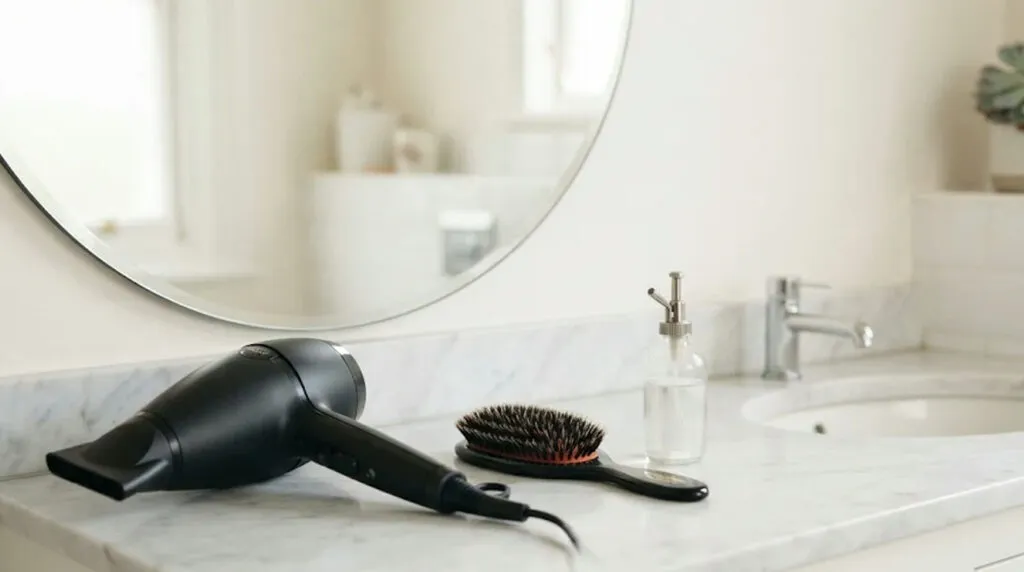
A straightener and a brush on dry hair only hide the problem until the first gust of wind. The fix...

She wanted a bouquet of edelweiss and ended up with more than a thousand white gerberas. A Spanish wedding that...

From a silversmith's workshop with roots in Epirus to Elizabeth Taylor and boutiques in New York and Paris. The funeral...

She wrote her phone number on his hand, and a film company paid for the second wedding. The story of...

The shawl Spanish women wear to their fairs came from China and got its name from Manila. Now Dolce &...

Celebrities have started dissolving the fillers they spent years injecting into their lips. The industry first sold volume, and now...

The princess saved up clothing coupons like every other post-war British woman. The dress had around 10,000 pearls, and her...

Quiet luxury and a handful of pieces that go with everything were rewarded by the algorithms, and getting dressed became...

Soft, bright and natural, which is why salons can't keep up with requests. There are three alternatives too: cashmere for...
This site uses cookies - is that okay? Learn more
Be the first to know when Metla launches something new
Leave your email and we'll write to you when there's a new guide or something new on Metla.