
Koraboski's Trial Begins: Custody Came Only After the Public Revolted
27.11.2026


27.11.2026

27.11.2026

27.11.2026

27.11.2026

27.11.2026

27.11.2026

27.11.2026

26.11.2026

25.11.2026

27.11.2026

27.11.2026

26.11.2026
27.11.2026

27.11.2026

27.11.2026

27.11.2026

26.11.2026

25.11.2026

27.11.2026

26.11.2026

25.11.2026

27.11.2026

27.11.2026
24.11.2026

23.04.2026

23.04.2026

12.04.2026

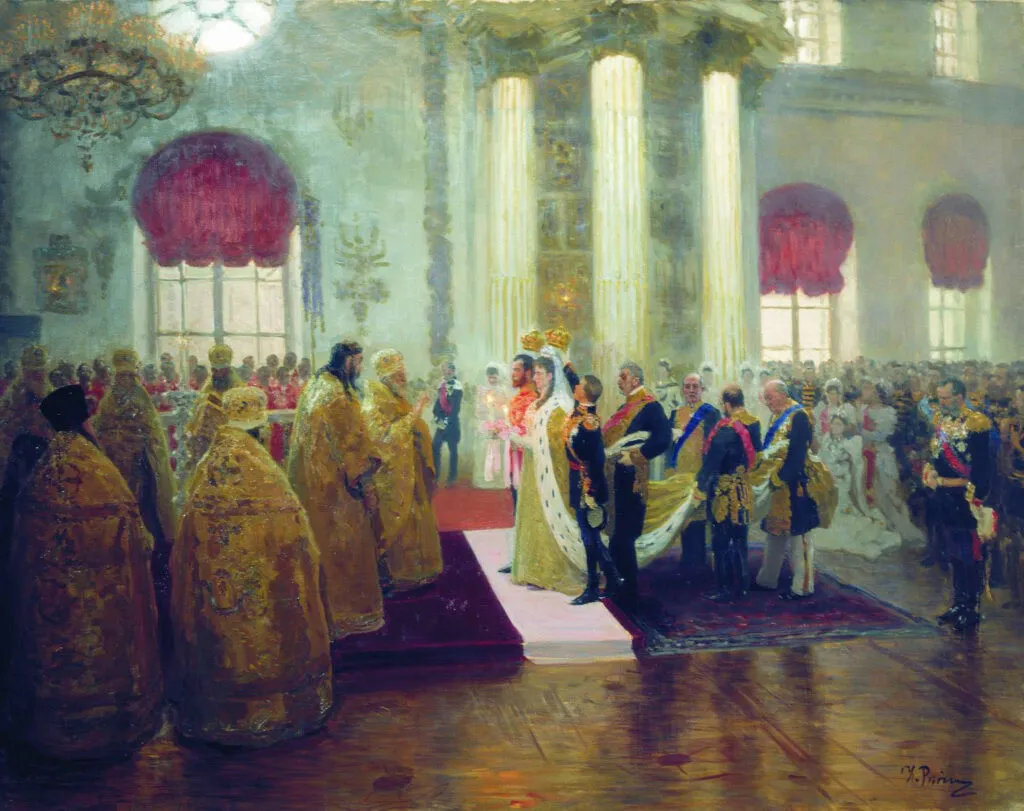
Photo: Ilya Repin Wikimedia Commons, Public domain
On this day, 26 November 1894, Nicholas II and Alexandra Feodorovna, Russia's last imperial couple, were married in the church of the Winter Palace in Saint Petersburg. Long before the 1997 animated film "Anastasia" turned the fate of their youngest daughter into a fairy tale, their love was one of the great romances among Europe's royal houses. And one of the most tragic.
The bride was born Victoria Alix Helena Louise Beatrice of Hesse, in Darmstadt in 1872, the daughter of Grand Duke Ludwig IV of Hesse and the British Princess Alice. That made her a granddaughter of Queen Victoria, who was especially fond of her and would have preferred to see her married into the British royal family. A deeply devout Lutheran, Alix left her faith that same year and converted to the Russian Orthodox Church, a decision that was hard for her and that nearly wrecked the engagement.
The groom didn't have it easy either. His parents didn't see the German princess as a good match, and neither the nobility nor the court liked her. Queen Victoria, for her part, thought her granddaughter was heading to a country far too unstable. Nicholas didn't give in. "My dream is one day to marry Alix. I have loved her for a long time, since 1889, when she spent six weeks here in Saint Petersburg," he wrote in his diary. They first met when he was 16 and she was 12, and for years they kept the relationship going through letters.
The engagement was announced in Coburg, at the wedding of Alix's brother Ernst to Princess Victoria Melita of Saxe-Coburg and Gotha, with the blessing of the German Kaiser. In her letters, the future empress hid nothing: "I dreamed that I was loved, I woke and found it was true. I thanked God on my knees. Every day my love grows deeper, fuller, purer."
A wedding in mourning
Then something happened that changed every plan. On 1 November 1894, the groom's father, Tsar Alexander III, died, and Nicholas became tsar at 26. The wedding, planned for spring 1895, was brought forward. The Russian people saw their future empress for the first time in her father-in-law's funeral procession, walking in black, and the courtiers already read it as a bad omen. From that moment on, superstition followed the two of them.
They chose as the date the birthday of the groom's mother, Empress Maria Feodorovna, so that the court's strict mourning would ease at least for that one day. The ceremony was Orthodox, in front of members of royal and noble families, foreign diplomats and members of the Holy Synod and the State Council. There was no wedding reception and no honeymoon. "The thought that our dear father is not among us did not leave me during the wedding. I had to summon all my strength not to burst into tears there in the church in front of everyone," Nicholas later wrote.
A ten-kilo dress
Romanov women married according to their own tradition: dresses with a fitted bodice and a wide skirt meant to display the splendour of the empire, made of silk, silver thread and fur. Alexandra's dress was of white silk with silver motifs and a very long train, with a lavish cloak of gold brocade lined with ermine. The design was inspired by a sketch by her older sister, Grand Duchess Elizabeth Feodorovna. Together, the silk and silver weighed around ten kilos: ladies-in-waiting had to dress Alexandra, and in the church several people held the train. When they let go, the bride could barely walk. The dress is kept today in the Hermitage.
She didn't forget her roots. The veil was English Honiton lace from Devon, the kind worn by her grandmother, Queen Victoria, and her mother, Alice. She also wore a 475-carat necklace and earrings that had belonged to Catherine the Great. There are no photographs of the ceremony, because Orthodox tradition did not allow photography in church, so painters captured the moment. The best known is Ilya Repin's 1894 painting, now kept in the Russian Museum in Saint Petersburg.
400 letters and the Ipatiev House
As empress, Alexandra won over neither the people nor the court. Shy, and therefore seemingly cold and stiff, she remained a foreigner. But the marriage never faded. Not even the First World War interrupted their correspondence: they wrote each other 400 letters full of tender messages.
Those letters also hold what cost them the throne. Alexandra pushed her husband towards autocracy and an iron fist, and he, gentler by nature, listened. She opened the court to Grigori Rasputin, the healer who claimed he could help the heir to the throne, Alexei, born in 1904 with haemophilia after four daughters: Olga, Tatiana, Maria and Anastasia. Rasputin even came to influence political decisions. He was murdered in 1916, and a few months later, in 1917, the entire imperial family was arrested.
On 17 July 1918, all seven of them were shot in the Ipatiev House in Yekaterinburg. The story that began in mourning ended in the basement of that house. The Balkans, which in 1903 saw the murder of King Alexander Obrenović and Queen Draga in Belgrade, had learned that lesson about royal marriages and hated queens even before Yekaterinburg.
The latest 10 news from this category
Before Anna Wintour and before the first Monday in May, the ball was "The Party of the Year" in December....

A manicure looks perfect until day five, and then the regrowth shows up. These shades buy you another week before...

A child's drawing convinced the designer to throw out the suit, and the mother had no idea the dress started...

The accessory that waited for decades in our grandmothers' jewellery boxes is back on the runways, and Saint Laurent turned...

Black mascara is treated as an untouchable rule, but after 50 it can harden the features. The irony: for the...

A high-street dress from the spring 2014 collection, back again at Stockholm's grandest evening. A good piece, it turns out,...

One night isn't the problem - the habit is. A dermatologist explains why micellar water has to be rinsed off...

Red for future rulers, blue for the rest, at least according to an interpretation the palace has never confirmed. And...

Fashion is selling us the cut Jacqueline Kennedy made iconic all over again. The good news: the pencil skirt outlasts...

Hats, cold and wind damage the scalp in winter, and the hair along with it. Before a 1,100-euro treatment, the...
This site uses cookies - is that okay? Learn more
Be the first to know when Metla launches something new
Leave your email and we'll write to you when there's a new guide or something new on Metla.