Father and son beat up a doctor and a nurse outside the Jane Sandanski clinic: the law provides up to five years in prison, and almost 70% of attacks aren't even reported
23.11.2026


23.11.2026

23.11.2026

23.11.2026

23.11.2026

23.11.2026

23.11.2026
23.11.2026

22.11.2026

22.11.2026

23.11.2026

23.11.2026

22.11.2026

23.11.2026
23.11.2026
23.11.2026

23.11.2026

22.11.2026

21.11.2026

23.11.2026

22.11.2026

21.11.2026
23.11.2026

23.11.2026

22.11.2026

23.04.2026

23.04.2026

12.04.2026

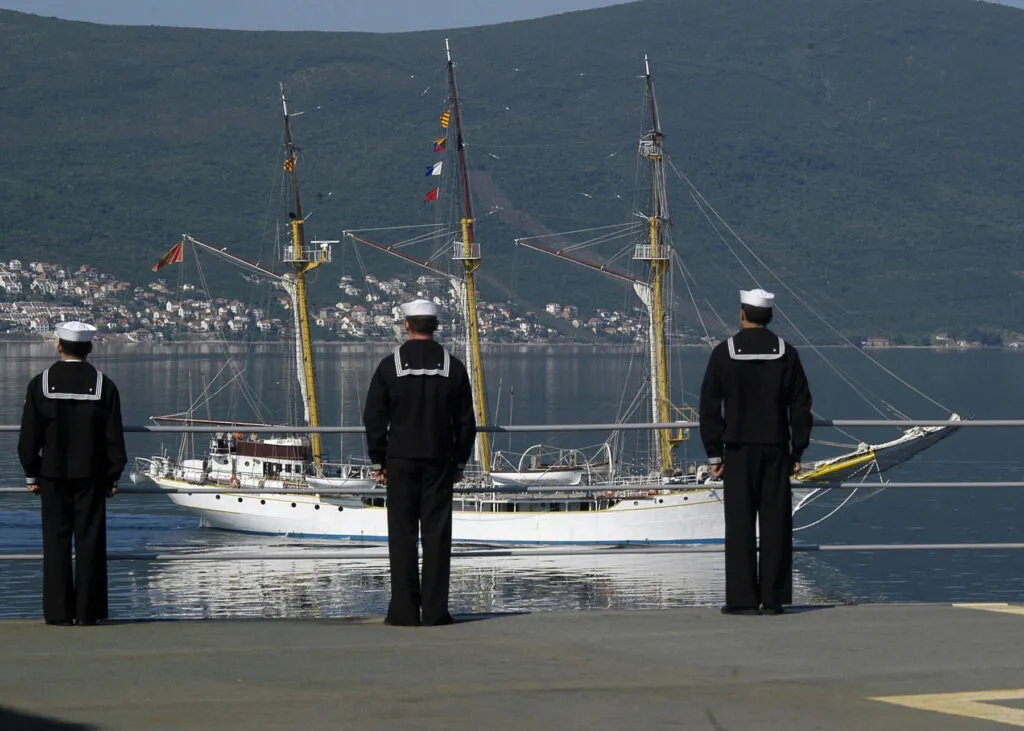
More than three decades after Yugoslavia broke up, one of the things the former republics still haven't managed to divide is a three-masted sailing ship. The "Jadran", the training ship of the former royal navy, is moored at the Pine waterfront in Tivat, in the Bay of Kotor. Croatia now wants it back - and precisely as Montenegro prepares for the European Union, with membership being mentioned for 2028.
The ship was ordered in September 1930 from the H. C. Stülcken Sohn shipyard in Hamburg and launched on 25 June 1931. It cost 622,743 German marks, around 3.4 million euros today. Over 80 percent of the money came from the state budget and from German war reparations after the First World War, King Alexander I contributed a share, and the Split-based association "Jadranska straža" raised about 13 percent from donations by its readers. It reached Tivat on 16 July 1933.
The life of the "Jadran" is the history of the Balkans in miniature. Before the Second World War it made seven cruises across the Atlantic, the Mediterranean and the Black Sea, and in 1938 it sailed 11,262 nautical miles to North America. Then the Italians took it and renamed it "Marco Polo". After Italy's capitulation in 1943 the German navy seized it and used it as a bridge across a canal in Venice. It returned to Yugoslavia after liberation in 1945.
Until 1990 it served as the Yugoslav navy's training ship, with regular cruises from Ulcinj to Koper and from Divulje near Split to Piran. In 1976 it won the "Blue Ribbon" of the newspaper Vjesnik for more than 5,000 nautical miles sailed. Then came the break-up, and the ship stayed where it happened to be - at the Sava Kovačević repair yard in Tivat.
Zagreb and Podgorica read different rules
Montenegro, then part of FR Yugoslavia, kept the "Jadran", arguing the ship didn't fall under the division of the SFRY's assets. After independence it became part of the Montenegrin navy. Zagreb argues the opposite: military property of the former Yugoslav People's Army belongs to the successor state where it was permanently stationed and registered before the break-up. According to the Croatian side, from 1933 to 1991 the ship was entered in the fleet register in Croatia, with bases in Split, Divulje and Pula.
Today the "Jadran" is a tourist attraction run by Tivat's tourist organisation and a training ship of the Montenegrin navy. School trips visit it, and officials receive foreign guests on board. Its value is estimated at 10 to 20 million euros, and a new ship of the same size would cost up to 25 million. In April 2019 military police and the special prosecutor's office found between 50 and 60 kilograms of cocaine in its hull, worth several million euros, which was allegedly meant to reach Turkey with the help of soldiers. A ship paid for by a king, sailed by Italians and Germans, also ended up as a smuggling hideout.
The EU's door as leverage
The most interesting thing is the timing. The question of the ship is being raised now, when Podgorica most needs goodwill from every member of the Union. Macedonia knows very well what it looks like when a neighbour brings its bilateral issues to Brussels' doorstep. It is also one of the five successor states that signed the Agreement on Succession Issues of the SFRY in 2001 - and a ship from 1931 shows that dividing things on paper doesn't mean dividing them on the pier.
Whether the "Jadran" will sail for Croatia or stay in Tivat, nobody knows for now. But if one sailing ship can become a topic in accession talks, how many other unresolved issues from Yugoslavia are waiting in ministry drawers?
The latest 10 news from this category
Last December Vučić pointedly boycotted the summit in Brussels. Now Serbia's new acting president is staying home too, just with...

One was killed in the morning near Cetinje, the other was stopped by an Interpol red notice before a flight...
The Slovak prime minister compared Serbia to Slovakia in the years when he himself was in opposition. How often in...
The students won 140 seats, and the party that held every lever of the state for 14 years now complains...

Greetings just before midnight, applause from the benches and an Instagram post saying the holiday "doesn't exist". Yet Bosniaks have...

An assistant professor with six children and an organic farm is now also acting president of Serbia. Has the street...
The Student List won the election, but Serbia still has no parliament speaker, because the loser won't let go of...

Moscow complains it is being pushed out of NIS, Belgrade says the deal is signed, and MOL denies it. Serbia's...
Major Goran Bulajić was killed when his MiG-29 came down in a field near Belgrade. Serbia guards its airspace with...
The man who ran Serbia for years now asks for the floor from the opposition benches, and the new majority's...
This site uses cookies - is that okay? Learn more
Be the first to know when Metla launches something new
Leave your email and we'll write to you when there's a new guide or something new on Metla.