
Sixteen Arrests in Twenty-Four Hours, All for Drugs: The Police Are Working - But Where Are All These People Coming From?
20.09.2026


20.09.2026

20.09.2026

20.09.2026
20.09.2026

20.09.2026

20.09.2026

20.09.2026

20.09.2026

20.09.2026

20.09.2026

20.09.2026

19.09.2026

20.09.2026

20.09.2026

20.09.2026

20.09.2026

19.09.2026

18.09.2026

20.09.2026

20.09.2026

20.09.2026

20.09.2026

20.09.2026

20.09.2026

09.03.2026

27.02.2026

19.02.2026

20.09.2026

19.09.2026

18.09.2026

23.04.2026

23.04.2026

12.04.2026

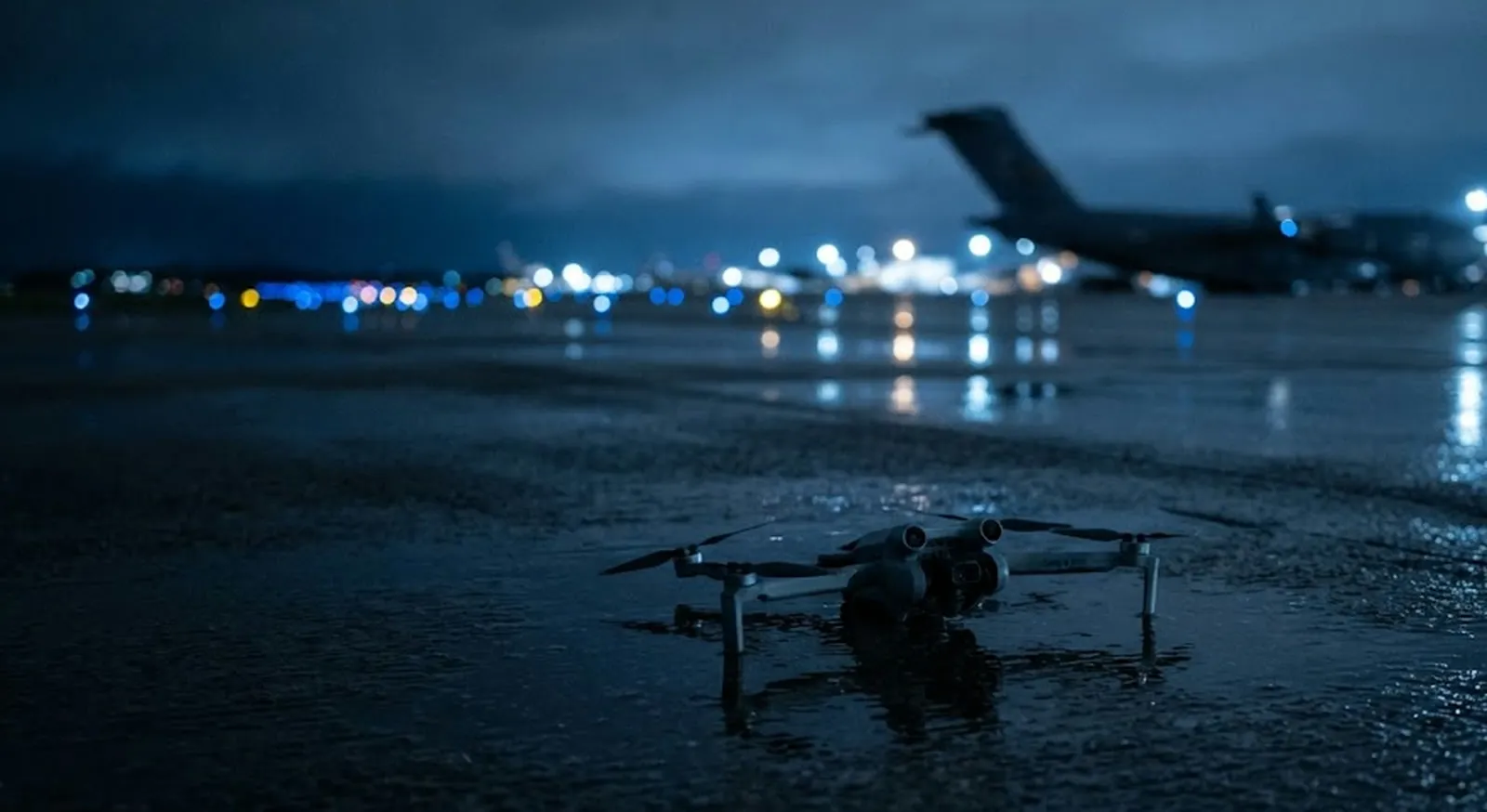
A drone carrying an explosive device was found overnight at Leipzig/Halle airport in eastern Germany - a few metres from a parked Ukrainian Antonov cargo plane. Not over the Donbas. Not over Kharkiv. In a NATO member state, at one of the most important cargo airports in Europe.
The suspicious object was spotted by an airport employee, after which police sent in a bomb disposal robot. Specialists removed the detonator and the device was then destroyed in a controlled explosion. According to Germany's Welt, an explosive substance suspected to be Semtex was attached to the drone. Investigators believe it did not detonate only because the detonator failed.
That is the sentence worth pausing on. This time the difference between a security incident and an attack on infrastructure in the heart of Europe was a faulty detonator.
What Leipzig/Halle is, and what it is not
The airport is not a random point on a map. It is one of Europe's most important air cargo hubs and DHL's main logistics centre. It is also used by the German armed forces and NATO allies to move military equipment. Ukrainian company Antonov Airlines is based there too, its aircraft carrying a large share of Ukrainian air freight.
Traffic was temporarily suspended because of the incident. The northern runway reopened during the night, while the southern one stayed closed. Not long afterwards, a DHL cargo plane near the same airport collided with an unidentified object. The crew continued the flight and landed in Hanover, where minor damage was found on the front of the aircraft. Investigators are checking whether there is a link between that event and the drone.
"Who else could it be but Russia?"
German authorities are investigating the case as a serious security incident, but have not so far said who was flying the drone or whether the intent was an attack. The Saxony police, the Dresden prosecutor's office and the federal police have opened an investigation, with German security officials also involved. Saxony's interior minister, Armin Schuster, described the case as "a very serious security incident".
Ukraine's ambassador to Germany, Oleksii Makeiev, was blunter. Asked who might be behind it, he replied: "Who else could it be but Russia?" German authorities have not published evidence linking the incident to Moscow, and Russia has not commented.
German airports and other sensitive facilities have been under heightened surveillance for months because of a series of unauthorised drone flights over military bases, energy plants, ports and logistics hubs. None of those drones had carried explosives. Now one has - and nobody is answering for it.
The question that remains is not who launched the drone, but how many nights like this Europe needs before it stops calling them incidents. The Balkans have their own experience of what it looks like when a threat is finally named only after it has become history.
The latest 10 news from this category
Two prime ministers in the same Union, the same month, completely opposite diagnoses of who is provoking whom. There is...

A broken aircraft in a field usually ends up in a police note. This one ended up with federal investigators,...

Beijing will easily find another supplier. The harder question is what Washington is actually testing: whether private Chinese companies will...

The law lets Washington hit the five biggest buyers of Russian oil with tariffs of up to 100 per cent....

Measures imposed over the war in Ukraine are now being offered as currency in an entirely different dispute. If the...

A smaller dose and more needles does not mean a safer vaccine, it means an ineffective one. Science has had...

Harald designed the sarcophagus himself, and it is shaped like a ship. The stone is 400 million years old and...

Von der Leyen proposed a status that does not exist in European law, the Canadians distanced themselves, and Washington announced...

The French candidate called the war in Ukraine a slaughterhouse and pointed out it has already lasted longer than the...

Four decades in politics, but the headline the world wrote was about her brother and his sixteen wives. When the...
This site uses cookies - is that okay? Learn more
Be the first to know when Metla launches something new
Leave your email and we will write when there is a new guide or something new on Metla.