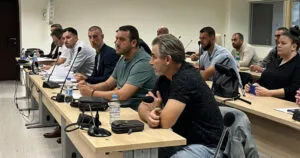
"That's not my job": the trial of the 13 Puls police officers restarted from scratch, and witnesses describe help being refused
22.09.2026


22.09.2026
22.09.2026
22.09.2026

22.09.2026
22.09.2026

22.09.2026

22.09.2026

21.09.2026

20.09.2026

22.09.2026

22.09.2026

21.09.2026

22.09.2026

22.09.2026
22.09.2026

22.09.2026

21.09.2026

20.09.2026

22.09.2026

22.09.2026

22.09.2026
22.09.2026

22.09.2026

22.09.2026

09.03.2026

27.02.2026

19.02.2026
22.09.2026

21.09.2026

21.09.2026

23.04.2026

23.04.2026

12.04.2026

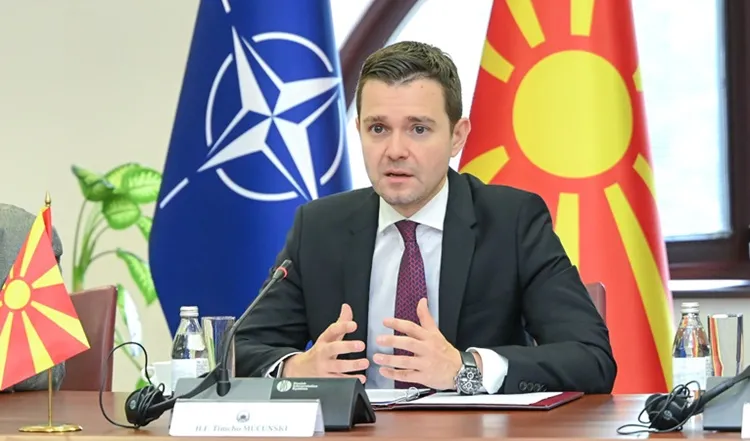
Foreign affairs and foreign trade minister Timčo Mucunski confirmed in an interview with MIA that the government is holding talks on a lasting solution to unblock the EU accession process. And immediately afterwards he explained why he cannot say anything more.
"We often speak about the fact that there are talks. We cannot share the details, because if we start sharing them with the public, then we condemn them to failure. But citizens should rest easy that the government has clearly drawn red lines and issues it is not prepared to negotiate," Mucunski said.
So the talks exist, the red lines exist, but both are confidential. Citizens should rest easy - on the basis of being told to rest easy.
The admission that went unnoticed
In the same interview Mucunski said something far more concrete than anything else, and it deserves far more attention than it got. He claims that at bilateral meetings with Bulgarian officials he was informed that it is not only the constitutional amendments being demanded.
"At our bilateral meetings we were first informed by official Bulgarian representatives that the constitutional amendments are not the only thing being asked of us, but that various concessions are also being sought, among them concessions of a historical nature, and we are also being told that this is not merely about their interpretation, but about promises given by senior representatives of the previous government to Bulgaria," Mucunski says.
Read that again. This is not a party talking point - this is a foreign minister saying the conditions are broader than the publicly known ones, and that promises exist from a previous government that the public knows nothing about. If that is true, then the "red lines" are not a negotiating position. They are a defence against something that has already been promised.
The opposition has the right to criticise - except on one thing
Mucunski told the opposition it has a legitimate right to criticise and take positions on every issue except foreign policy, where, he says, catastrophic mistakes were made. He wants it to "apologise to citizens" for its seven years in power and to accept the reality of the decisions taken in 2021 and 2022.
This is where the logic collapses on its own. If the French proposal was good, the minister says, not everyone would have a different reading of our obligations. Correct. But the same argument applies to his own current talks: if the solution is good, why can it not be seen?
SDSM responded with what it calls the most obvious contradiction - there is no country in the world where a foreign minister publicly says he is holding talks about the fate of the state, but that the talks are a secret. And it reminded the minister of statements from his own camp: Hristijan Mickoski called the Prespa Agreement "a masterpiece of diplomacy", President Gordana Siljanovska-Davkova said national identity, language and culture were fully protected, and Mucunski himself said NATO was an excellent thing.
"Do you trust Timčo Mucunski and his secret talks conducted in the name of citizens and their future?" SDSM asks.
The question is fair, but incomplete. Over the past five years every government has promised a solution that would be lasting, sustainable and free of concessions. Not one showed it before signing it. If membership depends on something we are not allowed to see while it is being agreed, then what exactly was the point of parliament's consensus five years ago - the resolution on national positions that, as the minister himself says, the government of the day trampled within months?
The latest 10 news from this category
Andonovski admits there was no project, no study, and no figure for how many megawatts the facility would draw. The...
The video has no room, no table, no flags. In the same week the State Department redirected 52 million dollars...
The right to an opinion is not in dispute. The problem is that in certain offices the line between personal...
America sees us as a close friend, the prime minister says. A 200-billion portfolio, six data-centre companies, Chebren and Galishte....
Eight days of invitations to a joint test, then "report your dealers", then a criminal complaint over photographs and the...
From Washington, the prime minister asks for a third party at the table so the dispute stops being bilateral. Brussels...
Mickoski lays out the chain from Washington: pipeline, power, data centres, artificial intelligence. The order of the announcements runs backwards...
Marta Kos listed the countries getting a timetable. We are not on it. What remains is the condition we know...
Monitoring by the All for Fair Trials coalition: hearings twice a year, proceedings running up to 33 months, and young...

Of 340 million denars, only 40 million came from private money - the rest came from the State Lottery. Prosecutors...
This site uses cookies - is that okay? Learn more
Be the first to know when Metla launches something new
Leave your email and we will write when there is a new guide or something new on Metla.