The defence in the Puls case has called 244 witnesses, and the nightclub owner's detention runs out on Saturday
01.10.2026


01.10.2026
01.10.2026

01.10.2026
01.10.2026
01.10.2026
01.10.2026
01.10.2026
30.09.2026
29.09.2026

01.10.2026
01.10.2026
30.09.2026

01.10.2026

01.10.2026
01.10.2026

01.10.2026
30.09.2026
29.09.2026
01.10.2026

01.10.2026
01.10.2026
01.10.2026
01.10.2026

01.10.2026

09.03.2026

27.02.2026

19.02.2026

01.10.2026

01.10.2026
30.09.2026

23.04.2026

23.04.2026

12.04.2026

The European Commission is preparing an offer that sounds like a gift: candidate countries will get "gradual integration" into the Union's single market - frictionless trade and access to research programmes while they are still waiting for membership. The gift, however, comes with a price tag. Access will depend on whether candidates back Brussels's foreign policy goals and keep key technologies away from its strategic rivals.
The Commission's draft proposal, which has leaked to the public, was overseen by Alexandre Adam, Ursula von der Leyen's chief adviser and a former aide to French President Emmanuel Macron. His plan overhauls the existing approach to the neighbours from the ground up. Today almost all the economic benefits are reserved exclusively for members, and the last country to join the Union was Croatia - in 2013.
Two speeds, and Macedonia in the slower one
Here is the part Skopje should read twice. Under the package, Ukraine, Moldova, Albania and Montenegro will get plans to speed up their accession process. For the others - Macedonia, Kosovo, Bosnia and Herzegovina, Serbia and Turkey - the process is taking too long, and in Brussels there is growing fear that they will lose interest or turn to Russia and China.
The irony is hard to miss. Macedonia has been a candidate since 2005, it even changed its name to open the door, and now in the new scheme it sits in the group Brussels is most afraid will get bored. Is fatigue really the candidates' problem - or the problem of those who have kept them on the doorstep for decades?
Von der Leyen arrives in Albania today at the start of a tour of the Western Balkans, and will also visit Kosovo and Macedonia. The two countries, which under the new plan have no fast track, will use the visit to push for economic benefits from closer alignment.
A carrot that can be taken away
The conditions are written without beating about the bush. "As industrial and market integration deepens, participation in sensitive sectors must go hand in hand with cooperation on investment screening, export controls, sanctions enforcement and the protection of sensitive technologies," the document says. Where the conditions are not met, the scope of participation will be adjusted. Areas for closer cooperation include semiconductors, quantum technologies, biotechnology, artificial intelligence and space.
There is also a sentence worth remembering: "If commitments are not met, participation must remain reversible. Access should be suspended or withdrawn where justified." In other words - a carrot that can be taken away at any moment. And who decides when it is "justified"?
Kosovo's Prime Minister Albin Kurti immediately asked the obvious question. Gradual integration, he said, must be tangible for citizens and businesses and lead to full membership, "not be a substitute for it". The analysis formally agrees that the end goal remains membership, but adds that accession takes time, a rigorous merit-based process and deep, lasting reforms.
Hungary as a warning
Behind all this lies current members' fear of new countries that might walk away from their commitments once inside. The example cited is Hungary, which under former Prime Minister Viktor Orbán used its veto to block sanctions against Russia and aid to Ukraine. That is why the analysis, to be presented to senior officials on 6 October, proposes monitoring and incentives even after accession, as well as more decisions by qualified majority instead of unanimity - without reopening the founding treaties and without the risk of national referendums.
Leaders will discuss enlargement at a two-day summit in Brussels starting on 15 October, and Enlargement Commissioner Marta Kos is already announcing an "autumn of enlargement". The Balkans have heard many such seasons. The question is whether this one will bring membership - or just a longer corridor with better lighting.
The latest 10 news from this category
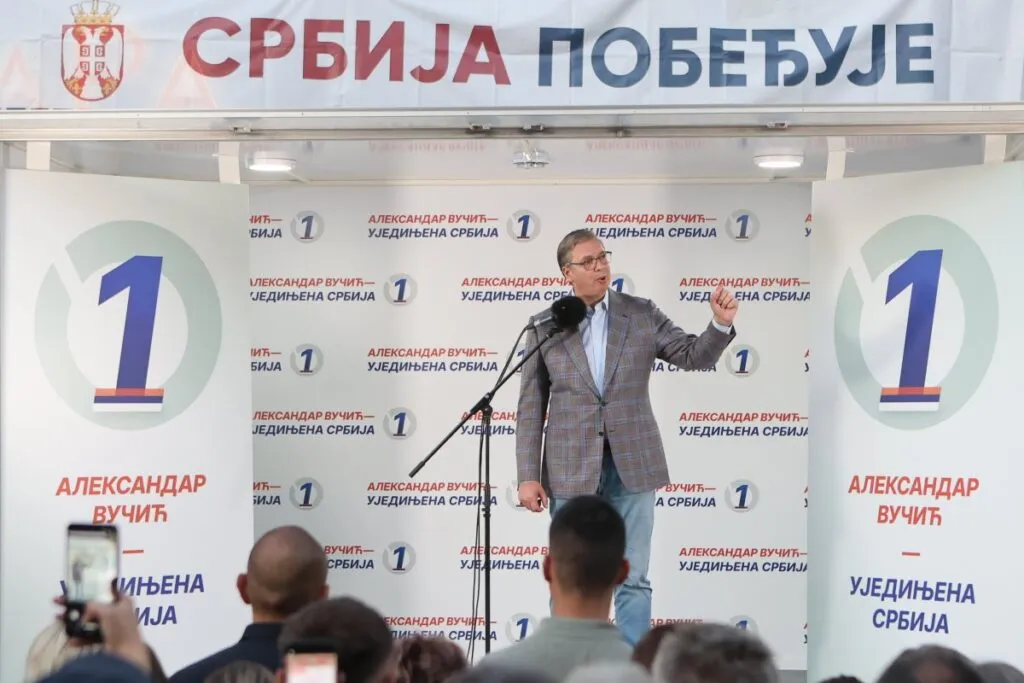
In front of more than 10,000 people in Jagodina, Vučić talked about six or seven billion euros "from outside" and...
Russian news agency RIA Novosti celebrates him as a master at sitting on two chairs, while describing Serbia as an...
A Greek firm's lobbyist sat beside the US ambassador, the firm won a six-billion-dollar deal in Albania, and the Romanian...
After two terms, Vučić signed his resignation outside the Presidency, in front of a crowd with flares - and that...
On Sunday evening Vučić steps down as president, but first he personally informed Putin. The legacy he leaves: Russian gas...
A billionaire with a Kyiv arrest warrant first bought a 10-million-euro property in Croatia, then got a Serbian passport. Belgrade...
Zelensky in Ukraine, Lavrov in New York, Putin on the phone - all within a few days. Belgrade plays at...
Dozens of delegations walked out of Netanyahu's UN speech; Serbia's stayed in their seats. Belgrade and Israel are now also...
Before the General Assembly, Vučić complained of double standards over Kosovo, attacked Croatia and looked to Trump to save the...
In front of the entire General Assembly, the Croatian prime minister called the military honours for the convicted war criminal...
This site uses cookies - is that okay? Learn more
Be the first to know when Metla launches something new
Leave your email and we will write when there is a new guide or something new on Metla.