


Glasses and a Wristwatch for a Tip-Off: Nine Charged Over Tax Inspections at the "Pulse" Nightclub
28.10.2026


28.10.2026
28.10.2026

28.10.2026
28.10.2026
28.10.2026

28.10.2026

28.10.2026

27.10.2026

27.10.2026

28.10.2026

28.10.2026

27.10.2026

28.10.2026

28.10.2026

28.10.2026

28.10.2026

27.10.2026
26.10.2026

28.10.2026

28.10.2026

28.10.2026

28.10.2026

28.10.2026
27.10.2026

28.10.2026

27.10.2026

27.10.2026
27.10.2026

26.10.2026

24.10.2026

23.04.2026

23.04.2026

12.04.2026

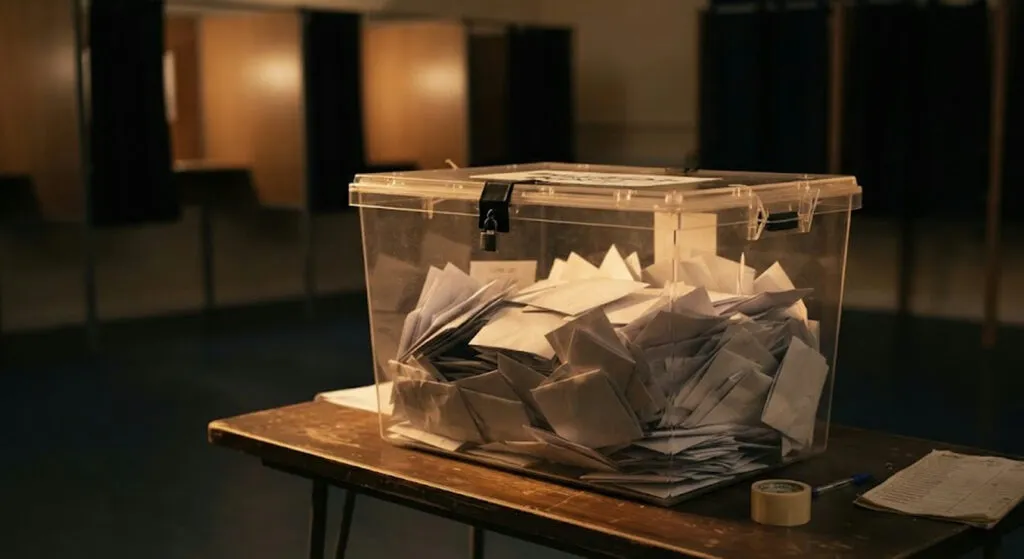
The first exit polls after Israel's parliamentary elections show that the opposition bloc led by Gadi Eisenkot has won more seats than Prime Minister Benjamin Netanyahu's coalition. But neither side has a majority to form a government. That requires 61 of the Knesset's 120 seats, and according to the first estimates, neither bloc gets there.
Turnout was the highest since 1999 - at least 77.7% of voters went to the polls. Netanyahu's Likud remains the largest single party, while the Arab parties, according to projections, won a record 17 to 18 seats. They could now decide who governs Israel.
Eisenkot immediately announced he would move to replace Netanyahu. The prime minister's allies warn that the opposition is celebrating too soon. Only the exit poll by Channel 14, a broadcaster widely seen as Netanyahu's mouthpiece, put the prime minister on the verge of victory. Few believed it.
"Netanyahu's coalition lost 18 seats. I would call that a flood," said Lian Pollak-David, an incoming MP from Eisenkot's Yashar party. The leader of the left-wing Democrats, Yair Golan, wrote that "the public has replaced Netanyahu's government". From Likud, former education minister Yoav Kisch told everyone already making plans to wait for the final results.
The Arab parties move from the margins to the centre
One of the biggest winners should be the Arab party Ra'am, which the projections give seven seats. Its leader, Mansour Abbas, said both blocs had contacted him. "Everyone is talking to us, not just the change bloc," Abbas said, signalling that he is ready to join a coalition led by Eisenkot. Still, he admitted that "at the moment there aren't enough seats to form a government".
A survey by the aChord Center at the Hebrew University found that a majority of opposition-bloc voters want Eisenkot to form a government precisely with Ra'am. The Arab parties now hold the balance. Will Israel's centre dare to form a government that depends on them - and how long would such a government last?
What comes next
The real battle begins after the count. Once all the votes are counted, which usually takes a few days, President Isaac Herzog consults with every elected party and hands the mandate to the candidate with the best chance of building a stable coalition - not necessarily the leader of the largest party. Since neither the opposition nor the Arab parties will recommend Netanyahu, Eisenkot will probably get the first shot.
He would have four to six weeks to negotiate ministerial posts, budget priorities and policy direction. If he fails - and given his limited political experience, that's a real possibility - the mandate most likely goes to Netanyahu and everything starts over. If he fails too, new elections follow.
Israel's longest-serving prime minister has pulled off incredible comebacks before. But tonight voters left him with the largest party and no path to power. And in Israel, as in the Balkans, the vote count is only the first step - the real victory is measured by who gets to form the government and keep it alive.
The latest 10 news from this category

Convicted of extortion, decorated by Putin, paid for part of Trump's son's wedding. Now a joint hunt far from the...

Two Belarusians and a Ukrainian under investigation, targets picked by Russia across Europe, and a company that had just signed...

Дали двајца луѓе на иста возраст можат да стареат со различна брзина? Научниците открија дека дел од одговорот можеби се...

Демократска Република Конго се соочува со најтешката епидемија на ебола во својата историја. Според најновите податоци од 27 октомври 2026...

Флавиу Болсонару, син на поранешниот бразилски претседател Жаир Болсонару, според медиумските информации, го напуштил Бразил по изборниот пораз, во време...

He didn't turn up for Sunday family lunch, and that evening he was found dead behind Villa Sauber. The palace...
Brazil's first-ever fourth term, and the first win for a candidate who came second in the first round. The Bolsonaro...
Henry VIII broke with Rome over one divorce. Five centuries later, Charles III and the Pope are exchanging honours -...
One joke about the gilding, then the serious message: while the powerful admire themselves in the mirror, voters pay the...

Over 400,000 people on the streets of France, Molotov cocktails in Tirana, water cannon in Rome, tear gas in Brussels....
This site uses cookies - is that okay? Learn more
Be the first to know when Metla launches something new
Leave your email and we will write when there is a new guide or something new on Metla.


