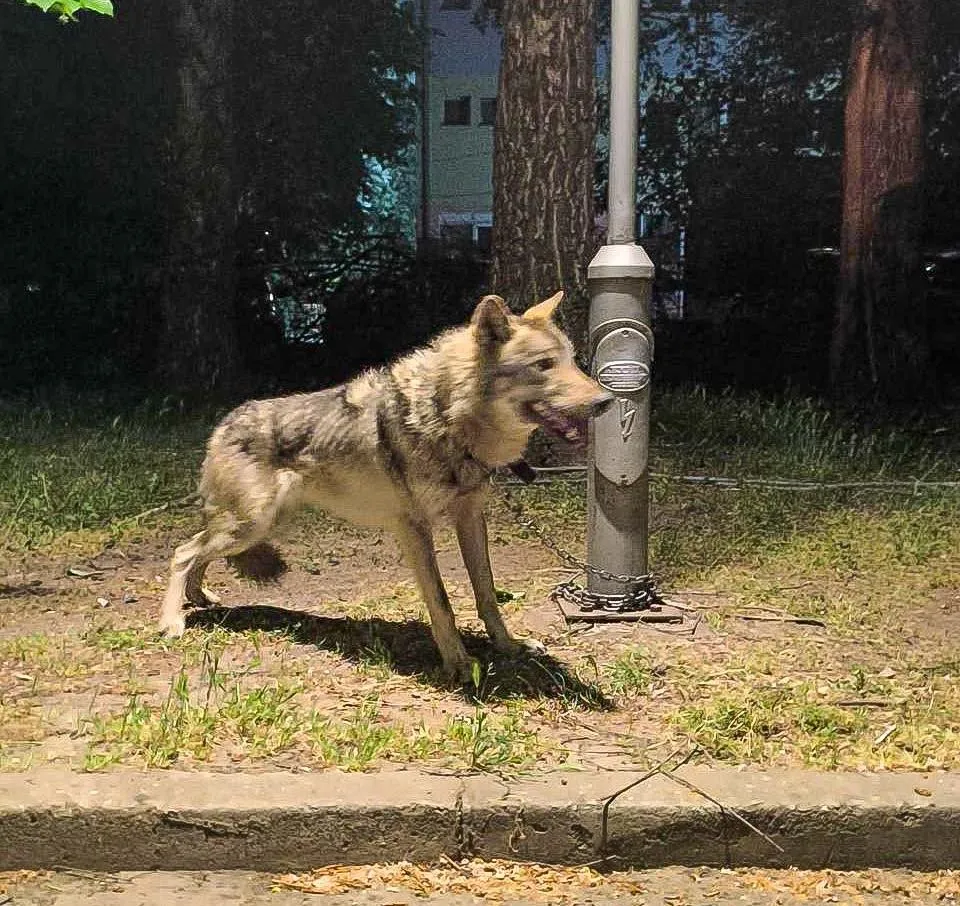
Волк на ланец во Козле: казни до 20.000 евра, но нема центар за прифаќање – системот функционира само кога ситуацијата ќе се појави на улица
15.05.2026


15.05.2026

15.05.2026
15.05.2026
15.05.2026
15.05.2026

15.05.2026
15.05.2026

14.05.2026
14.05.2026

15.05.2026

15.05.2026

14.05.2026

15.05.2026

15.05.2026

15.05.2026

15.05.2026
14.05.2026

14.05.2026

09.03.2026

27.02.2026

19.02.2026

14.04.2026

07.11.2025
07.11.2025

23.04.2026

23.04.2026

12.04.2026

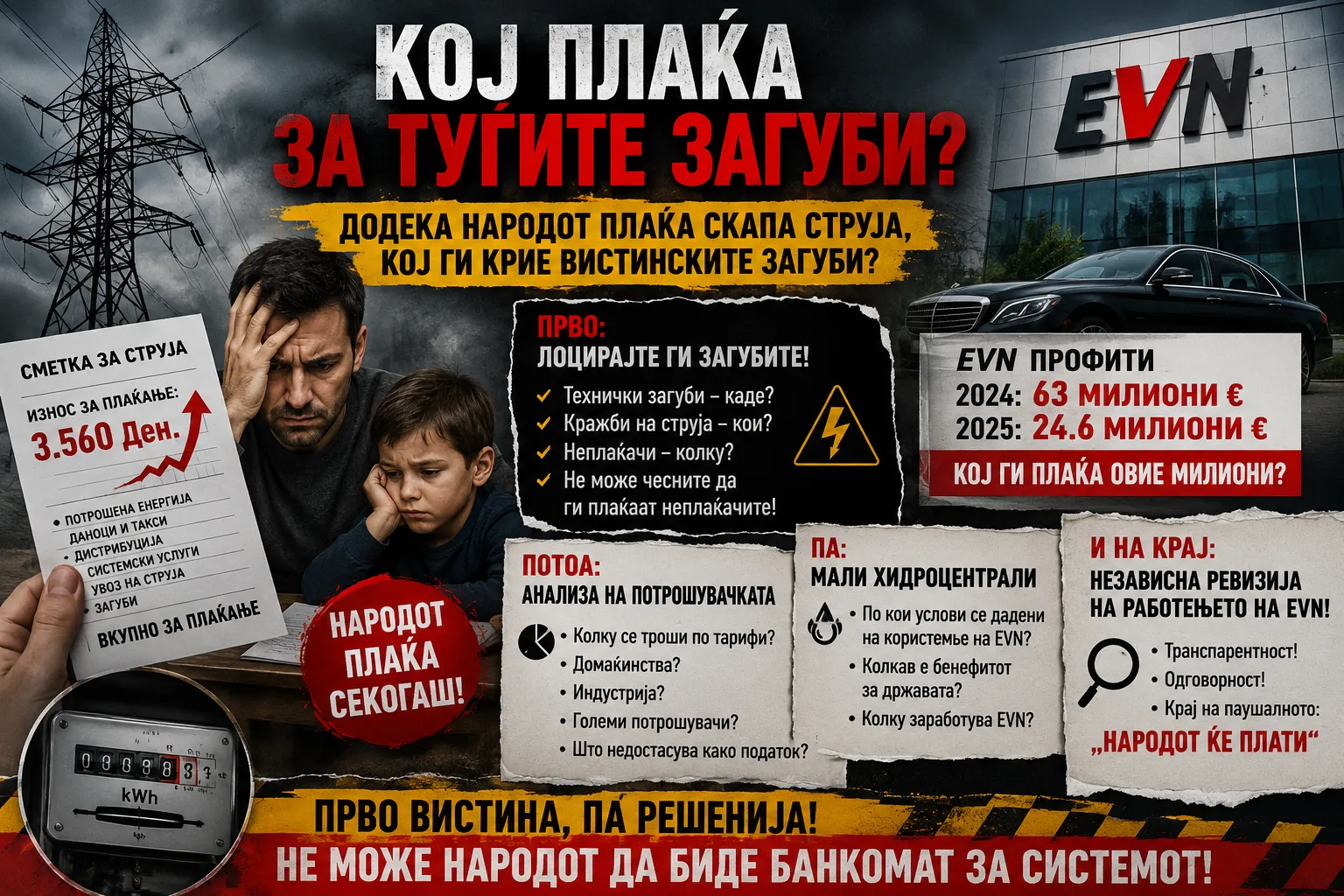
For years now, Macedonia has been living in an energy system in which every problem ends on the backs of the people. When there are losses - the people pay. When electricity is imported - the people pay. When policy fails - the people pay again. But nobody is saying where exactly the millions of euros are disappearing, and why honest citizens have to cover other people's debts and the chaos in the system.
The biggest scandal is that the state and the institutions have been talking about „losses" for years, but nobody is publicly saying where those losses are. In which cities? In which substations? In which parts of the grid? How much of it is technical, and how much is theft and non-payment? An entire country cannot be paying millions of euros on the basis of round percentages with not a single detailed analysis available to the public. Without that analysis, the „fight against losses" is just a slogan in a press release. A slogan that for two decades has changed nothing - except the bill.
If someone is not paying their bill - then it has to be said who that is. Citizens who pay their bills on time cannot be financing a system in which one consumes and another pays. That is not social policy, it is injustice towards everyone who honestly meets their obligations. Especially when the state has both the legal and technical capacity to identify non-payers - but chooses not to go down that road, because „collective redistribution" via the price costs fewer political points.
On top of that, Macedonia has no clear analysis of how much electricity is consumed by tariff group. How much do households use? How much industry? How much do the big consumers use? How much is subsidised? Without that data, every story about a „real price" is just public manipulation. A real price is one you can defend in front of citizens with the documentation in your hand. Here there is no documentation - just statements and percentages thrown into the air.
And while citizens are told „there is no money" and „the price has to go up", the numbers say something completely different. EVN reported a net profit of around 63 million euros for 2024, and around 24.6 million euros for 2025. That is tens of millions of euros earned in a system that constantly demands another burden on the people. Around 90 million euros in two years. That money does not stay in Skopje - it goes to Vienna, the company's headquarters. That is the maths citizens understand, even when economic experts stay silent.
The grid losses in Macedonia are the highest among the former Yugoslav republics, at 14.1%. In Slovenia they are 4 to 5% - we have 60% bigger losses. That is not a coincidence. It is not a „socialist legacy". It is the result of two decades of policy in which the concession holders got everything, while the obligations stayed with the people.
A separate topic are the small hydropower plants handed over to EVN, built in the former Yugoslavia. On what terms were they handed over? How much profit do they bring? What is the benefit for the state? How much does Macedonia earn from natural resources that have been signed over to them? Citizens have the right to know whether national wealth is being used in the interest of the state, or only for private profit. A river running through a Macedonian village and turning a turbine that pays for the Vienna budget is not „privatisation" - it is a handover.
In addition, the state holds a 10% stake in EVN - and in 20 years not a single audit has been done. A minority shareholder anywhere in Europe would have the right to an annual financial inspection. Macedonia has that right - but for 20 years it has not used it. That is not an oversight. That is a decision.
So, before any new price hike on electricity, Macedonia must get: a complete map of grid losses, an analysis by tariff group, publication of the conditions under which the small hydropower plants were given out, and an independent audit of EVN's operations.
Without that, every price hike means one thing only - the people are paying again for someone else's mistakes, losses and lack of transparency. And the Balkans know this story by heart. The difference between a country in which you ask „why" and one in which you just pay.
The latest 10 news from this category
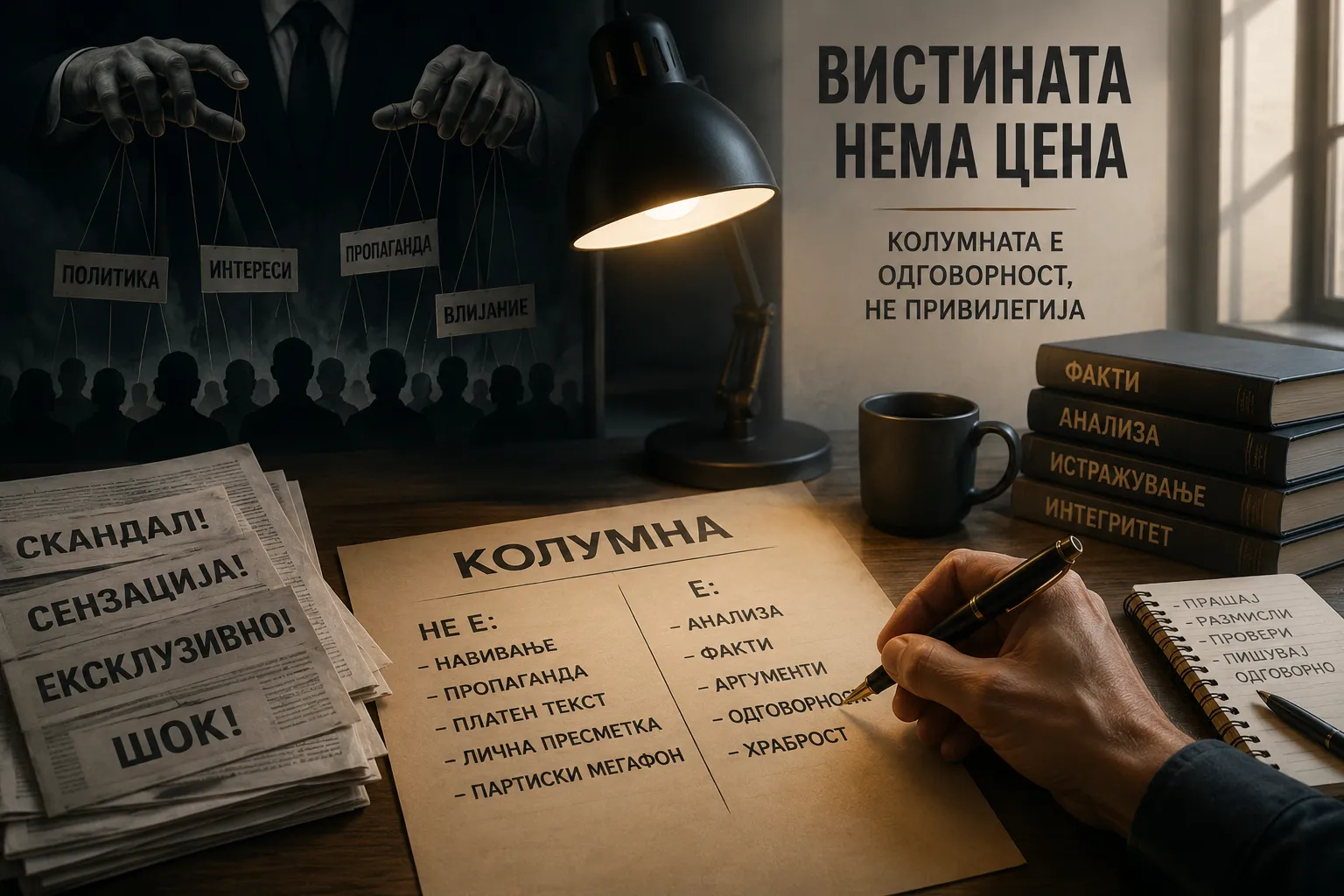
Медиумски простор денес е преплавен со колумни. Секојдневно десетици „аналитичари“, „експерти“, „познавачи“ и „независни интелектуалци“ пишуваат текстови во кои наводно...
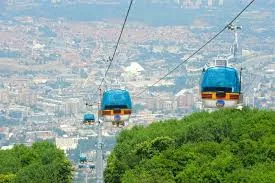
Во Македонија изгледа најлесно е да се стави катанец. Жичницата на Водно нема да работи цело лето, а никој не...
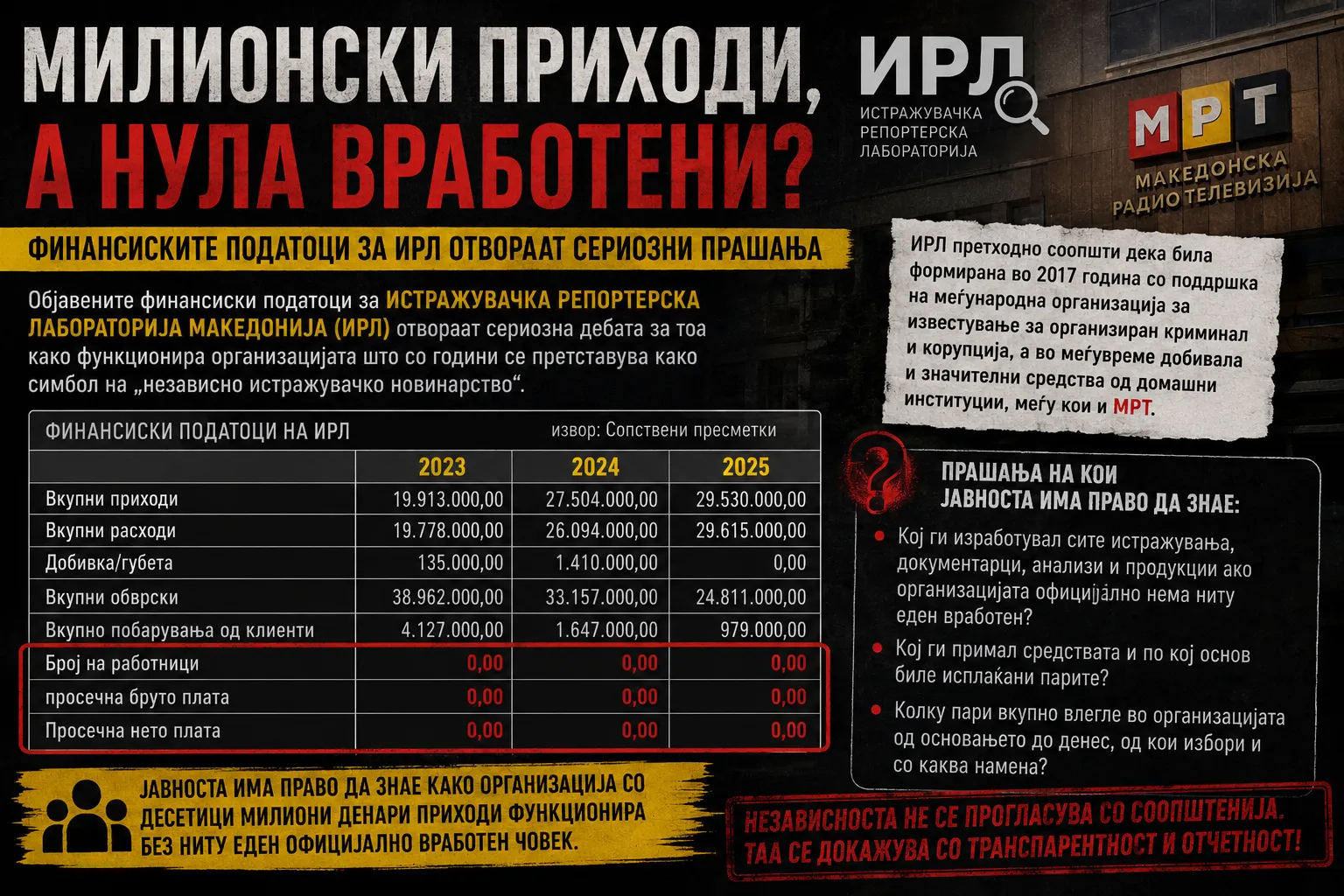
Објавените финансиски податоци за ИСТРАЖУВАЧКА РЕПОРТЕРСКА ЛАБОРАТОРИЈА МАКЕДОНИЈА (ИРЛ) отвораат сериозна дебата за тоа како функционира организацијата што со години...
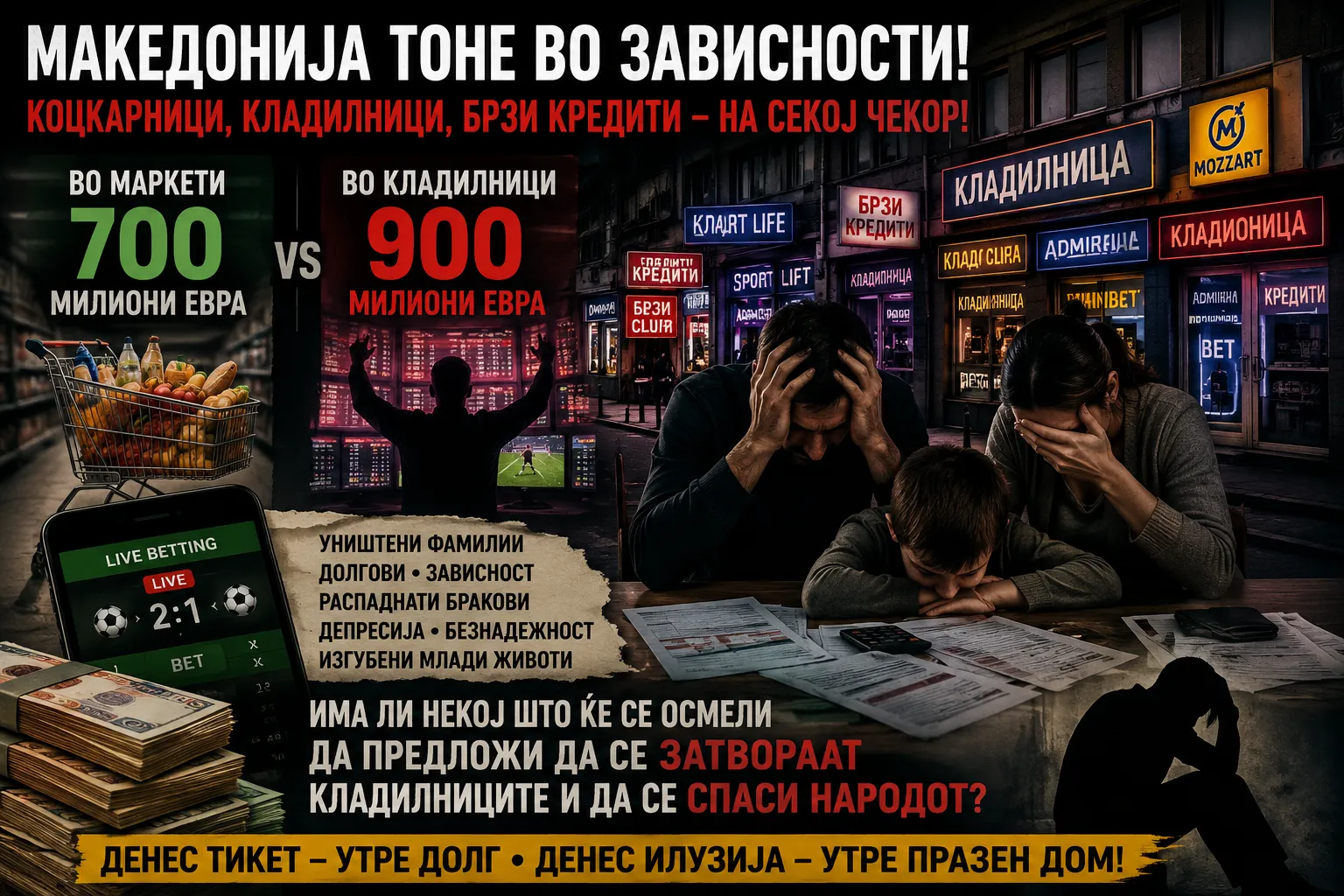
Додека државата зборува за економија, реформи и иднина за младите, реалноста на улиците изгледа сосема поинаку. Во речиси секој град...

Секогаш кога ќе се отвори тема за војна, лесно е да се покаже со прст кон...

Генерацијата З, младите родени отприлика помеѓу 1997 и 2012 година, веќе не се „иднината“ – тие се сегашноста што ги...

Крипто-пазарот сè појасно се движи кон нула — не како техничка вредност, туку како губење на...
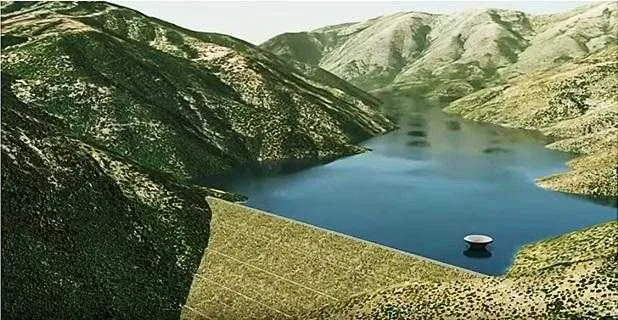
Проектот Чебрен не е нова идеја. Напротив – тој е проектиран уште во 1963 година, во...

Во ист ден кога Србија најавува набавка на суперкомпјутер за вештачка интелигенција и фабрика за роботика, Северна Македонија ја „смирува“...

Ако се тргнат настрана насловите, сензациите и дневната доза страв што ни ја сервираат, вистината е едноставна: светот е полн...