Counter-terror raid in Skopje: an ISIS flag and weapons, while official details come "once it's over"
29.09.2026


29.09.2026
29.09.2026
29.09.2026
29.09.2026
29.09.2026
29.09.2026
29.09.2026
28.09.2026

27.09.2026
29.09.2026

29.09.2026
28.09.2026
29.09.2026
29.09.2026
29.09.2026
29.09.2026
28.09.2026
27.09.2026
29.09.2026
29.09.2026
29.09.2026
29.09.2026

29.09.2026
28.09.2026

09.03.2026

27.02.2026

19.02.2026
29.09.2026
28.09.2026
27.09.2026

23.04.2026

23.04.2026

12.04.2026

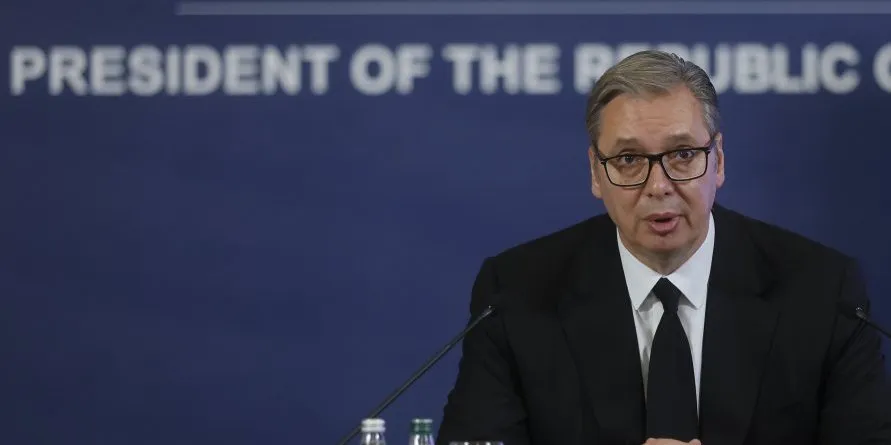
Aleksandar Vučić has resigned as President of Serbia before the end of his term, and one of the audiences that reacted most loudly wasn't in Belgrade but in Moscow. Russian media put the resignation among their top stories and stressed above all that he had decided on his own to leave before his term was up.
Several outlets also quoted his line that every meeting in Europe over the past four years had been torture, because one of the first questions was always: "Why haven't you imposed sanctions on Russia?" It's no surprise that exactly that sentence made the Russian headlines.
A master of two chairs
The longest piece was written by Dmitry Bavyrin, a journalist and political analyst, for RIA Novosti, Russia's largest news agency. "A quarter of a century ago the plan was for him to rot in The Hague along with Slobodan Milošević. Instead, he outlived the fall of many of his enemies, despite the war that was lost back then," Bavyrin writes. He calls him a true talent, known for his exceptional resilience, his "dual nature" and his skill at sitting on two chairs at once - and sometimes more. He makes a point of noting that in his resignation speech Vučić quoted both Winston Churchill and Xi Jinping.
Then comes the sentence that will probably be reread most in Belgrade. "This is not a criticism of his two-facedness, but an expression of admiration. As the leader of an impoverished nation - a nation whose soul belongs to Russia while its body is in Europe - Vučić is exactly the man the situation calls for," Bavyrin writes, adding that the Serbian people are satisfied with his policies.
A compliment that cuts both ways
Some media in Belgrade reported the piece as proof of "deep respect and open admiration". Maybe. But when a writer at Russia's biggest agency calls your country "impoverished" and praises you for being two-faced, that is praise with a sharp edge. Moscow isn't celebrating Vučić as an ally who picked a side - it's celebrating him as a player who managed for years to avoid sanctioning Russia without shutting the door on Brussels.
Now Serbia is entering an election marathon. Parliamentary elections are set for October 25, presidential ones by the end of December, and until then the duties of President of the Republic are being performed by the Speaker of Parliament, Ana Brnabić. Vučić's supporters already see him as prime minister, and Bavyrin is convinced his rival Srdanović is no match for him as a politician.
For Macedonia, which shares both a border with Serbia and a place in the queue at Europe's counter, the question isn't academic. Will Belgrade keep sitting on two chairs after Vučić - or will someone finally have to pick one?
The latest 10 news from this category
A Greek firm's lobbyist sat beside the US ambassador, the firm won a six-billion-dollar deal in Albania, and the Romanian...
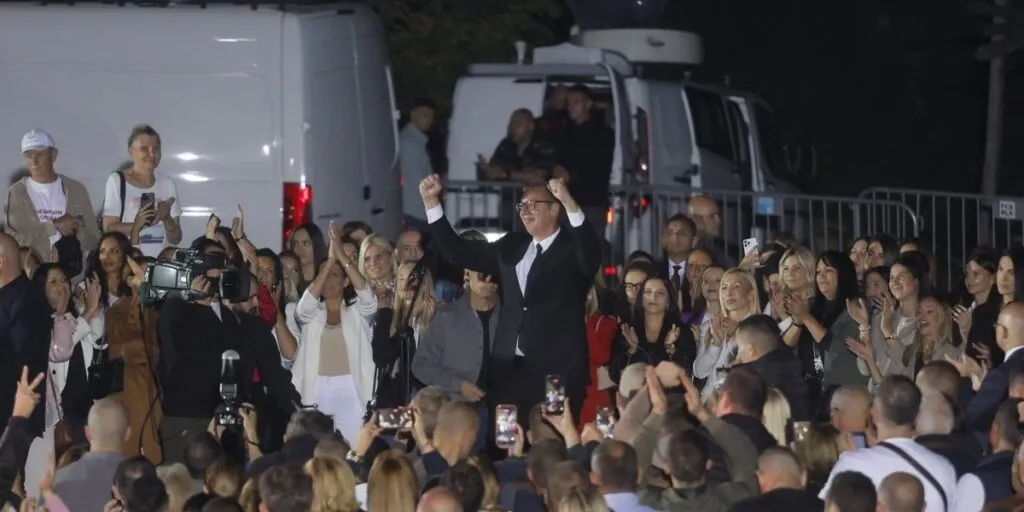
After two terms, Vučić signed his resignation outside the Presidency, in front of a crowd with flares - and that...
On Sunday evening Vučić steps down as president, but first he personally informed Putin. The legacy he leaves: Russian gas...
A billionaire with a Kyiv arrest warrant first bought a 10-million-euro property in Croatia, then got a Serbian passport. Belgrade...
Zelensky in Ukraine, Lavrov in New York, Putin on the phone - all within a few days. Belgrade plays at...
Dozens of delegations walked out of Netanyahu's UN speech; Serbia's stayed in their seats. Belgrade and Israel are now also...
Before the General Assembly, Vučić complained of double standards over Kosovo, attacked Croatia and looked to Trump to save the...
In front of the entire General Assembly, the Croatian prime minister called the military honours for the convicted war criminal...
The Serbian president told the great powers they demand respect for rules they trampled themselves, from Kosovo to the 1999...
The question is not emotional but institutional: what does accepting European criteria mean if the verdicts of a court whose...
This site uses cookies - is that okay? Learn more
Be the first to know when Metla launches something new
Leave your email and we will write when there is a new guide or something new on Metla.