A Grave of Soil Outside the Interior Ministry for 59 Murdered Women: "Not One More" Gives MPs Until 10 December
26.11.2026


26.11.2026

26.11.2026

26.11.2026

26.11.2026

26.11.2026

26.11.2026

26.11.2026

25.11.2026

24.11.2026

26.11.2026

26.11.2026

25.11.2026

26.11.2026

26.11.2026

26.11.2026

26.11.2026

25.11.2026

24.11.2026

26.11.2026

25.11.2026

24.11.2026

24.11.2026

23.11.2026

23.11.2026

23.04.2026

23.04.2026

12.04.2026
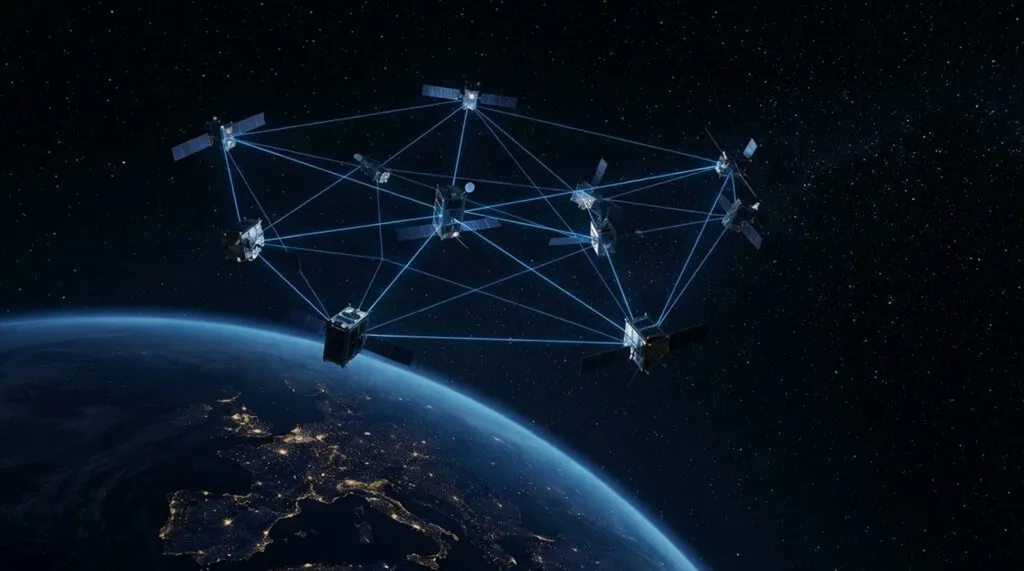
On 25 November, the US Federal Communications Commission (FCC) gave SpaceX conditional approval to launch and operate a constellation of up to a million satellites. The goal isn't internet, but data centres in orbit - processors that will work for artificial intelligence at an altitude of 500 to 1,002 kilometres above our heads.
The satellites are called Starmind. They will communicate with each other and with Starlink mainly by laser, and the licence also provides for backup radio control from Earth if the main systems fail. The timeline is generous: seven years for the first operational satellite, 14 years for the whole constellation.
FCC Chairman Brendan Carr said the decision "opens a bold new frontier for the computing infrastructure needed for American leadership and growth". Elon Musk thanked him on X, calling the approval "a great boon for America and the world". The regulator and the regulated, in perfect harmony.
Not everyone applauded. Amazon, Viasat and the American Astronomical Society filed objections over space debris, orbital congestion, radio frequency interference and environmental impact. Amazon, a direct competitor of Starlink, called the plan "high ambition, not a real plan". Some of the objections, including the threat to scientific research, were dismissed by the FCC on the grounds that they fall outside its jurisdiction.
More important is what hasn't been approved yet. The FCC has not yet accepted SpaceX's space debris plan for satellites above 600 kilometres. The company is seeking an exemption from the rule that satellites below 2,000 kilometres must re-enter the atmosphere within five years of the end of their mission. Instead, it wants to move some of its spent satellites into other orbits around Earth or around the Sun.
The approval doesn't mean data centres in space are just around the corner. SpaceX needs to cut manufacturing and launch costs, figure out how to cool a processor in space and find someone to finance the chips that will fly in orbit. The paper is signed; physics and money still have their say.
Orbit formally belongs to no one, but whoever fills it first with a million satellites practically writes the rules for everyone who comes after. Europe is still building its IRIS² satellite network. The US regulator, meanwhile, has opened the way for a constellation of up to a million satellites for a single private company. Will Brussels have anything to say - or will it find out on X?
The latest 10 news from this category

A teddy bear that tells a child it's more fun than school and that it will keep their secrets. New...
Nvidia invested in Decart at a 4-billion-dollar valuation, and now watches it go to Amazon for almost twice as much....
Over 43 percent of new songs on Tidal were created by a machine, and 96 percent of fully AI songs...
Two weeks ago he left over a relationship with a woman suspected of spying for China. Today he is back,...
The company's emissions more than doubled in four years, and there is no new net-zero deadline. A voluntary target, it...
The measure is called perplexity, and Sam Altman called the post the most important thing OpenAI has published lately. The...

The startup got its Indian patent more than a year after Apple announced the feature. Now it wants the court...

Instead of another wave of layoffs, an offer to walk out on your own. Microsoft's boss says every job will...

Shortical doesn't yet have a single signed "rent-your-face" contract, but it's already advertising the offer in capital letters. In China,...

A 167-year-old problem, a million-dollar prize and an employee of a company that went public this very week. Meanwhile, Stanford...
This site uses cookies - is that okay? Learn more
Be the first to know when Metla launches something new
Leave your email and we'll write to you when there's a new guide or something new on Metla.