
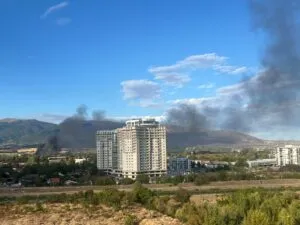
Black Smoke Over Skopje: A Paint and Varnish Warehouse Burned Inside the Old Steelworks
23.09.2026


23.09.2026
23.09.2026
23.09.2026
23.09.2026
23.09.2026
23.09.2026
23.09.2026
22.09.2026
21.09.2026
23.09.2026
23.09.2026
22.09.2026
23.09.2026
23.09.2026
23.09.2026
23.09.2026
22.09.2026
21.09.2026
23.09.2026

23.09.2026
23.09.2026
23.09.2026
23.09.2026

23.09.2026

09.03.2026

27.02.2026

19.02.2026
23.09.2026
22.09.2026
21.09.2026

23.04.2026

23.04.2026

12.04.2026

Zelensky landed at Belgrade airport and went straight to dinner with Aleksandar Vucic. It is a scene that would have been unthinkable three years ago - the Ukrainian president, guest of the man who has not imposed a single sanction on Russia. And that is exactly what makes it more interesting than any declaration that comes out of it.
This is Zelensky's first official bilateral visit to Serbia since becoming president. Vucic posted the dinner on Instagram and gave it the usual diplomatic framing - the meeting, he says, should contribute to the further development of relations between Serbia and Ukraine and to cooperation in areas of mutual interest. He added that the evening served to open the topics for the formal talks that follow, „especially on the European path of our countries”, but also to give the guests a feel for the spirit of Serbia. Zelensky was met at „Nikola Tesla” airport by the minister of mining and energy, Dubravka Djedovic Handanovic.
A visit postponed several times
It gets more interesting from there. According to diplomatic sources quoted in the German press, the visit was long in the planning and postponed several times, with part of Kyiv strongly opposed to it - precisely because of Belgrade's pro-Russian position. German analysts read it above all as a political signal, even though the official talks will revolve mainly around economic topics. Journalist Michael Martens puts into words what everyone knows but is rarely written this directly: nowhere in Europe are sympathies for Russia and for Vladimir Putin as pronounced as in Serbia.
So why dinner with Zelensky? The reading offered by the German sources is coldly calculated: the leadership in Belgrade evidently does not believe Putin will win a decisive victory in Ukraine. So it is strengthening contacts with Kyiv without cutting those with Moscow. This is not switching sides - it is keeping two doors open until you see which way the wind blows.
The ammunition everyone knew about and nobody admitted
The most candid part of the whole story comes from Christopher Hill, former US ambassador in Belgrade. He recounts that at the start of his term the Ukrainian ambassador arrived with a list of military equipment urgently needed at the front, and his team checked whether the Serbs could fill those orders. They could. After that, Hill says, the US began supporting the purchase of significant quantities of Serbian ammunition that they knew Ukraine desperately needed.
At the same time Hill rejects the criticism that Belgrade did not join the sanctions: in his view, Serbia can take far more significant measures than playing a supporting role in sanctions regimes. And he adds that there was no sale of Serbian weapons to Russia, at least not in any quantity worth mentioning. So - the rhetoric goes one way, the cargo manifests another. How many times have we seen that division of labour in this part of the world?
Drones, the Emirates and a deal that will wait until 2027
Something concrete is expected from the military cooperation too, though officially unconfirmed - possible joint production of drones which, according to the same sources, could be financed by the United Arab Emirates on Serbian territory. It is the kind of arrangement where everyone gets something and nobody has to explain publicly why.
The economic part is slower. Ukraine and Serbia are negotiating a free trade agreement, but its application could be delayed until the beginning of 2027. Marko Cadez, president of the Serbian chamber of commerce, says both the Serbian and the Ukrainian economies have an interest in such a deal. The loudest talk is about pairing Ukraine's IT sector, which managed to keep working even under wartime conditions, with Serbia's growing tech industry.
Which leaves the question worth asking from Skopje. For years Serbia has been described as the country that will not choose, and it is precisely that refusal to choose which now lets it host Zelensky while holding its line towards Moscow. Where that leads - to real EU entry or to another decade in the waiting room - will be shown by what gets signed, not by what gets said after dinner.
The latest 10 news from this category
The question is not emotional but institutional: what does accepting European criteria mean if the verdicts of a court whose...
An economic normalisation signed in 2020 is now filed as a finished war before the General Assembly. A conflict does...
Under the trailer there is not one claim that anything in the film is untrue. There is a ledger: you...
Regimes do not spend tabloid artillery on candidates they are not worried about. Ilija Srdanović got that treatment ahead of...
The president who dissolved parliament himself is now resigning too, promising a cabinet of no more than 12 ministers and...
Eight countries, 120 million people, a motorway to Timisoara and energy connections. And one cancelled visit that says more than...
The call was about damaged furniture on a terrace. Armin Dzutovic died three days later. The internal investigation found first...
Four KLA leaders received 81 years in prison, and Albania's parliament immediately adopted a declaration calling the verdict unjust. The...
The court established responsibility for 96 killed, 303 tortured and 385 unlawfully detained. The prosecution asked for 45 years. Serbia...
Thaci and Krasniqi got 25 years each, Veseli 18, Selimi 13. The court established 385 unlawfully detained, 303 tortured and...
This site uses cookies - is that okay? Learn more
Be the first to know when Metla launches something new
Leave your email and we will write when there is a new guide or something new on Metla.
