
The "Lottery" Trial: 231 Pieces of Evidence, and So Far Not a Single Message Between Grubi and Bajrami
24.09.2026


24.09.2026

24.09.2026

24.09.2026

24.09.2026

24.09.2026

24.09.2026

24.09.2026

23.09.2026

22.09.2026

24.09.2026

24.09.2026

23.09.2026

24.09.2026

24.09.2026

24.09.2026

24.09.2026

23.09.2026

22.09.2026

24.09.2026

24.09.2026

24.09.2026

24.09.2026

23.09.2026

23.09.2026

09.03.2026

27.02.2026

19.02.2026

24.09.2026

23.09.2026

22.09.2026

23.04.2026

23.04.2026

12.04.2026

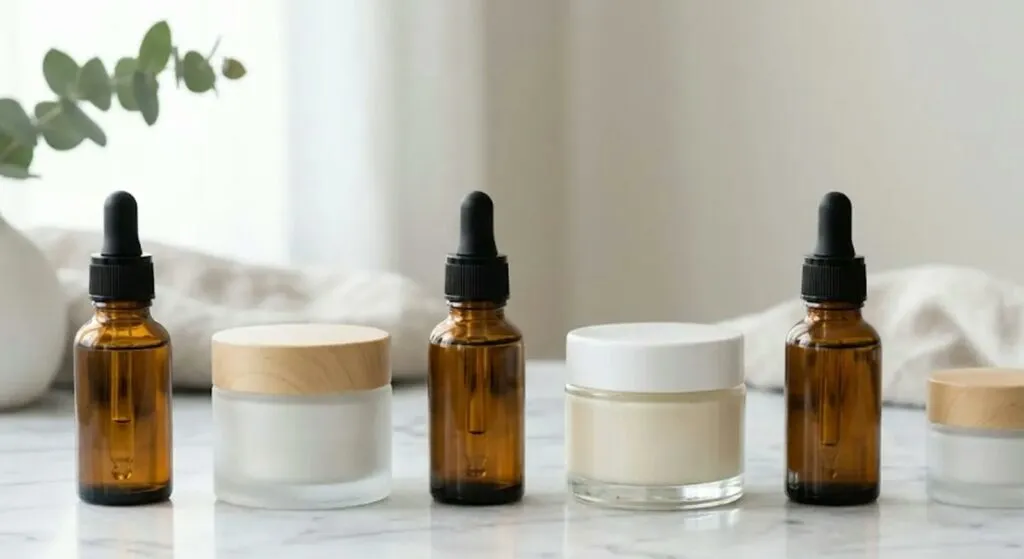
You buy a face cream with hyaluronic acid, retinol and peptides all at once. You're buying a free promise that everything will work, one on top of the other. But pharmacologists and dermatologists say it doesn't work like that. The molecular weight of an ingredient decides how far it will get into the skin - and what sits on the surface cannot work deep down.
Lucía Altozano, pharmacist at Skinpharmacy, explains it simply: „Molecular weight shows the size or mass of a molecule”. Bigger molecules stay on the surface - they usually act as a moisturiser there. Smaller ones can travel deeper - down towards the fibroblasts, which build collagen.
The classic example: sunscreen. By regulation, it has high molecular weight - precisely because it must not penetrate deep. Its job is to stay on top and reflect UV radiation. Vitamin C and the retinoids, on the contrary, have low molecular weight - they go further down and work at the structural level.
But the question doesn't end there. Dr Carlos Morales Raya, a dermatologist in Madrid, adds nuance: „In dermatology we always look for balance”. Molecular weight matters, but concentration, formulation quality and suitability for the skin type matter more. A perfect retinol with a bad vehicle - doesn't work. An average retinol with a smart formulation - does.
The third voice in the debate is Arturo Alvarez-Bautista, a chemist with a PhD in nanomedicine. He warns: „Combining different weights is no guarantee of superiority”. A simple formula with two well-chosen ingredients often delivers a better result than a complex formula with ten ingredients that clash with each other. That is what the industry doesn't want everyone to know - because „a cream with 18 active ingredients” sells for more than a cream with 3.
Hyaluronic acid is an interesting case. It is sold as a hydration superhero - but in fact comes in different molecular weights and works at different levels. The manufacturers who understand this use a „multi-channel approach” - a combination that hydrates the surface and penetrates deeper at the same time. The others just put the two words on the box and hope buyers will pay for magic.
What do you do in practice? First, check the order of application. Lighter ingredients (serums) - first. Heavier (creams, masks) - later. Second, don't combine everything in one day. Vitamin C in the morning, retinol in the evening, basic moisturising in between. And third - less is more. Three solid ingredients, well chosen and used with discipline, give a better result than 15 ingredients tossed together like a salad.
The latest 10 news from this category

Hermès started out making horse tack, and Longines has been timing racecourses since 1912. The equestrian trend isn't a story...

A higher percentage sounds better on the label, but experts say that's exactly where the mistakes begin. Two or three...

Grandma collected wedding dresses in her shop in Granada, and after her death her granddaughter found the one she would...

The costume work was done under deadline and budget pressure, and fifty years on it is resold as a fashion...

It works on any length and any hair type, and after forty it softens the lines on the forehead. An...

Here the ceremony and the party mean two outfits and two bills. A convertible cut means one dress - and...

Here, half a wardrobe is bought by calculating how many years it will last. The brown leather one will look...

A decade in which aesthetic medicine sold transformation ends with one sentence: they want to look better, not different.

The catering was run by an uncle, the music was played by an uncle. If that sounds familiar, you have...

Three days in a lab coat with colorimetry scientists to produce a collection in lime and tangerine. The design director...
This site uses cookies - is that okay? Learn more
Be the first to know when Metla launches something new
Leave your email and we will write when there is a new guide or something new on Metla.