

Studeničani: 35-year-old dies after being electrocuted while washing his car with a pressure washer
18.09.2026


18.09.2026

18.09.2026

18.09.2026

18.09.2026

18.09.2026
18.09.2026

18.09.2026

17.09.2026

16.09.2026

18.09.2026

18.09.2026

17.09.2026

18.09.2026

18.09.2026

18.09.2026

18.09.2026

17.09.2026

16.09.2026

18.09.2026

18.09.2026

18.09.2026

18.09.2026

17.09.2026

17.09.2026

09.03.2026

27.02.2026

19.02.2026

18.09.2026

17.09.2026

16.09.2026

23.04.2026

23.04.2026

12.04.2026

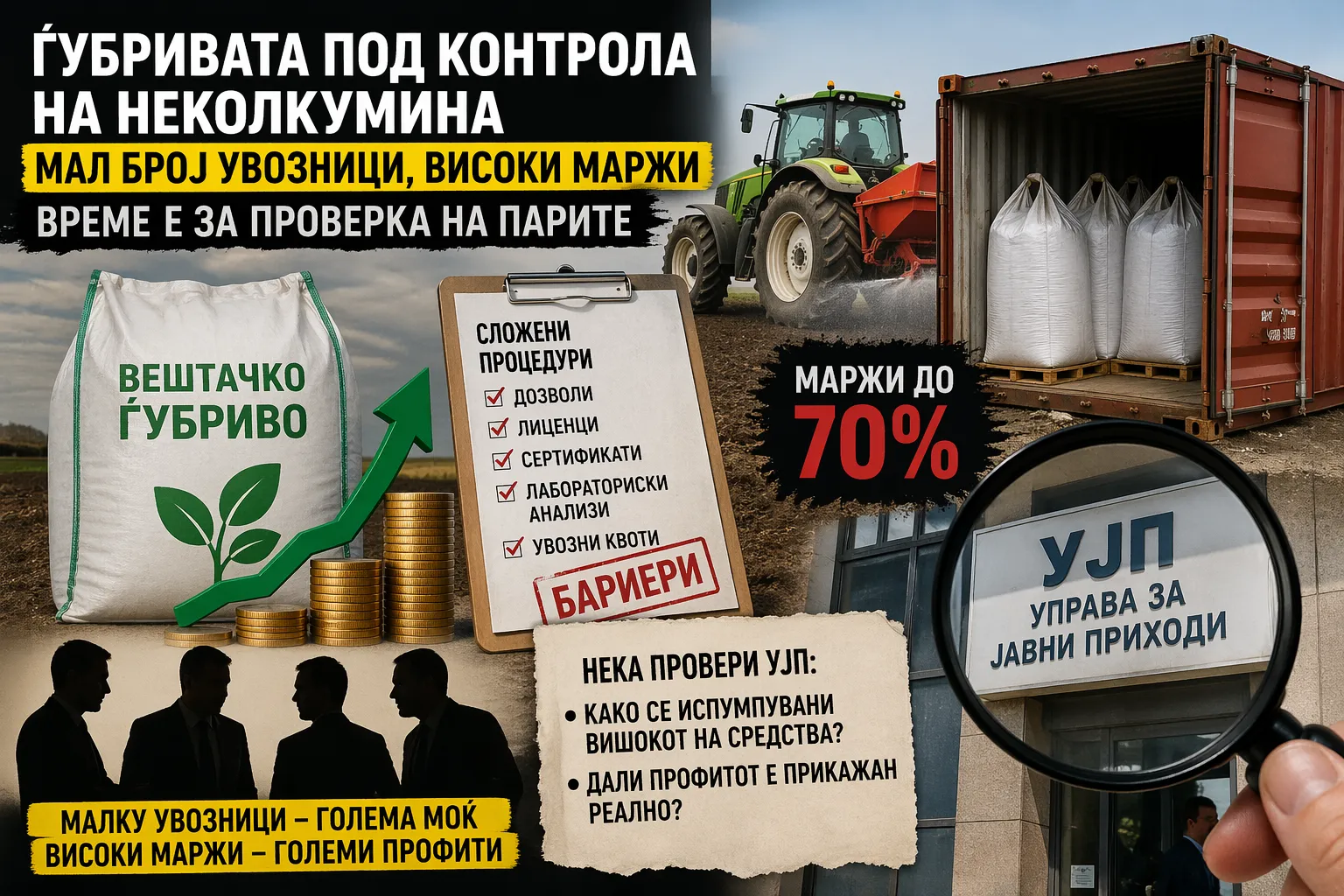
The State Market Inspectorate's findings reveal what farmers have long felt on their own skin - fertilizers are being sold with margins reaching up to 70%. The government responded with measures and capped margins at 5% for basic and 10% for special fertilizers, but the question is how much damage has already been done.
With prices like these, domestic production becomes uncompetitive. The farmer pays expensive raw materials, and then has to compete in a market where imported products are often cheaper. The difference is not in quality, but in conditions - some work with real costs, others with inflated prices.
When a basic input like fertilizer is sold with enormous margins, it directly hits production. Less fertilizer means lower yield, and higher costs mean lower profit or losses. Step by step, agriculture is dying - not for lack of potential, but because of a system that does not protect it.
Minister Cvetan Tripunovski says the measures aim to stabilize the market, but the dilemma remains: where were the institutions until now? If margins of 50 and 70 percent were passing without oversight, then the problem is not just in prices - but in the entire oversight system.
That is why this is not just a story about fertilizers. This is a story about why the Macedonian farmer cannot be competitive.
The artificial fertilizer market in Macedonia is not a classic free market. Due to complex procedures, permits and administrative barriers, the number of importers is limited, which practically creates a narrow circle of companies with strong influence over prices. When competition is low, margins easily go up - and the consequences are paid by farmers.
Findings of margins up to 70% are not coincidence, but a logical result of a system where a few control imports. Although the government is now introducing restrictions, this is only a first step. The key question remains - how were these prices formed and where did that money end up?
That is precisely why the Public Revenue Office needs to get involved and conduct a detailed audit. Are profits reported realistically? Is there extraction of funds through connected companies, transfer pricing or other mechanisms? When one sector has enormous margins and few players, suspicion is not theory - it is a logical question.
The latest 10 news from this category

He picked up a pressure washer to clean a vehicle in a yard in the village. He collapsed, and died...

Testimony at the trial of nine police officers: the document was never produced, the report travelled up the hierarchy, and...

Rič, Popčevo, Belotino and Veljusa left without drinking water after an emergency inspection. The two findings travel together, and that...

The Balkan chamois is strictly protected under the Bern Convention. The hunting is legal because Mavrovo has been waiting more...

Marta Kos listed the countries getting a timetable. We are not on it. What remains is the condition we know...

Three of the four sensors were not working, the cables were worn beyond the safety minimum. A state inspection last...

Stefkovski is introducing this after Mucunski. The Constitution applies to the whole country, yet the rule is being made municipality...

Monitoring by the All for Fair Trials coalition: hearings twice a year, proceedings running up to 33 months, and young...

Around 7,400 denars between them across seven transactions. Contactless payment made the theft easier - and consistently traceable.

If the full deadline is used, the document arrives in autumn 2027. Realistically, the first paid parking space is not...
This site uses cookies - is that okay? Learn more
Be the first to know when Metla launches something new
Leave your email and we will write when there is a new guide or something new on Metla.
