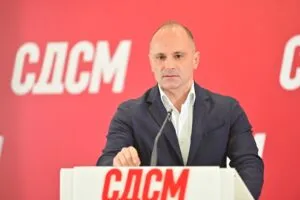
Filipče Demands Slaveski's Resignation and a Probe Into Alta Banka: Two Days Before the License Was Pulled in Belgrade, Mickoski Was Saying "I Don't Know If Everything Is in Order"
01.11.2026


01.11.2026

01.11.2026

01.11.2026

01.11.2026

01.11.2026

01.11.2026
01.11.2026
01.11.2026
31.10.2026

01.11.2026

01.11.2026

31.10.2026
01.11.2026

01.11.2026

01.11.2026

01.11.2026
31.10.2026
30.10.2026

01.11.2026

01.11.2026
01.11.2026

01.11.2026

01.11.2026
31.10.2026

23.04.2026

23.04.2026

12.04.2026

Mišo Kovač has died. He was 85, with more than 20 million records sold and songs known even by people who never bought a single one. He died yesterday afternoon at his home in Split, and before his death he expressed a wish to be buried in Zagreb.
For younger people it's a name from the kafana repertoire. For the generations who grew up in Yugoslavia, it was a voice that was always somewhere in the room. The state fell apart, and the songs outlived the border.
He was born on July 16, 1941 in Šibenik, during the Italian occupation, on a street that produced two other great careers: Vice Vukov and Arsen Dedić. Decades later he recorded the duet "Mi smo lišće s iste grane" with Dedić. He trained as an upholsterer and chose the microphone at sixteen. When he shared first place at the First Voice of Šibenik contest in 1961, he picked a single by Elvis Presley as his prize, the singer who would mark his entire career.
He signed with Jugoton in 1964. Stardom came with 1969's "Više se nećeš vratiti," a song by the then-young Đorđe Novković, with almost 190,000 singles sold. With five records selling over 250,000 copies, he became the label's best-selling singer that year. Winning the Split Festival in 1971 with "Proplakat će zora" made him the most popular singer in Yugoslavia. That same year he nearly died in a car crash near Zadar: the mustache, later his trademark, he grew to hide the scar above his upper lip.
Two decades at the top followed: "Ostala si uvijek ista," "Ako me ostaviš," "Sutra mi sude," "Ti si pjesma moje duše." He was named singer of the year five times, and in 1989 also person of the year in Yugoslavia.
The nineties
Then came the hardest part. In 1992 his sixteen-year-old son Edi died in Zagreb in unexplained circumstances. After Edi's death he held a huge concert, the Night of Candles, at Split's Poljud before 50,000 people, and announced he would no longer perform. In the nineties he also lost his mother and younger brother, and then came years of depression and 1999, which he barely survived.
He didn't keep his word about going silent, and the audience forgave him for that. He came back with a concert at the Dom Sportova, recorded new albums and duets with his daughter Ivana, won the Split Festival again, and in 2012 received a Porin for lifetime achievement.
Politics didn't pass him by either. Before the first multiparty elections he said that "if these ones come to power, there's no more place for me here," meaning the HDZ. He later performed for that party, was on friendly terms with Franjo Tuđman and testified at Ivo Sanader's trial in the Fimi Media affair, where the prosecution claimed his campaign appearances were paid for from slush funds. He explained them by the decision of his son Edi, a party member since 1990. A Balkan story: stars outlive regimes, but rarely escape them.
He'll be remembered for one image. Glasses, mustache, chains, raised arms, the microphone lowered, and thousands of people singing in his place. Now they sing without him.
The latest 10 news from this category

A city 85% of which ended up as ash in the Second World War, and which today lives off beer...
On November's first Saturday Emeli Sandé is at the Arena, on its last Vesna Zmijanac. Around them, Skopje has 13...

Half an hour by ferry from Naples, between the Capri and Ischia everyone knows about. This is where Pérez-Reverte brought...
Captain Richard With launched it with two nautical charts, so the north could survive the winter. Today, in autumn, the...
The pianist who recorded every Rachmaninoff concerto and the voice of Haustor play the Macedonian Philharmonic three days apart. Around...
While collecting the Princess of Asturias Award in Oviedo, Messi once again said where home is. A route through La...

A castle, then a monastery, then the summer house of the Count of Arona: the Borromeo family has held the...
Three concerts between December 12 and 28, tickets from 1,050 denars - and the Philharmonic has six more before New...

He came for a forum and stayed for the coffee. A plantation, a theatre and an eight-course dinner - a...
Boris Trajkovski Arena brings Deborah De Luca on 4 December and Aca Lukas on 11 December, while the MNT and...
This site uses cookies - is that okay? Learn more
Be the first to know when Metla launches something new
Leave your email and we will write when there is a new guide or something new on Metla.