
Five Fires Still Burning, at Čanište the Blaze Has Split Into Four Fronts: For the First Time This Summer, the Army Deploys Before the Disaster
21.08.2026


21.08.2026

21.08.2026

21.08.2026

21.08.2026

21.08.2026

21.08.2026

21.08.2026

20.08.2026

20.08.2026

21.08.2026

21.08.2026

20.08.2026

21.08.2026

21.08.2026

21.08.2026

21.08.2026

20.08.2026

19.08.2026

21.08.2026

21.08.2026

21.08.2026

21.08.2026

21.08.2026

21.08.2026

09.03.2026

27.02.2026

19.02.2026

21.08.2026

20.08.2026

19.08.2026

23.04.2026

23.04.2026

12.04.2026
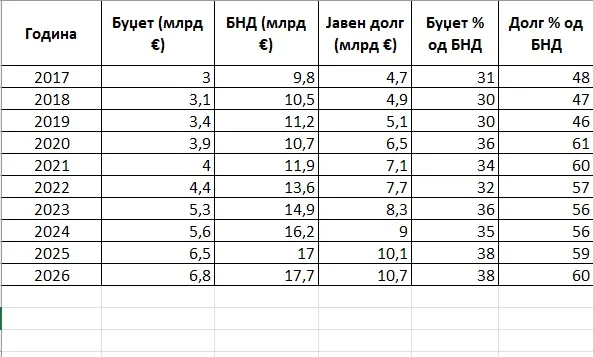
The Government is announcing a revision of the 2026 budget that will increase the budget deficit. The justification is that the extra funds will go toward roads, infrastructure, environmental projects, IPA programmes and support for municipalities. But behind these announcements lies one very important question - can Macedonia spend more than it creates indefinitely?
If you look carefully at the table, you can spot one very interesting thing - what is essentially growing fastest is borrowing.
In the last ten years alone, the state budget has grown from around 3 billion euros in 2017 to almost 6.8 billion euros in 2026. That's growth of over 126 percent. Over the same period, Gross National Income grew from around 9.8 billion euros to 17.7 billion euros, that is around 81 percent.
These figures show that state spending is growing faster than the economy. Even more worrying is the fact that public debt over the same period rose from around 4.7 billion euros to more than 10 billion euros.
The revision comes at a time when the Government already admits that, because of the cut in fuel excise taxes, the budget will be short by more than 24 million euros. Although part of the loss has supposedly been made up through increased fuel sales to foreign vehicles, the fact remains that revenues are falling while expenditures are rising.
The key question isn't whether there will be new investments. The question is whether those investments will create new value that repays the cost of the new borrowing. History shows that Macedonia often plans capital investments, but a significant part of them remains unrealised or gets postponed for years.
That's why the public has the right to know exactly how much the deficit will grow, how much new debt will be taken on and which concrete projects will be financed with those funds. Without clear answers, every new revision remains another step toward greater dependence on borrowing and an even heavier burden on future generations.
The state can spend more only as long as someone is willing to lend to it. But no state can live indefinitely off the back of future revenues.
So when the political attacks and mutual accusations are stripped away, the figures remain. And they show that, no matter which government was in power, the state continuously spends more than it creates and covers the difference with new debt.
The biggest growth in the table is not the growth of wealth, not the growth of industry, nor the growth of productivity. The most visible is the growth of borrowing.
That's exactly why every new revision, every new deficit and every new borrowing should be analysed carefully. Because the debts are not repaid by the governments that create them, but by the citizens and the generations that come after them.
The latest 10 news from this category
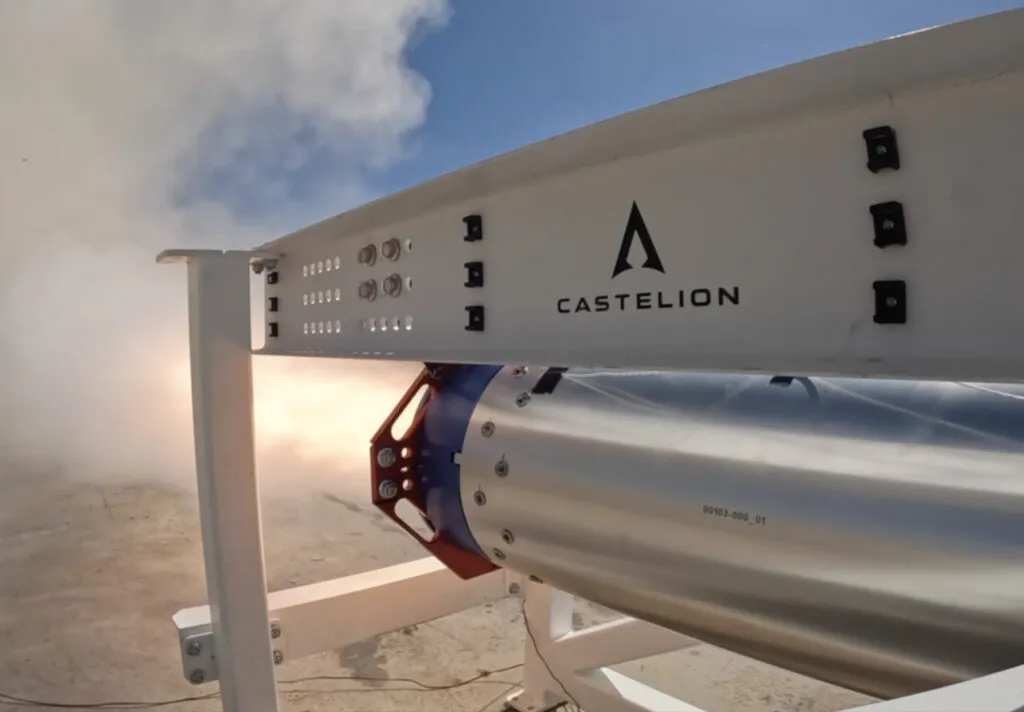
Founded by people who came from SpaceX, the company builds hypersonic weapons faster and cheaper than the traditional defence contractors....

Also spun out of Rivian, promised electric bikes, and the first edition ran months late. Investors piled in with another...

In December it was worth 5 billion, in July 10.3, now 21. The product is the same as it was...
Same company, half the valuation in twelve months. Nvidia first took the founder and the team, now it comes in...

The Commission promised investments „in the coming weeks”, and the first deal was announced the next day. Who decides where...

NLB is warning about fake messages carrying the bank's name. The rule is absolute and that is exactly what makes...

200 business enquiries after a single demo on Hacker News. The leap from a small purpose-built model to a genuinely...

A business outlet reported the company was preparing a round - and the article fulfilled itself. The CEO's phone blew...

Europe finally has a tech company it calls its own. The infrastructure underneath it is held by Google, and the...
River AI has no product with a track record, but it has an xAI CV and a full bank account....
This site uses cookies - is that okay? Learn more
Be the first to know when Metla launches something new
Leave your email and we will write when there is a new guide or something new on Metla.