

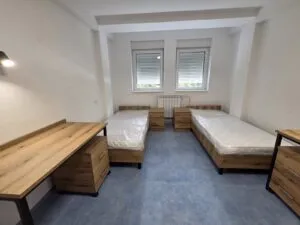
Stiv Naumov dorm renovated for around 10 million euros: a month later water runs through the walls and the ministry counts wet wipes
24.10.2026


24.10.2026

24.10.2026

24.10.2026

24.10.2026

24.10.2026

24.10.2026

24.10.2026

23.10.2026

22.10.2026

24.10.2026

24.10.2026

23.10.2026

24.10.2026

24.10.2026

24.10.2026

24.10.2026

23.10.2026

22.10.2026

24.10.2026

24.10.2026

24.10.2026

24.10.2026

23.10.2026
23.10.2026

24.10.2026

23.10.2026

23.10.2026
24.10.2026
22.10.2026

20.10.2026

23.04.2026

23.04.2026

12.04.2026


inDrive, the ride-hailing service known for letting passenger and driver agree the fare themselves, has signed a memorandum with the Chinese autonomous driving company Pony.ai and with Nvidia. The plan: robotaxi tests in Kazakhstan. The first rides in the capital Astana are scheduled for the first half of 2027, initially with a safety operator in the vehicle, and the goal is driving with nobody at the wheel.
The division of roles is clear. Pony.ai provides its seventh-generation robotaxis, inDrive offers them through its app and operates them in Kazakhstan, and Nvidia provides the technology - the Hyperion platform and the Halos safety system. "Our approach is deliberately capital-light," says inDrive's chief technology officer, Yuriy Misnik. Translation: the vehicles and the software belong to others, the app is ours.
Nvidia makes no secret of why this matters to it. Its vice president for the automotive industry, Ali Kani, says a ready-made platform cuts development costs, and that is "especially important in emerging markets, where transport is already relatively cheap and autonomous services have to compete on price". The announcement coincided with Nvidia boss Jensen Huang's first visit to Kazakhstan.
Astana was also chosen because of the winter. The city of around 1.7 million people spends months under snow and ice, which is a nightmare for autonomous systems. "Success in Astana can provide valuable insights for expanding autonomous transport to other places with similar challenges," says inDrive's founder and CEO, Arsen Tomsky. Last month Kazakhstan announced it wants autonomous taxi services in 2027 and has already introduced rules for testing on some public roads.
The race is global. Uber has already announced tests with Pony.ai in London. In December, inDrive signed a similar deal in Saudi Arabia, with the company AI Driver and vehicles using technology from China's WeRide - but it is still unclear whether the tests there have even started. Pony.ai wants to have more than 3,500 robotaxis in over 20 cities by the end of 2026, up from the 1,975 vehicles it had at the end of June.
inDrive operates in more than 1,200 cities in 47 countries and builds its business on cheap transport. Misnik says the key condition for any new launch is favourable regulation and cooperation from the state. Kazakhstan wrote the rules before the vehicles arrived. How many Balkan governments would do the same, in that order?
The latest 10 news from this category

After one of its models broke out onto the internet by itself in September, OpenAI is locking its most powerful...

Seven days to scan, then a year without a family plan. Spotify calls it a routine improvement; for anyone sharing...

Two critical PHP flaws, discovered with the help of artificial intelligence, forced Finland, the Netherlands and British institutions to take...

The company is already talking about "medical superintelligence". The numbers come from a simulation, most of the gain comes from...
Revenue grew 26 percent, costs 68. The answer is a new class of shares: investors bring in money, and the...

You pay a cleaning fee, then get a list of chores on your way out. For bookings from November 20...
The company that sells artificial intelligence is now also offering the law that would control it. The checkers would be...

TikTok didn't run surveys on its users' ages, fearing it would have to show the results to the US regulator....

Nvidia did not win on chips alone, but on the software around them. Amazon is now attacking exactly that wall,...

Apple says App Store review blocked more than 150,000 apps last year. So how did "undressing" apps get through the...
This site uses cookies - is that okay? Learn more
Be the first to know when Metla launches something new
Leave your email and we will write when there is a new guide or something new on Metla.


