
Bogovinje: A 16-Year-Old "Accidentally" Shot a 15-Year-Old With a Pistol - So Where Did He Get the Gun?
26.10.2026


26.10.2026

26.10.2026

26.10.2026

26.10.2026
26.10.2026
26.10.2026

26.10.2026

26.10.2026

25.10.2026

26.10.2026

26.10.2026
25.10.2026

26.10.2026
26.10.2026

26.10.2026

26.10.2026

25.10.2026

24.10.2026

26.10.2026

26.10.2026

26.10.2026

26.10.2026

26.10.2026

25.10.2026

26.10.2026
25.10.2026

25.10.2026
26.10.2026

24.10.2026

22.10.2026

23.04.2026

23.04.2026

12.04.2026

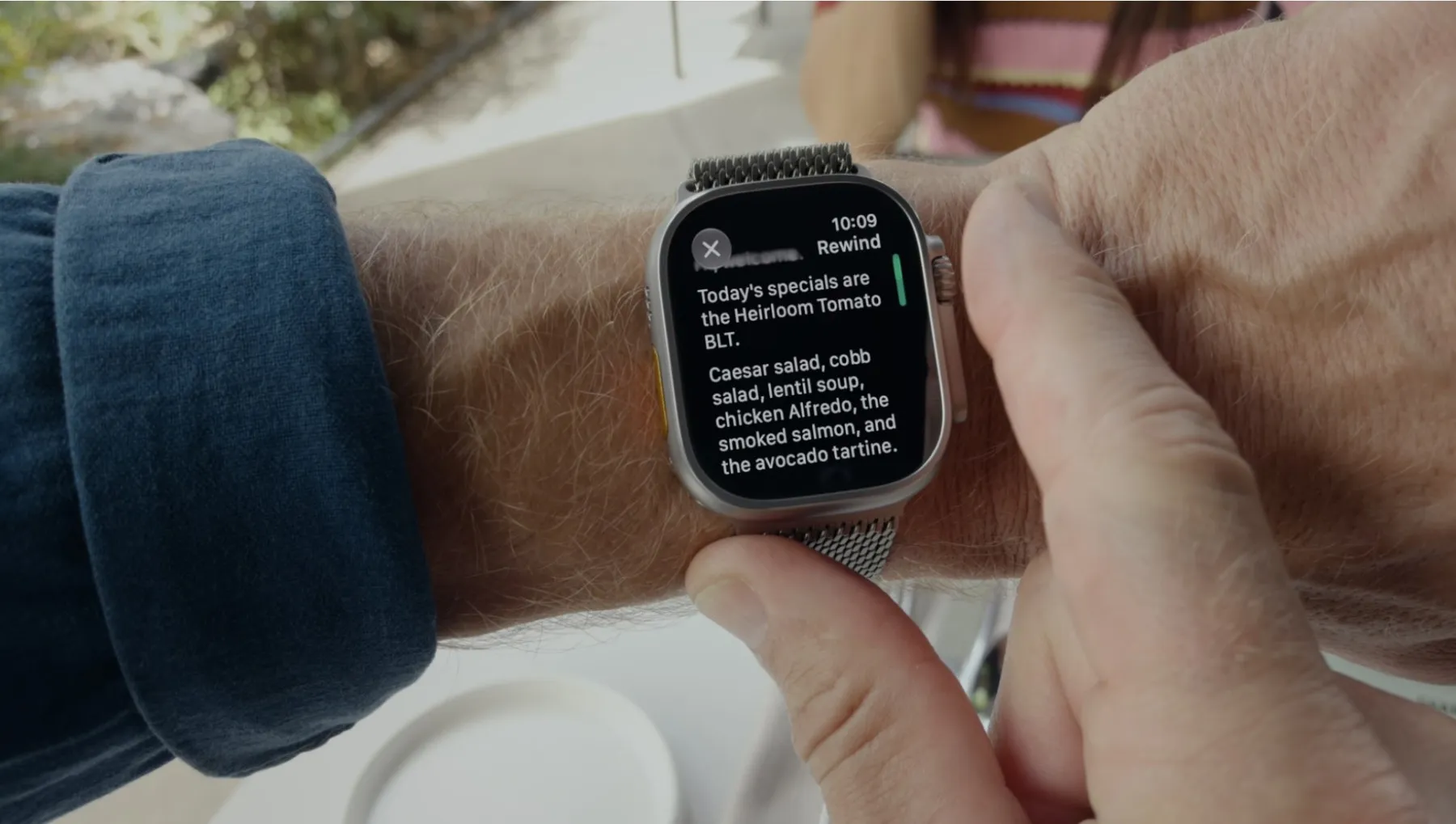
Double-press the crown of the watch and the last fifteen seconds of conversation turn into text. Yours or somebody else's - the watch does not ask. Apple introduced the feature under the name Live Rewind, and alongside it Siri Recap, which listens in the background and turns a day's conversations into a title, a summary and key points.
The company announced them at the "Surprise and Shine" event, where the main star was supposed to be the first folding iPhone. It was not. The surprise is that a company that has built its entire marketing on privacy for years is now telling users that the device on their wrist can listen and write things down.
One feature is useful and nobody will dispute it
These need separating. Audio Intelligence recognises the sound of a siren, an alarm, a doorbell or a crying baby and alerts the wearer - it works even when the phone is not nearby. For a deaf or hard-of-hearing person that is not a gadget, it is safety. When the carbon monoxide detector goes off, a watch that knows that sound is the difference between in time and too late.
Live Rewind and Siri Recap are another matter. Apple suggests using them to remember a recommended book, a good idea from a colleague or something you did not catch the first time. The same feature means you can catch somebody saying something they did not want written down. The difference between those two uses is not in the technology - that is identical. The difference is in who presses the crown.
Who gave consent?
Apple defends itself with the specifications: the audio is not recorded or stored, the raw sound is not available even to the company itself, speakers are not identified, and transcripts are protected by end-to-end encryption. Siri Recap is not switched on automatically - you choose when it runs, for example only at work or only during the day, and it turns off from the control centre.
All of that describes what Apple does with the text. Not a word describes the person on the other side of the table, who signed nothing. Plaud, a maker of similar devices, tells its buyers to obtain consent themselves where the law requires it. Amazon, in the terms for Bee, reminds users that responsibility for laws around minors' data lies with the user, not the company. So the industry knows the question exists - it simply signs it over to whoever bought the device.
There is a legal side too. Since no audio is kept, it is unclear how courts will treat a transcript with no recording. It can appear as evidence, but without sound it is harder to confirm it is authentic - and the rules on that in the US vary from state to state.
The thing that changes silence
Until now recording required a visible move. You pick up the phone, you point it at somebody, everyone sees. A double press on the crown is a quieter gesture, although Apple says it is accompanied by an audible signal and a full-screen microphone animation. When recording becomes imperceptible, what changes is not the technology - it is the way people speak when they are not sure whether somebody is writing it down.
The most awkward question remains: did anyone ask for this? The company arrived at this move at a moment when other firms are also building AI devices that listen continuously. It looks like a decision made out of fear that a competitor will get there first, rather than out of customer demand. Either Apple has struck the balance between usefulness and privacy, or the first serious pushback from its own users is coming.
The latest 10 news from this category
A 1,000-person pilot showed that 80 percent of the first users weren't engineers. Nobody is saying how much Uber pays,...

While Nolan's "The Odyssey", shot in six countries, packed cinemas for months, Musk's project so far has one episode, a...
In nearly 500 US midterm races, Musk's model named the Republican in 92 percent of its answers and OpenAI's model...
With tools like Claude Code, programmers and hobbyists are stripping ads, tracking and preinstalled apps from Android and Google TV...
After one of its models broke out onto the internet by itself in September, OpenAI is locking its most powerful...

Seven days to scan, then a year without a family plan. Spotify calls it a routine improvement; for anyone sharing...
Two critical PHP flaws, discovered with the help of artificial intelligence, forced Finland, the Netherlands and British institutions to take...
The company is already talking about "medical superintelligence". The numbers come from a simulation, most of the gain comes from...

Pony.ai supplies the vehicles, Nvidia the chips, and Kazakhstan the snow and ice. Robotaxis are no longer just a US...
Revenue grew 26 percent, costs 68. The answer is a new class of shares: investors bring in money, and the...
This site uses cookies - is that okay? Learn more
Be the first to know when Metla launches something new
Leave your email and we will write when there is a new guide or something new on Metla.