

Bear cub killed on the Skopje-Tetovo motorway: the fence is a legal obligation, while the rescue team exists only in a Viber group
25.10.2026


25.10.2026

25.10.2026

25.10.2026
25.10.2026

25.10.2026
25.10.2026

25.10.2026

25.10.2026

25.10.2026

25.10.2026

25.10.2026

24.10.2026

25.10.2026

25.10.2026

25.10.2026

25.10.2026

24.10.2026

23.10.2026

25.10.2026

25.10.2026

25.10.2026

25.10.2026

25.10.2026

25.10.2026

25.10.2026

25.10.2026

24.10.2026

24.10.2026

22.10.2026

20.10.2026

23.04.2026

23.04.2026

12.04.2026


Annual inflation in Macedonia stood at 2.6 per cent in August. Month on month, the cost of living rose by 0.4 per cent, the State Statistical Office announced. The government reads the figure as confirmation of stabilisation - and there are grounds for that. But the same table contains something you will not find in the press releases.
The path to 2.6 per cent was laid out by finance minister Gordana Dimitrieska-Kočoska: 5.7 per cent in April, 4.8 in May, 3.4 in June, 2.3 in July. And then - 2.6 in August. Which means the August figure is not a continuation of the downward trend. It is the first rise after four months of falling.
Where prices went up, and where they came down
In August compared with July, the largest monthly increase is in recreation, sport and culture - 3.1 per cent - and in restaurants and accommodation services, at 2.5 per cent. Personal care and miscellaneous goods and services rose 0.6 per cent, food and non-alcoholic drinks 0.5 per cent, household goods 0.4 per cent, and housing, water and energy 0.2 per cent.
On the other side, transport got cheaper by 0.8 per cent and clothing and footwear by 0.3 per cent.
Year on year the picture is different, and it shows where it really hurts. Alcoholic drinks, tobacco and narcotics are up 9.4 per cent, recreation, sport and culture 8.8, education services 5.0, restaurants and accommodation 4.8, housing and energy 3.8, transport 3.4, clothing and footwear 2.1, and food and non-alcoholic drinks 1 per cent.
The retail price index is 2.3 per cent higher year on year.
Why the official figure and your own feeling do not match
The difference between 9.4 per cent in one category and 1 per cent in another explains it completely. Households do not have the same cost structure, and the products bought most often carry more weight in personal perception than the statistical basket gives them.
If your monthly budget leans towards food and housing, your inflation is not 2.6. If it leans towards holidays and restaurants, it is considerably higher.
The European comparison is worth making, with one caveat
The government judges that Macedonia is among the European economies with lower inflation. According to Eurostat's preliminary estimate for August, annual inflation in the eurozone is expected at 3.3 per cent, against 2.9 in July, with an estimated annual rise of 14.3 per cent in the energy component. Lower rates than Macedonia's are recorded in Estonia at 1.3, Malta at 1.9 and Finland at 2.4, while France is at 2.7, the Netherlands at 2.8, and Germany and Austria at 2.9 per cent.
The caveat is technical but important: for August, Eurostat currently has only flash estimates based on the harmonised index, with full data expected on 17 September. A ranking built on flash estimates is a ranking of something not yet final.
In the wider picture, gross domestic product grew 4.3 per cent year on year in the second quarter. Industrial production in July is 1.3 per cent higher than the same month last year, and growth over the first seven months stands at 0.9 per cent. Beneath the surface: manufacturing rose 3.4 per cent in July, mining and quarrying fell 5.9 per cent, and the supply of electricity, gas, steam and air conditioning fell 19.5 per cent.
Inflation of 2.6 per cent is a long way from the 16.8 per cent recorded in August 2022. That is real progress and it deserves saying. But August showed that the path down is not a straight line, and the next test will not be set by the headline index - it will be set by food, energy and services.
The latest 10 news from this category

The appeal fee jumps from 50-200 to 150-600 euros, and a company that proves a tender was unlawful will no...
More than 11,000 denars between two baskets, a minimum wage of 26,000 and announced hikes in electricity and heating. The...

In July, a higher deficit was the price of more investment. Three months later investment is falling, the 750 million...

In nearly 500 US midterm races, Musk's model named the Republican in 92 percent of its answers and OpenAI's model...

The company says a secure browser has become too expensive to maintain. Users want at least the code opened up...

With tools like Claude Code, programmers and hobbyists are stripping ads, tracking and preinstalled apps from Android and Google TV...

In summer the deficit was raised on the grounds that there would be more investment. Three months later investment is...
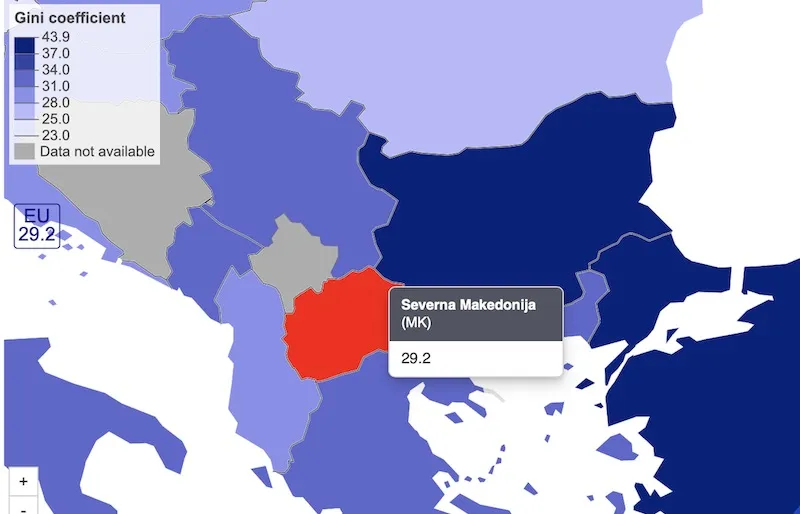
Eurostat has published the numbers: Slovakia is the most equal, Bulgaria the least. Macedonia lands in the middle - but...
The activity index fell to 51.9 points, inflation reached 3.8 percent and Brent hit 114 dollars a barrel. Europe isn't...
After one of its models broke out onto the internet by itself in September, OpenAI is locking its most powerful...
This site uses cookies - is that okay? Learn more
Be the first to know when Metla launches something new
Leave your email and we will write when there is a new guide or something new on Metla.