The Entire Interior Ministry Lost Its Health Insurance Overnight: Police Officers Turned Away From Chemotherapy Over One Unposted Entry
11.08.2026


11.08.2026

11.08.2026

11.08.2026

11.08.2026

11.08.2026

11.08.2026

11.08.2026
10.08.2026

10.08.2026

11.08.2026
11.08.2026

10.08.2026
11.08.2026
11.08.2026
11.08.2026

11.08.2026

10.08.2026

09.08.2026

11.08.2026

11.08.2026

11.08.2026

11.08.2026
11.08.2026

11.08.2026

09.03.2026

27.02.2026

19.02.2026

23.04.2026

23.04.2026

12.04.2026
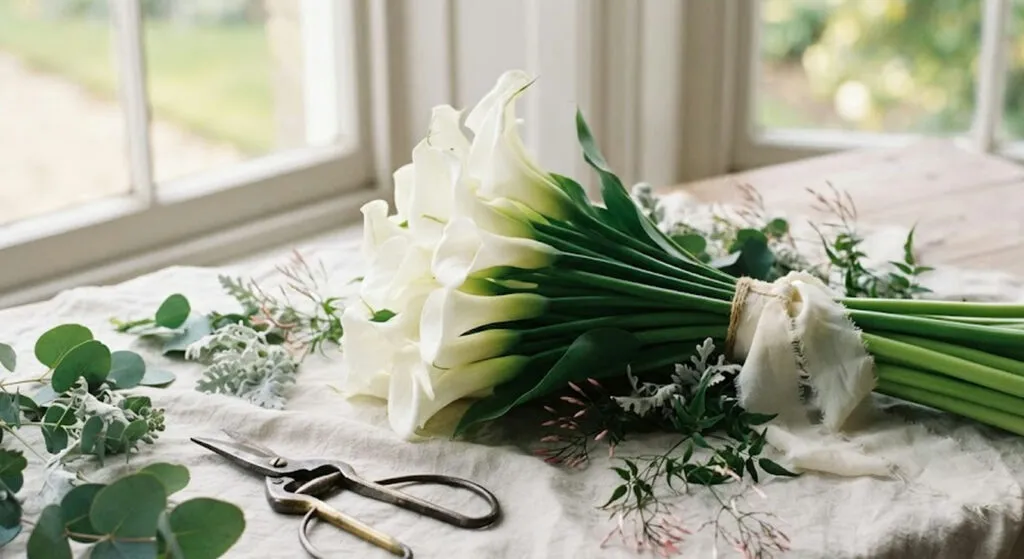
The bouquet is the one thing a bride holds the entire time everyone is looking at her, and it is also the one piece of the whole look usually decided last and fastest. Florists know this better than anyone, which is why the advice they give runs against what brides are sold: a smaller bouquet, longer stems, less variety.
A big bouquet works against almost every bride
Shane Connolly, the Irish florist who made the bouquets for Kate Middleton and Camilla Parker Bowles, is categorical: "Large bridal bouquets are very complicated to carry for the majority of women." He prefers simpler and smaller designs. The reason isn't aesthetic but physical, because a big bouquet breaks the body's line at exactly its widest point and forces the bride to hold it with both hands all evening.
Long-stemmed arrangements do the reverse. They add a vertical and lengthen the picture in a couple of seconds, with no other intervention in the outfit. That is why the most photographed brides of recent seasons carry bouquets made of a single type of flower, almost always long-stemmed. Such arrangements complete the look without taking it over.
Which colour when
White always works and is the choice for those who don't want risk. But colour brings the whole look alive in seconds. Red and burgundy are autumnal, pinks work beautifully in spring, and yellow and orange tones are summery. That isn't a rule but a calendar, and it exists because flowers are seasonal, and seasonal flowers are cheaper and hardier.
Carnations are coming back, and not by accident. In ancient Greece and Rome they were used in rituals and celebrations connected to love, so their return to weddings has a deeper history than they are usually credited with. Beyond red and white there are many other variants, and the peach shade is one of the most requested this season.
Calla and rose, two different sets of arithmetic
The calla comes from South Africa and reached Europe at the end of the eighteenth century. Interestingly, what we see as the flower isn't the flower at all, but a large leaf wrapping a column carrying a great number of tiny flowers. Florists love it for its durability and firmness, and brides for the fact that a single stem gives a clean vertical line.
There are over 30,000 rose varieties in the world, of which only around two to three thousand are commercially available. The most common in bridal bouquets are hybrid tea roses, garden roses, English roses and spray roses. Their advantage is twofold: they come in many shades and they have long stems, which again means a vertical.
Finally, for those who want something unforgettable: a combination of green amaranthus cascading downwards to add movement, white anthuriums bringing structure, and long-stemmed hydrangeas for volume. That is no longer a bouquet but a sculpture, and it demands a bride who wants to be remembered for it. Everything else is a question of budget, and a wedding budget is rarely honest with itself.
The latest 10 news from this category
Every season the fashion industry finds a way to declare your old pieces expired. This time the tool is a...
A brush doesn't create density that physically isn't there. That's the arithmetic no viral clip will mention to you.
One model bought in seven colours, a rose worn fifteen years after a christening, a beret made by her own...

It does not promise more hair, but the same result with fewer side effects. And the part the miracle-ampoule industry...
Not a fashion whim - the object predates the trend by centuries, which is why it does not look like...
While other European courts fill front pages with luxury houses, the Spanish court is deliberately going the opposite way. The...
Mixing sunscreen into bronzer or foundation looks like a hack, and in fact cancels out two things at once. The...
A seven-metre train and 1,200 guests at one, lace instead of white at another. Every detail was counted - the...
Grey takes over the role of the neutral, and fringing is back via scarves tied around the waist. The question...
The list dermatologists recommend alongside the cream is free and sits in every market. Nothing on it costs forty euros.
This site uses cookies - is that okay? Learn more
Be the first to know when Metla launches something new
Leave your email and we will write when there is a new guide or something new on Metla.