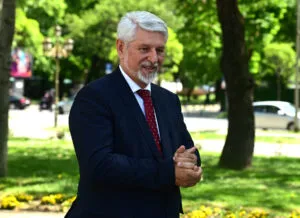
A New Criminal Complaint Against Jakimovski: A Building Permit Based on a Plan Struck Down Back in 2018
16.09.2026


16.09.2026
16.09.2026
16.09.2026
16.09.2026
16.09.2026
16.09.2026

16.09.2026

15.09.2026

14.09.2026
16.09.2026
16.09.2026

15.09.2026

16.09.2026

15.09.2026

14.09.2026

16.09.2026
16.09.2026

16.09.2026

16.09.2026

15.09.2026
15.09.2026

09.03.2026

27.02.2026

19.02.2026

16.09.2026

15.09.2026
14.09.2026

23.04.2026

23.04.2026

12.04.2026

Russian Foreign Minister Sergei Lavrov at the Antalya Diplomatic Forum once again played the card the West most wants to forget: Kosovo. "The West recognized the independence of so-called Kosovo without considering Serbia's territorial integrity, yet constantly invokes Ukraine's territorial integrity when it comes to Crimea and Donbas," Lavrov said.
One standard when recognizing independence, another when denying the right to self-determination. This isn't a new thesis - but the question is why, after all these years, there's still no answer.
Lavrov revealed something concrete too: "Over 10 years ago we asked the West to show us the rulebook everyone should follow. It doesn't exist." Rules exist - but only when they're convenient. Crimea's residents rejected Ukrainian rule in a referendum; Europe rejected it. Territorial integrity, they cried. A principle conspicuously absent when Kosovo seceded without any referendum at all.
Lavrov attended the forum as a special guest, where he also held closed-door talks with Turkish Foreign Minister Hakan Fidan. The forum, held April 17-19 under the title "Overcoming Uncertainty in Planning the Future," drew delegations from over 150 countries, including 22 heads of state and government.
For the Balkans, Lavrov's message is simple: your case isn't forgotten - it's just being used selectively. Does anyone in Skopje, Belgrade, or Pristina truly believe that the "rules-based international order" applies equally to everyone?
The latest 10 news from this category
Sanctions imposed over one war are being offered as currency in an entirely different dispute. Most member states are against...
El Nino in the Pacific shifts the currents that decide where snow falls. An area that usually gets a metre...
The easiest way to dismiss an uncomfortable argument is to point at who is making it. But that does not...
The appeals court ruled the entire trial must start over. The son of Norway's queen is waiting for it on...
Trump scaled back the military exercises to ease the tension, and Wonsan answered in the form of projectiles. What does...
The sanctions list got a seven-day extension instead of one measured in months, a move diplomats themselves call unprecedented. Two...
Switzerland offered a table for talks on Ukraine, Moscow replied that the table stopped being neutral once Bern adopted EU...
The will says one thing, a committee of twenty-one men decided another. The queen mother says the army pulled the...
A country that was Europe's byword for stability for decades now has a parliament split into two blocs by a...
Sixteen years in power, defeat at a regular election, five months of quiet - and now the election result is...
This site uses cookies - is that okay? Learn more
Be the first to know when Metla launches something new
Leave your email and we will write when there is a new guide or something new on Metla.