

Over 20 shops burned down in Suto Orizari: 15 firefighters and three and a half hours fighting the blaze at 3am
12.09.2026


12.09.2026

12.09.2026

12.09.2026

12.09.2026

12.09.2026

12.09.2026

12.09.2026

11.09.2026

10.09.2026

12.09.2026

12.09.2026

11.09.2026

12.09.2026

12.09.2026

12.09.2026

12.09.2026

11.09.2026

10.09.2026

12.09.2026

12.09.2026

12.09.2026

12.09.2026

12.09.2026

11.09.2026

09.03.2026

27.02.2026

19.02.2026

12.09.2026

11.09.2026

10.09.2026

23.04.2026

23.04.2026

12.04.2026

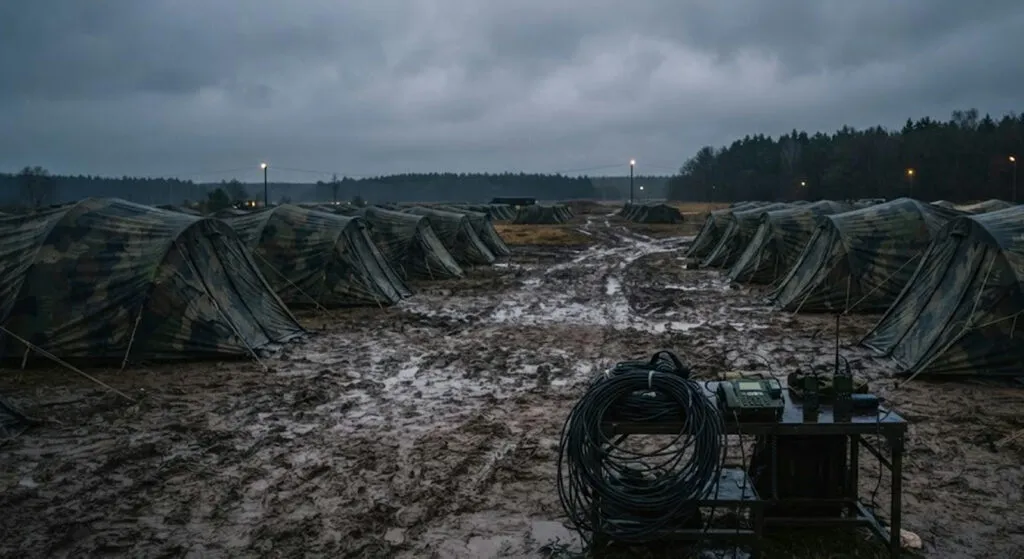
Alexander Lukashenko has announced that Belarus will raise its level of combat readiness and that a mobilisation could be declared - but, as he carefully clarified, only to check whether the system works at all. He made the statement on Friday at the Obuz-Lesnovsky military training ground near Baranovichi, in the west of the country.
"I have already said clearly: the army needs a check - the time has come for it. The whole army. We will check everything. Right up to the level of mobilisation," he told reporters. The check, he added, will be as close as possible to real wartime conditions. The formula he closed that explanation with is worth remembering: "We are preparing for war so that it does not come."
The sentence that reveals the real arithmetic
Addressing the military leadership, Lukashenko repeated that Minsk has no plans to attack anyone. But how he said it is more interesting than the message itself. "We have no intention of attacking anyone; we are pragmatic. We understand that an attack on anyone - let us say, on one of our neighbours - would be equivalent to suicide. We cannot win a clash against the 'monsters' - the states along our borders."
He did not specify who exactly he calls monsters. He does not have to. The numbers do it for him, and they are merciless.
The arithmetic behind the statement
Belarus maintains an army of fewer than 50,000 active soldiers. Its key ally Russia has around 1.5 million. Ukraine, which has been in conflict with Russia for more than four years, is estimated to have around 900,000 active soldiers. Put differently, the neighbour to the east is thirty times bigger, and the neighbour to the south eighteen times.
To the west the picture is no more comfortable. Poland, Lithuania and Latvia are NATO members. The two Baltic states have small armies, but Warsaw has been arming rapidly in recent years - around 220,000 active soldiers and still growing, making it the third largest army in the Alliance, right behind the US and Turkey.
When a man with 50,000 soldiers stands surrounded by those numbers, "we are preparing for war so that it does not come" sounds less like a threat and more like a calculation done many times at a desk.
What was actually being checked
During the visit Lukashenko met senior military officials and inspected communication and command systems. An artillery brigade and the signals units, he revealed, are currently undergoing extensive checks. Those are not details for show - communications and command are exactly the parts of an army that fail first, and exactly the ones nobody wants to discover are not working at the moment they are needed.
Will the check stay a check? That is the question this region recognises instinctively. The Balkans have watched more than once as an exercise quietly turns into a deployment, with the official wording staying identical until the last moment.
The latest 10 news from this category
Five institutions declined to comment on damaged infrastructure the global oil market depends on. When that many addresses have nothing...
One unidentified object on the tracks, 180 passengers on board, 140 firefighters on site. The difference between railways is not...
Three years ago the Polish army waited twenty days for satellite images, today it gets them in minutes. And one...

At 22 she had to become Norway's first lady because her mother had died. At 29 she married a divorced...

The tool lets you draw an area on a map and returns a list of everyone who posted to Instagram...

The Athens declaration of friendship lasted less than three years. Now the Aegean is being divided through ecological zones, while...

The aircraft registered RA-82040 is the same one that carried missiles to Belarus in 2022. The flight lasted two days,...

The cargo ship "Ocean Melody" caught fire while moored for repairs at one of China's largest maritime hubs. Twelve were...

The Court of Appeal accepted the appeal in full, twenty-four hours after Harald V's funeral. The convicted man awaits the...
Three people killed by a strike on a boat, with no trial and no names. Since September 2025 the total...
This site uses cookies - is that okay? Learn more
Be the first to know when Metla launches something new
Leave your email and we will write when there is a new guide or something new on Metla.
