Double Billing for Eye Surgery: Court Takes Nine Suspects' Passports, While Up to 4,000 Patients Still Don't Know Who Pays Them Back
31.10.2026


31.10.2026
31.10.2026

31.10.2026

31.10.2026

31.10.2026

31.10.2026
31.10.2026

30.10.2026

29.10.2026

31.10.2026

31.10.2026

30.10.2026

31.10.2026

31.10.2026

31.10.2026

31.10.2026

30.10.2026

29.10.2026

31.10.2026

31.10.2026

31.10.2026

31.10.2026

31.10.2026

31.10.2026

23.04.2026

23.04.2026

12.04.2026

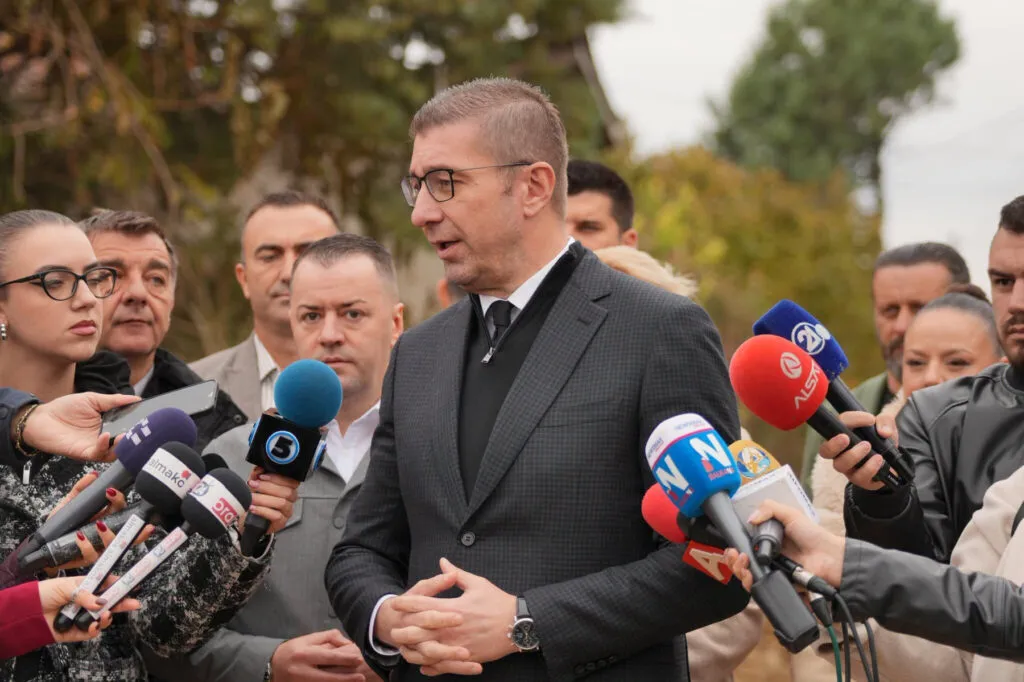
Hristijan Mickoski came out with a number and an insult. The number is 1.5 percent, which is what, according to him, private pension funds yield instead of the promised 5 percent or so. The insult is "weak entrepreneurs". They were delivered at the opening of a sewage construction site in Jurumleri, and behind them stand around 3.5 billion euros in the savings of more than 640,000 citizens.
"You can't do it lying down: either there'll be work, they'll roll up their sleeves, or things can't go on functioning the way they have so far," the prime minister said. The government, he says, is considering a hybrid solution in which citizens would decide for themselves whether to pay only into the state pension fund PIOM or into a private fund as well. He also mentioned two harder scenarios: full nationalisation of the second pillar, as in Hungary and Poland, and a temporary halt to contributions on a Scandinavian-Baltic model. There is no final decision, and a public debate has been announced.
Whose number is right?
That's where the problem starts. According to the official report of the Agency for Supervision of Fully Funded Pension Insurance (MAPAS) for 2024, the average annual nominal return of the mandatory funds from 2018 to 2024 was 5.03 percent. The agency's latest data, cited by the companies, shows an average annual return above 5.5 percent.
But the funds have nothing to celebrate either. The MAPAS report shows that the real return, after inflation, was only 0.16 percent. In other words, inflation ate almost the entire profit. So the prime minister is right that people are getting little, but he hasn't explained where his 1.5 percent comes from, for what period and for what kind of return. When there's no methodology behind a number, the number is an argument for a rally, not for a reform.
And the state?
Mickoski talks as if the second pillar were a private problem. The State Audit Office has a different story: transfers of contributions from PIOM to the private funds were on average two months late, and on 27 February 2026 some 2.59 billion denars, or around 42 million euros, was undistributed. Money that hasn't reached the accounts isn't invested and earns no return. How much of the "weak" return is the companies' fault, and how much the state counter's? That question has no answer for now.
Another important number is the one that explains why 3.5 billion euros looks so tempting. For the broader pension structure in 2026, according to PIOM director Nikola Memov, around 64 billion denars is needed from the budget, or more than one billion euros. The deficit is large, capital investment is being cut in the budget revision, and six percentage points of gross pay leave the reach of the state coffers every month.
Quick relief, long burden
Professor Dejan Trajkovski calculated the effect: moving around three billion euros from the private funds to the state fund would cover pensions without additional subsidies for roughly three years. After that the money's gone, and the obligation to future pensioners remains and grows. That's relief for today's government and a burden for the one after it.
Mickoski assures people that the money collected remains the property of the insured. The companies, for their part, point out that the money is personal property and can be inherited, and instead of abolition they want multi-funds and more room to invest. The MAPAS agency has not commented for now.
A choice for citizens sounds democratic. But a choice without a clear figure for returns, without an answer on what happens to the money already in the accounts and without an audit of PIOM's own delays is not freedom. Before the public debate the government should publish the methodology behind its 1.5 percent. If the number holds up, it'll hold up in the debate too.
The latest 10 news from this category
On paper the money looks tidy: a smaller deficit, more revenue, growth of 3.8 percent. The problem with budgets has...

The statistics say the economy grew last year. The tables also show what grew: concrete and shopping more than factories.

Most of the money left in twenty minutes, and the preparations took at least 36 hours. If the trail to...

Washington bought 10 percent of Intel and is now learning what being a shareholder means. Its data centres are up...

A firm of 1,200 lawyers is preparing to vote on its own shutdown, and a startup that only came out...

What was a fog of words 18 months ago is now a car purchase. Waymo's robotaxi is headed for Japan...

Изградбата на автопатот Кичево – Охрид започна во февруари 2014 година, а по 12 години и 8 месеци, проектот сè...

Македонија продолжува да се задолжува, а јавниот долг достигнува износи што отвораат сериозни прашања за долгорочната одржливост на државните финансии....

Tetovo leads with 22.5 million euros, and ten construction firms took a quarter of the total. Tender spending nearly doubled...
The Development Bank came out clean, small firms got a quarter of the money, and one in seven workers is...
This site uses cookies - is that okay? Learn more
Be the first to know when Metla launches something new
Leave your email and we will write when there is a new guide or something new on Metla.