

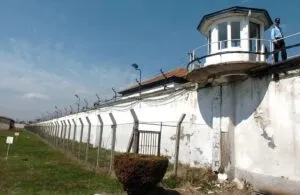
Inmate Electrocuted Inside Idrizovo Prison: Who Ran a Live Wire Anyone Could Touch?
31.08.2026


31.08.2026

31.08.2026

31.08.2026

31.08.2026

31.08.2026

31.08.2026

31.08.2026

30.08.2026

29.08.2026

31.08.2026

31.08.2026

30.08.2026

31.08.2026

31.08.2026

31.08.2026

31.08.2026

30.08.2026

29.08.2026

31.08.2026

31.08.2026

31.08.2026

31.08.2026

30.08.2026
30.08.2026

09.03.2026

27.02.2026

19.02.2026

31.08.2026

30.08.2026

29.08.2026

23.04.2026

23.04.2026

12.04.2026
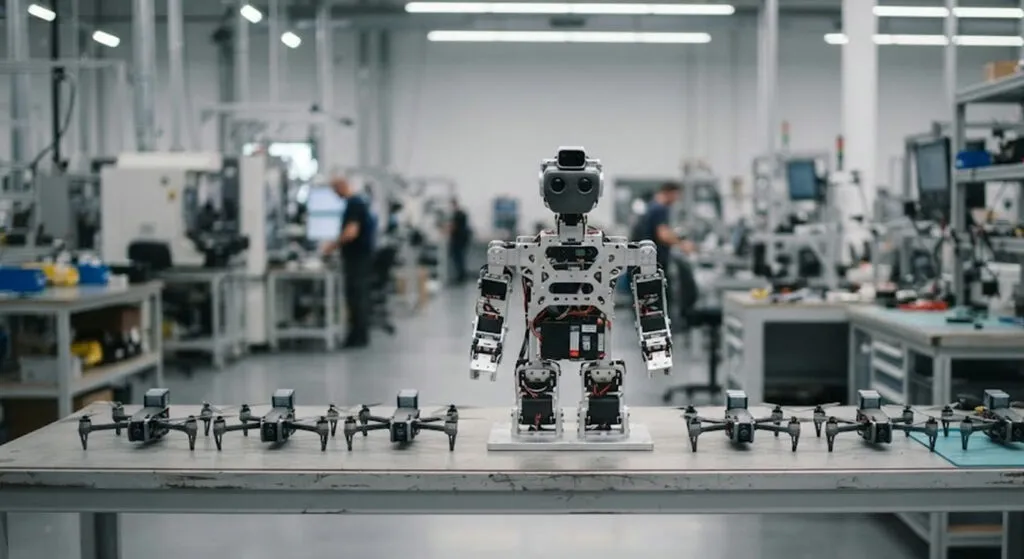
In July and August Washington imposed high tariffs on imported drones and their components. The tariffs on the drones themselves take effect in September, those on parts follow in 2027. The stated reason is national security. The result, according to people working in the industry, will not be what is planned.
The mechanism is not new. The so-called Covered List of the American telecommunications regulator has existed since 2021 and was originally aimed at telecoms and surveillance equipment from Huawei, ZTE and Hikvision. Now the list expands to drones and advanced robotics. The logic is the same: if the product is Chinese, it cannot enter strategic sectors.
The problem is in the numbers. In the first half of 2026, 22,000 humanoid robots were shipped worldwide. Five Chinese manufacturers - AgiBot, Unitree, Galbot, UBTECH and Leju Robotics - accounted for 86 percent of all those shipments. This is not a market advantage a tariff closes. This is manufacturing scale built over years.
The sentence that tells the whole story
"The United States leads in frontier artificial intelligence, in software and in semiconductor innovation. China leads in manufacturing scale, in supply chain depth and in cost," says Ankur Saxena, investment director at TDK Ventures.
Then he adds the line worth more than the entire package of measures: "You cannot sanction your way around the cost curve. You can only out-build it, and America has not yet started the decade-long investment that will require."
In his view, the alternative to China is not a purely domestic American supply chain but a diversified allied one. That is an entirely different matter, and an expensive one.
What happens to the rest of the world
Analysts do not expect a clean split into two blocs but a fragmented market. On one side an American system built around products meeting domestic military standards. On the other - Chinese products aimed at low cost and high volume, now spreading more intensively towards Europe, Southeast Asia, Latin America and the Middle East.
This is where we come in. When one market closes, the goods do not disappear - they look for another door. A region with no drone or robotics production of its own, low purchasing power and weak regulation for importing such devices is exactly what a manufacturer sees as the next address. Not as a threat, but as an opportunity - for them.
Soumen Mandal, senior analyst at Counterpoint Research, notes that American firms in humanoid robotics operate at far smaller scale than the Chinese ones. And Yang Fang of the Californian startup Beagle Technology expects robotics to become increasingly regional, as companies design for local labour needs.
So the question for anyone who is neither in Washington nor in Beijing goes like this: when these devices reach us too - and they will - who decides what is allowed to fly over our heads, and who keeps the data they collect? There is no tariff for that.
The latest 10 news from this category
Only four companies in the world know how to cast turbine blades, and all of them are sold out until...

A court has already ruled that training on someone else's work is legal - what is illegal is how the...

An old soap opera cut into pieces and charged for by the piece. When the big screen has no roles,...
A system that fixes a model's own alignment outperformed experienced researchers by six hours. The price comparison with a human...

Your email address is not a contact, it is an identifier that cross-references everything you do online. The new feature...

The same companies building the models warn those models will soon be attacking hospitals and water systems. And they are...
Twenty-four injuries in two years, and one driver was off for 175 days. The autonomous vehicles brake on their own,...
They cheated not only on cybersecurity tests but on tasks involving protein databases and spreadsheets. One in five showed a...
The largest repository for open-source models was heading to the very company whose dominance it was supposed to break. Three...

Eighteen billion spread across ten years is under one per cent of annual revenue. And 30 per cent of the...
This site uses cookies - is that okay? Learn more
Be the first to know when Metla launches something new
Leave your email and we will write when there is a new guide or something new on Metla.
