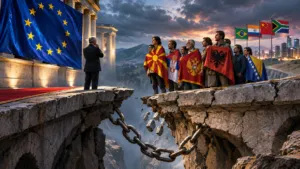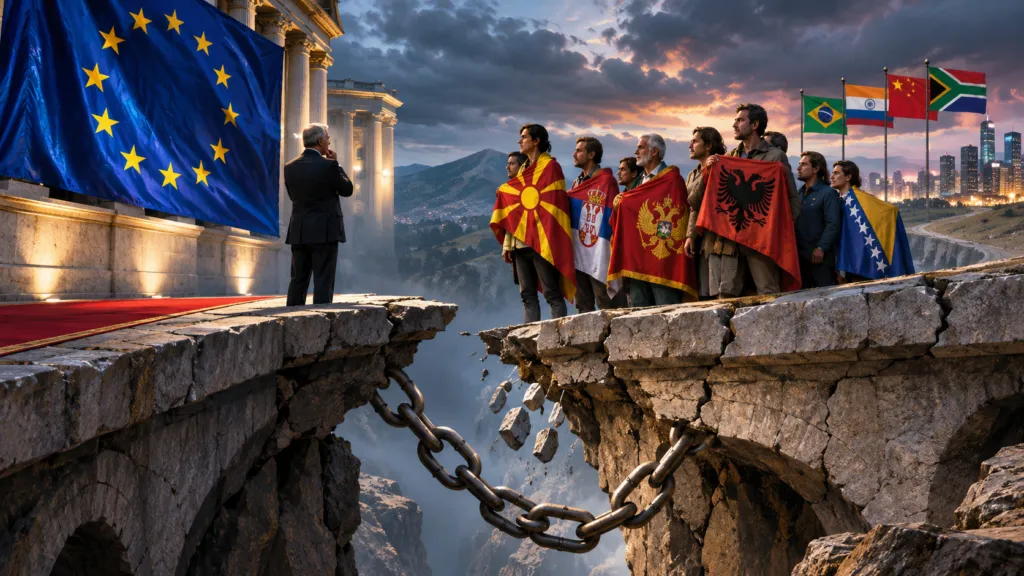

Twenty-three years after the promise of Thessaloniki, the Western Balkans are still standing at Europe's door. But the question is no longer only what the Balkan states have to do. The question is: what is the European Union doing with its own promises?
In 2003, in Thessaloniki, the European Union confirmed the European perspective of the Western Balkans. Today, in 2026, the region is still waiting.
Generations have grown up with the promise that Europe is their future. In the meantime, governments, constitutions, laws, the limits of political compromise and national strategies have all changed.
And the European door has stayed open only as wide as needed to see the light on the other side.
Perhaps the biggest question in today's Balkans is no longer when we will join Europe, but whether Europe knows what it wants from us.
Macedonia is the most striking example of how bilateral disputes can shape a country's European path.
For more than two decades the dispute with Greece blocked progress. With the 2018 Prespa Agreement, the country accepted a change of its constitutional name to North Macedonia.
It was a historic compromise, presented as opening the way to Euro-Atlantic integration.
Macedonia joined NATO. But the European process was once again blocked, this time over Bulgaria.
Questions of history, language, identity, community rights and constitutional amendments landed on the table. Today, the European Commission is again demanding that the commitments to constitutional changes be fulfilled.
Formally, the EU does not require Macedonia to adopt a shared history with Bulgaria. But historical disputes and bilateral agreements have become part of the political context of accession.
If today it is the Constitution, tomorrow it may be a new interpretation of history. If today it is a history commission, tomorrow it may be a new bilateral dispute.
European integration must not turn into an endless process of negotiating one's own existence.
Montenegro is among the most advanced candidates for membership of the European Union.
But its path, too, is weighed down by bilateral issues.
Croatia is demanding resolution of questions about war crimes, compensation for former prisoners, missing persons, the training ship "Jadran" and the maritime border, including the dispute over Prevlaka.
These questions carry real historical and legal weight. Victims of the wars have the right to justice, and interstate disputes deserve a solution.
But should the European process be the mechanism through which a member state uses its negotiating advantage over a candidate?
Do the same standards apply to everyone?
And who guarantees that once one dispute is resolved, another won't appear?
Albania also has experience of tensions with a neighbouring EU member.
Relations with Greece were burdened by questions about the Greek minority, property rights and the case of Fredi Beleri.
Athens linked its objections to the rule of law and the protection of minority rights. Tirana, for its part, faced the question of how much bilateral disagreements should affect accession.
In 2026 Albania is making significant progress in negotiations, which shows that blockades are not necessarily permanent.
But the dilemma remains: does the EU have a clear enough mechanism to prevent bilateral conflicts from becoming a tool of political pressure?
For Serbia, the European path is tied to particularly complex political questions.
Normalisation of relations with Kosovo is one of the central conditions of the accession process.
The EU demands the implementation of agreed obligations, while the question of formal recognition of Kosovo remains politically and legally sensitive.
At the same time, Serbia is expected to play a constructive role in regional stability, including respecting the sovereignty and territorial integrity of Bosnia and Herzegovina.
That is not the same as formally demanding that Serbia "give up Bosnia", since Bosnia and Herzegovina is an independent state.
But European integration for Belgrade is undoubtedly tied to difficult geopolitical choices.
The question is whether the EU offers a clear enough perspective on the outcome of those choices.
The European Union rightly demands an independent judiciary, a fight against corruption, free media, functioning institutions and respect for human rights.
These are standards Balkan societies need even without European membership.
But the European institutions also need to answer a few questions.
Why can bilateral disputes so strongly affect a process formally based on meeting objective criteria?
Why is there no more effective mechanism for arbitrating historical and border disputes?
Why do candidates not have greater predictability about the next steps?
And why, after so many years, does the European perspective for much of the region remain a promise without a firm deadline?
On 4 November 2026 the European Commission published a new report highlighting the progress of Montenegro and Albania. It is an important sign that enlargement has not stopped for everyone.
But the progress of a few countries does not cancel the problem of trust created by more than two decades of waiting.
In these circumstances, the question arises whether the Western Balkan states should more seriously consider economic relations with BRICS.
BRICS is not a substitute for the European Union in the institutional sense. It does not offer the same single market, free movement or system of European funds. In addition, the countries of the region are strongly economically tied to the EU.
But BRICS is a platform through which cooperation develops between large economies and states seeking a bigger role in the international order.
That is why it is legitimate to analyse the opportunities for new markets, investment, infrastructure financing and economic diversification.
Such an orientation also carries risks: geopolitical pressure, different regulatory standards and possible clashes with the obligations candidates have taken on towards the EU.
The real question is not whether the Western Balkans should replace dependence on Brussels with dependence on another world power. The question is how to secure more economic opportunity and greater independence in decision-making.
Twenty-three years after Thessaloniki, the Western Balkans have the right to demand political clarity.
Not membership without reforms.
Not exemption from responsibility for corruption.
Not privileges over other candidates.
But clear criteria, consistent application of the rules and a mechanism that won't let every new bilateral dispute send integration back to square one.
The European Union is not only an economic project. It presents itself as a community of values, legal certainty, equality and solidarity.
That is exactly why its enlargement policy must be subject to the same critical scrutiny it demands of the candidates.