34 fires in 24 hours: three still burning, and the warnings put out nothing
09.09.2026


09.09.2026

09.09.2026

09.09.2026

09.09.2026

09.09.2026

09.09.2026

09.09.2026

08.09.2026

07.09.2026

09.09.2026

08.09.2026

08.09.2026

08.09.2026

08.09.2026

08.09.2026

08.09.2026

07.09.2026

06.09.2026

09.09.2026

09.09.2026

09.09.2026

09.09.2026

09.09.2026
08.09.2026

09.03.2026

27.02.2026

19.02.2026

23.04.2026

23.04.2026

12.04.2026

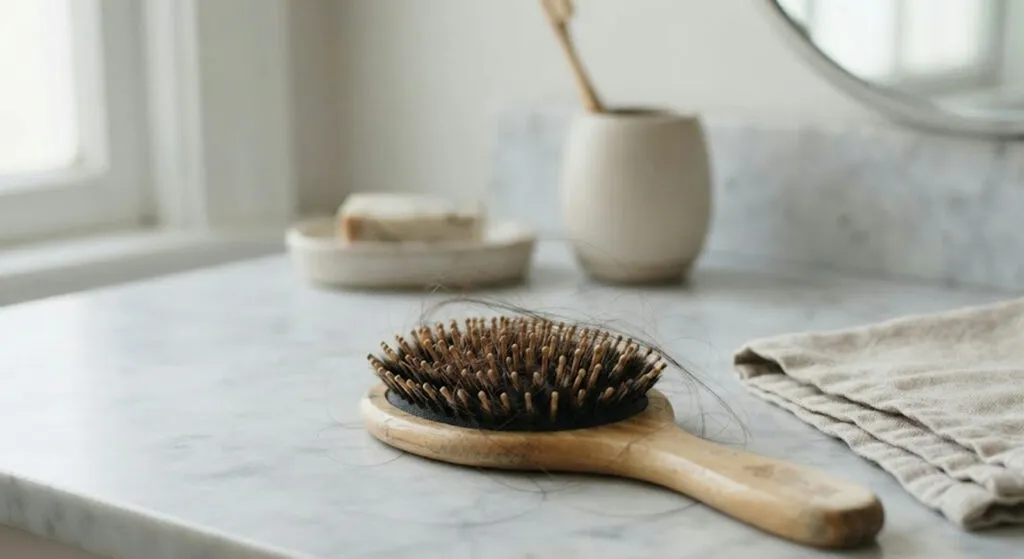
If more hair than usual is coming out on your brush in September, the cause is not September. Dermatologist Javier Pedraz gives the sentence that changes the whole calculation: "Intense hair loss in August or September usually reflects a stress factor that occurred between May and July."
The difference is in the delay. The hair does not react immediately - two to three months pass between the event and the consequence. That means what you are now seeing in the drain is a bill from spring.
Three phases, three numbers
Hair does not grow continuously. The anagen phase is growth and lasts several years - it holds around 90 percent of the hair. Catagen is transition and lasts two to three weeks, with around 3 percent. Telogen is a resting phase of around three months before the hair falls, and it holds 6 to 8 percent.
Those percentages are why the shedding looks dramatic even when it is not. When stress pushes a larger share of the hair into the telogen phase at once, all of those hairs fall together - three months later, in the same week.
Summer takes its share
Dr Walker of Hospital Capilar adds the sun element: "After the summer, telogen effluvium can appear because of exposure to sun and ultraviolet radiation, which causes inflammation, more free radicals and systemic oxidative stress."
But UV is not the only one. The list is longer than shampoo adverts ever mention: psychological stress, fever or illness, surgery, a thyroid problem, hormonal changes after childbirth or after stopping contraception, poor nutrition - a lack of protein, zinc, copper, iron, vitamins - and certain medicines, among them anticoagulants and beta blockers.
What actually helps
First the conservative part: enough protein and micronutrients, no crash dieting, less heat and chemistry on the hair. Then the professional part - biostimulation with micro-injections and regenerative procedures using your own plasma.
And the line at which it is no longer seasonal. If intense shedding lasts longer than two to three months, if you notice density loss in a specific spot, if your parting is widening or bare patches are appearing - that is not August, that is a question for a trichologist.
The shelf of products offered to you in September is built on the fact that people are frightened precisely now. Not one of them can change what happened to you in May - and that is exactly what you are looking at.
The latest 10 news from this category

The midi skirt is that rare piece that changes only the top half, not the whole wardrobe. From black lace...
Melanoma does not have to appear on an existing mole. A dermatologist lists the five areas almost nobody checks -...

Isabel Getty could have bought anything and chose a dress that looks modest in a photograph. Here a wedding works...

It is not a question of taste but of what each is allowed. For one the dress is a choice,...

The fix does not require a new makeup bag. It is a sequence, not a purchase.

Wedding bands are bought, and that does not change. Everything else on the bride is suddenly an open question.

A firm base, a dark colour, a zip and one internal pocket. That is not luxury, it is construction -...

Butterfly, wolf cut, micro bob - and half the list is not a cut at all but a way of...

The photographer is already paid, and the guest with the phone steps in front of the lens at exactly the...

The list has nothing to do with trends. A 135-euro bag satisfies all of it - so what exactly is...
This site uses cookies - is that okay? Learn more
Be the first to know when Metla launches something new
Leave your email and we will write when there is a new guide or something new on Metla.