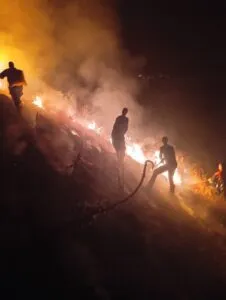
Twenty Fires in One Day, and the Blaze at Bogomila Was Stopped by Villagers and Veles Firefighters
15.08.2026


15.08.2026

15.08.2026

15.08.2026

15.08.2026

15.08.2026

15.08.2026
15.08.2026

14.08.2026
14.08.2026

15.08.2026

15.08.2026

14.08.2026
15.08.2026

15.08.2026

15.08.2026

15.08.2026

14.08.2026
13.08.2026

15.08.2026

15.08.2026

15.08.2026

09.03.2026

27.02.2026

19.02.2026

15.08.2026

14.08.2026

13.08.2026

23.04.2026

23.04.2026

12.04.2026

The palace in Amman issued a statement of four sentences. Princess Iman gave birth to two girls on 14 August, and their names have still not been released. For a royal house that has spent decades practising how to say very little, this counts as talkative.
The Hashemite court's statement is written in language you cannot extract anything from: "The Hashemite Royal Court is pleased to announce that Her Royal Highness Princess Iman bint Abdullah II and Mr Jameel Alexander Thermiotis have been blessed, on 14 August 2026, with the birth of two baby girls." No photograph, no weights, no hospital. Anyone wanting details will be waiting.
With this, King Abdullah II and Queen Rania gain a third and fourth grandchild at once. Princess Iman's first child, Amina, was born in February 2025, and before that Crown Prince Hussein and Princess Rajwa made them grandparents for the first time. Rania announced the pregnancy in early July with a line that sounds like a mother wrote it, not a palace official: "The grandkid club is expanding."
A husband the palace does not hide, but does not promote either
Iman married Jameel Alexander Thermiotis in 2023, at a ceremony the palace kept small. He works in finance in New York, has a degree in business administration and trade from Florida International University, his father is a Venezuelan businessman, his mother an artist. No title, no dynasty behind him. In a royal house that married strategically for generations, that is more interesting than the wedding itself.
Iman studied at the International Academy in Amman and read sociology at Georgetown. She appears at family events and that is where it ends - no foundation of her own, no campaigns, no Instagram account that has to produce content every month. At a time when Europe's royal houses fight for relevance through documentaries and podcasts, the Jordanian dynasty plays a different game: it appears rarely, speaks briefly and explains nothing.
Whether that discipline is strength or simply well-concealed insularity is a question a four-sentence statement will not answer. But it works. Unlike courts where every divorce plays out on front pages for months, in Amman the news arrives when the palace decides, in the form the palace has chosen. There is nothing else.
The latest 10 news from this category

A cinema, fairground rides and animals on one estate, and access had to be earned with homework. Her line about...

Дневен хороскоп - 15.08.2026
The Qatari and Dubai dynasties watched the eclipse from the same Spanish island where Felipe VI also stayed. No statement...

A third generation with the same name in the house behind Gucci and Balenciaga. All of it came out only...
Clement learned his father's name at sixteen and stayed silent for four years. The girlfriend waiting on the other side...
Every brand on the planet would have paid to be in that frame. They chose a civil ceremony, five children...
For years Sverre Magnus was treated as an ordinary Norwegian with no duties. Then everything fell apart, and Oslo copied...
This site uses cookies - is that okay? Learn more
Be the first to know when Metla launches something new
Leave your email and we will write when there is a new guide or something new on Metla.