

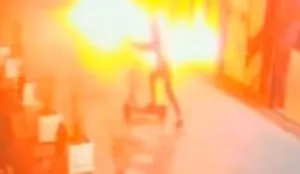
They Rode In on Scooters, Torched the Shops and Left: The Fire in Shuto Orizari Burned for Three Hours, Setting It Took Fifty Seconds
13.09.2026


13.09.2026

13.09.2026

13.09.2026

13.09.2026

13.09.2026

13.09.2026
13.09.2026

12.09.2026

11.09.2026

13.09.2026

13.09.2026

12.09.2026

13.09.2026

13.09.2026

13.09.2026
13.09.2026

12.09.2026

11.09.2026

13.09.2026

13.09.2026

13.09.2026
13.09.2026

13.09.2026

12.09.2026

09.03.2026

27.02.2026

19.02.2026

13.09.2026

12.09.2026

11.09.2026

23.04.2026

23.04.2026

12.04.2026


From tomorrow, Washington and Belgrade sit down at the same table under the heading "strategic dialogue". The State Department announced it as the start of a new era in relations between the two countries, with the first session held in Washington.
The wording in the American statement is carefully measured: the dialogue "reflects a new era in relations between the US and Serbia" and is "a sign of both countries' commitment to broadening and deepening the partnership". When diplomacy talks like this, it usually means something concrete was agreed behind closed doors, and the public gets the front page.
The decision isn't new. US Secretary of State Marco Rubio announced back on 6 August last year that the US would hold a first strategic dialogue with Serbia. So the preparation took nearly a full year - which tells you this isn't improvisation, but a process somebody built patiently.
Foreign Minister Marko Đurić put it in his own frame: "For the first time in history, Serbia and the United States of America are raising relations to the level of a strategic partnership," he said. Đurić added that the decision was taken in Washington and represents "a strong political signal" not only for Serbia, but for the American public and institutions as well.
Đurić also thanked President Aleksandar Vučić for backing the process. "President Vučić has for years supported our efforts to improve relations with the US," the minister said. The question the statement doesn't answer is a different one: what exactly is expected from Belgrade in return? Strategic partnerships are rarely gifts.
According to the announcement, the two sides will use the dialogue to work on shared goals - regional peace and stability, expanded business and educational ties, a more prosperous future. It all reads beautifully on paper. But "regional peace and stability" in Washington's vocabulary for the Balkans has never been an abstract phrase - it always has an address.
When one country in the region gets its own channel to Washington, that shifts the balance for everyone else in the neighbourhood. Is this recognition of somebody's weight, or another attempt to rearrange the Balkans from capitals outside it? The answer, as usual, won't be found in the statements - but in what happens over the coming months.
The latest 10 news from this category
A third attempt in three years, but this time the signatures came from the government benches too. Six MPs from...
Four days before the Hague verdict, the square in Pristina told the court it should back down. Among the guests...

Nobody banned anything - the line item simply stopped paying for itself. That is the purest version of modern censorship,...

The stated reason is expensive production and weak commercial return. The timing is two months before an election. In Belgrade...

Zukan Helez asked the international community to withdraw its signature from the existence of Republika Srpska - then added that...
The government asked itself for elections, and packaged the reason as global instability. Serbia votes on 25 October - with...
Almost every German party condemned the Serbian government over the state send-off for Ratko Mladic. The one that did not...
The previous government recognised Palestine. The new one is opening an Israeli embassy. Between the two there is not a...
Serbia sent six ministers but not the leadership of the state - and then claimed these were not state honours....
Belgrade kept the last direct air link between Russia and Europe, and is now opening a route to an enclave...
This site uses cookies - is that okay? Learn more
Be the first to know when Metla launches something new
Leave your email and we will write when there is a new guide or something new on Metla.
