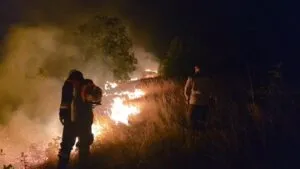
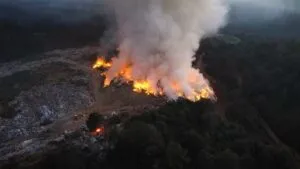
Five Fires Still Burning, at Čanište the Blaze Has Split Into Four Fronts: For the First Time This Summer, the Army Deploys Before the Disaster
21.08.2026


21.08.2026
21.08.2026

21.08.2026

21.08.2026

21.08.2026

21.08.2026

21.08.2026

20.08.2026

20.08.2026

21.08.2026

21.08.2026

20.08.2026

21.08.2026

21.08.2026

21.08.2026

21.08.2026

20.08.2026

19.08.2026

21.08.2026

21.08.2026

21.08.2026

21.08.2026

21.08.2026

21.08.2026

09.03.2026

27.02.2026

19.02.2026
21.08.2026
20.08.2026

19.08.2026

23.04.2026

23.04.2026

12.04.2026
When a name comes back from Africa and immediately turns up at a meeting with Vladimir Putin, that is not a personnel question. That is an announcement of tempo.
The name is General Sergei Surovikin, who commanded Russian forces in Ukraine during the previous phase of the war. His name stayed tied to a completely different way of running operations - tighter integration of air power, missile forces and ground units. In other words, a way that looked less like slow nibbling and more like a strike.
His return, and the alleged meeting with Putin, was assessed by retired American colonel Douglas Macgregor, a former adviser to the US defence secretary, in conversation with Professor Glenn Diesen. His thesis is that Moscow may be preparing for a far more brutal phase.
What is behind the combination
Macgregor ties three things together: possible changes at the top of the Russian military, the large forces Moscow still holds in reserve, and an assessment that the danger of direct European intervention in Ukraine is lower today than before. That combination, he argues, would let Russia abandon its slow and methodical advance and try to speed operations up significantly.
In parts of the Russian military and public space, information is circulating that the mandate of Chief of the General Staff Valery Gerasimov could end around mid-September. There is no official confirmation of such a decision, and that is worth repeating. Macgregor himself expresses serious reservations that Surovikin would be the one to succeed him - he thinks Moscow may choose a general from the ground forces. Gerasimov, in that same space, is associated with the slower and more methodical approach. If the top really is changing, it means that approach is no longer welcome.
Odesa, not Kharkiv
The analysis insists on one geographical priority: Kharkiv as a target can wait, Odesa cannot. Control of the Black Sea city would reshape the entire military, logistical and political picture of southern Ukraine and would mean a heavy blow to Kyiv's maritime position.
Except that an operation like that is not improvised. It requires enormous preparation - relocating air defence systems and building far greater capacity to supply operations at distance. That is not something you can hide. If preparation on that scale begins, it will be visible.
Why Poland is in this calculation
The most delicate part of the assessment is the claim that Russia increasingly doubts European NATO members would directly enter the conflict if Ukrainian lines gave way quickly. In that scenario Poland is central, because its territory would be the main base for equipment, supply and deploying units.
A clear head is needed here. This is the assessment of one retired American colonel, not an intelligence report and not an official position. Macgregor has for years held views that are sharply contested in Western military circles. But the assessment is worth hearing precisely for what it reveals - the logic in which an opponent is measured by whether someone will get involved, rather than by what is true.
Figures about Russian reservists in training and the presence of North Korean soldiers are also mentioned, moving through the analyses without independent confirmation. We pass them on as a claim, not as fact - the difference matters, because in this war a number is a weapon first and a data point second.
And the weather, literally
The end of the analysis is almost comic in how down to earth it is. September is named as a possible turning point, and the outcome depends partly on - the rain. If heavy rainfall does not turn the terrain into mud, Russian forces could run significantly more intense operations in that period.
Billions in equipment, generals returning from Africa, analysts measuring the intentions of entire continents - and in the end all of it runs into the question of whether the ground gets soaked. The Balkans know that lesson from their own history: a plan is only as good as the terrain allows.
The latest 10 news from this category
Zelensky said Russia attacked a crossing on the Moldovan border with drones. Three days earlier something had already exploded on...
A night missile strike on Kyiv and the surrounding region, warehouses and plants hit. The heaviest accusation did not come...
The front line is not moving, the negotiating table is empty, so what remains is striking deeper into the other...
Over 30,000 killed and wounded a month, a thousand new soldiers a day - and they only plug the holes....
Before the war it had almost 60 gigawatts. Today it has twelve. And if the strikes continue at the same...

A former defence minister said the number out loud. When a state spends resources finding the people it already mobilised,...
Drones and ballistic missiles on four residential districts of a European capital. The Balkans know this scene by heart -...
A refinery producing five percent of Russian refining capacity and a 173,000-square-metre logistics hub in flames. Above it all, transponder...
A Russian strike hit a drone exhibition near Kyiv. Moscow claims it hit a legitimate military target, Ukraine counts ten...
Three missiles, one intercepted, two got through. But beyond Russia, the question also under fire is who gathered people out...
This site uses cookies - is that okay? Learn more
Be the first to know when Metla launches something new
Leave your email and we will write when there is a new guide or something new on Metla.