Eye Surgeries Billed Twice, Up to 4,000 Patients Hit: The Violations Were Known, the Fines Never Came
30.10.2026


30.10.2026
30.10.2026
30.10.2026

30.10.2026
30.10.2026
30.10.2026
30.10.2026
29.10.2026

29.10.2026

30.10.2026

30.10.2026

29.10.2026
30.10.2026
30.10.2026

30.10.2026
30.10.2026
29.10.2026

28.10.2026
30.10.2026

30.10.2026

30.10.2026
30.10.2026
30.10.2026

30.10.2026
30.10.2026
29.10.2026
28.10.2026

23.04.2026

23.04.2026

12.04.2026

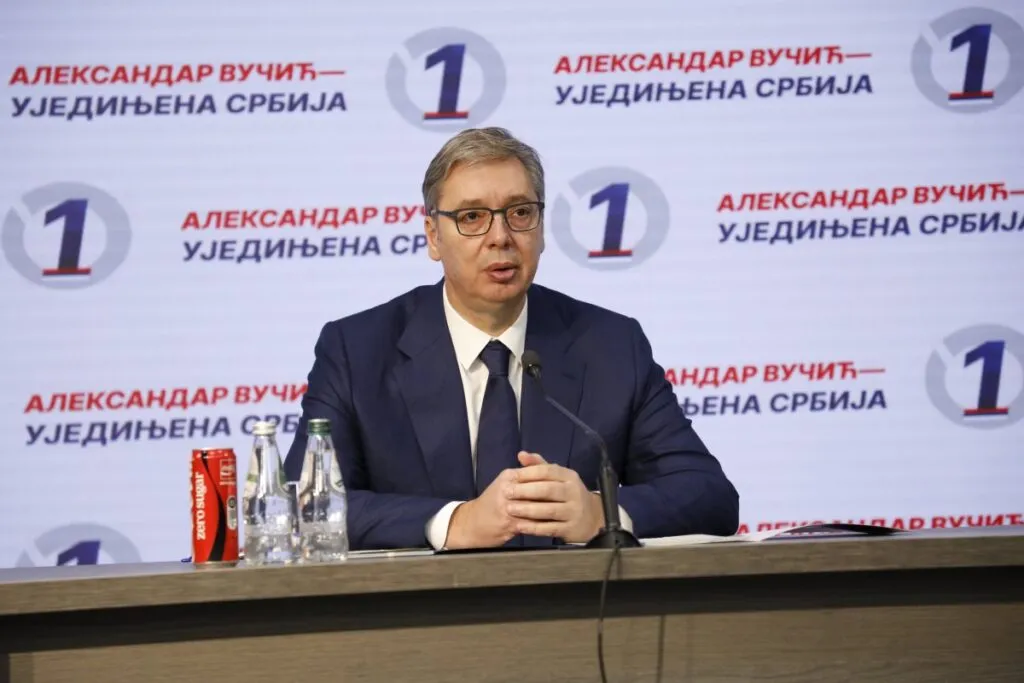
On Sunday, 25 October, at 9:30 p.m., Aleksandar Vučić admitted what for a long time seemed unthinkable: defeat. The student list won Serbia's snap parliamentary election, and the man whose party has been in power since 2012 congratulated his opponents. Four days later, speaking from the offices of the Serbian Progressive Party (SNS), he addressed the country as leader of the opposition - and the tone was no longer congratulatory.
"Over the past 72 hours, instead, we are witnessing naked, genuine revolutionary terror, just as they announced," Vučić said. Responsible, serious people, he says, would have got down to the work they ran for after winning. Instead, according to him, Serbia is watching raids and brawls.
What Vučić claims
The list of accusations is long. According to him, on the feast of St. Petka a group of people burst into family patron-saint celebrations at four locations in Serbia and interrupted the priest mid-prayer - something that, he says, hadn't happened "since 1945". In Lazarevac, Rakovica, Zemun and other municipalities, he claims, there were beatings and "liberating" raids on municipal buildings. He devoted the most time to the raid on the newsroom of Informer TV, where, he says, people demanded a public apology from editor-in-chief Dragan J. Vučićević under threat.
He also mentioned Professor Radivoje Stojković, who was arrested and held for 48 hours, with prosecutors seeking detention. The reason, according to Vučić, is that he didn't reinstate the wife of former provincial official Čanak at work, despite a court ruling. "He didn't steal money, didn't hit or kill anyone," Vučić said. And then came the line that will be quoted the most: "When a clown moves into a palace, he doesn't become a king - the palace becomes a circus."
The media - the first battlefield
Vučić claims that in all his years in power he "didn't shut down a single TV station", and said he would ask "both the Europeans and everyone else" not to let any station be closed. The irony is hard to miss. For years his critics, in Serbia and in the European institutions, accused his system of keeping the media on a short leash. Now Vučić is complaining to Brussels about freedom of speech.
And on the ground, things are moving fast. At its session, the Regulatory Authority for Electronic Media (REM) unanimously opened proceedings against Informer and summoned its representatives to the next session, and by majority vote launched an inquiry into TV Prva as well. Vučić also claims that the director-general of public broadcaster RTS, Manja Grčić, and Bojana Mlađenović resigned under pressure. Is this cleaning up the system - or just changing who holds the remote?
Support for Informer came from Vienna. Harald Vilimsky, head of the delegation of the far-right Freedom Party of Austria (FPÖ) in the European Parliament and vice-president of "Patriots for Europe", wrote that shutting down Informer TV would be "a dangerous precedent" and condemned the violent attack on the newsroom. A TV station that spent years close to the government is now being defended by Austria's hard right.
What comes next
Vučić reminded the winners that 104 opposition MPs will sit in parliament, all elected from one list, and drew a parallel with 2000: "We defeated that evil, and we will defeat this evil too. It will be hard, don't think it will be over quickly." Over the next three days, the SNS is convening its executive board, presidency and main board, and within a month a party congress will elect new leadership.
For the first time in more than a decade, Serbia is changing its government at the ballot box, and that is news in itself. But the first week reveals an old Balkan habit: a change of power begins with a fight over the microphones. If the winners want to prove they're different, they'll have to show that freedom of speech also applies to those who don't like them. And Vučić, if he wants anyone to believe him, will have to explain why we're only hearing this concern for the media now.
The latest 10 news from this category
A Chinook carrying 15 people went down over Gorice near Brčko, killing four. Three decades after Dayton, peace in Bosnia...
The student list leads by more than 582,000 votes, and 24,438 voters will cast ballots in the rerun - the...
They don't have a candidate for prime minister, and to the Russia question they answer with "dialogue with citizens". Skopje...
A Novi Sad professor said out loud what has been true on the ground for 27 years, and media close...
Witnesses claim: 4,000 police officers, groups in black and street lights switched off - and then, at 21:30, a retreat....
During the campaign he was shown in a positive light 96 percent of the time - and still lost. Now...
The new government in Belgrade hasn't even been formed yet, and Brussels has already set the terms: sanctions on Moscow...
Tabloids close to Vučić claim she announced the recognition of Kosovo. Biserko herself says she doesn't know what the new...
Serbia is on red terror alert after the overnight attack. Minister Dačić says the attacker was an Islamic State supporter...
Victory in Serbia came from a single goal - bringing Vučić down. But among the 140 MPs sit people who...
This site uses cookies - is that okay? Learn more
Be the first to know when Metla launches something new
Leave your email and we will write when there is a new guide or something new on Metla.