
A Loan-Shark Gang in Kumanovo Ran for Five Years - and Only Fell When One Citizen Found the Courage to Report It
06.11.2026


06.11.2026

06.11.2026

06.11.2026

06.11.2026

06.11.2026

06.11.2026

06.11.2026
05.11.2026

05.11.2026

06.11.2026

06.11.2026

05.11.2026

06.11.2026

06.11.2026

06.11.2026

06.11.2026

05.11.2026

04.11.2026

06.11.2026

06.11.2026

06.11.2026

06.11.2026

05.11.2026
05.11.2026

06.11.2026

05.11.2026

04.11.2026

23.04.2026

23.04.2026

12.04.2026

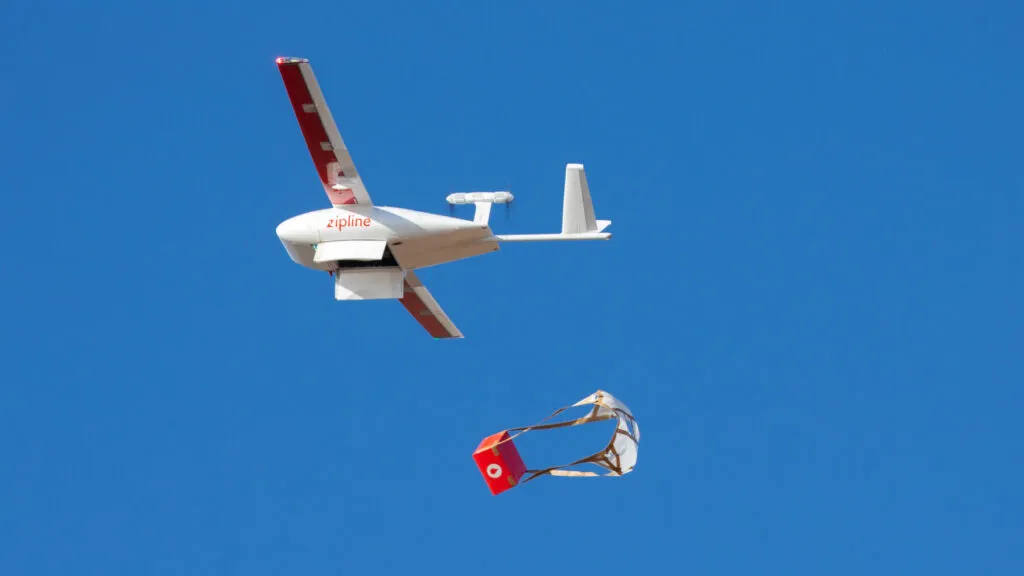
The startup that started out delivering blood to hospitals in Rwanda is now worth 21.5 billion dollars (around 18.7 billion euros). Zipline has raised 1.5 billion dollars (around 1.3 billion euros) in fresh money and at the same time signed a new multi-year deal with Walmart: 300 new drone delivery sites across the US. Today the two companies have 21 active sites between them.
The round is led by Paradigm, WCM Investment Management and Layer Global, joined by Valor Equity Partners, Fidelity, Uber, Tiger Global, J.P. Morgan, ARK Invest and Salesforce Ventures. When a Wall Street bank and the ride-hailing company Uber sit in the same round, the whole list is really betting that the sky above American suburbs will become yet another logistics network.
The road here is longer than it looks. Zipline was founded in 2014 and first flew in Rwanda, carrying blood, then in Ghana and Nigeria. In the US it started in 2020 with medical supplies for Novant Health in North Carolina, and it signed with Walmart a year later. The real breakthrough came in 2022, when it got approval from the US aviation authority FAA for commercial long-distance flights.
Today the drones carry food, store goods, agricultural and health products in five African countries, several American cities and Japan. Home delivery uses Platform 2, which carries up to 3.6 kilograms over a distance of up to about 16 kilometres. The bigger Platform 1 flies up to about 190 kilometres round trip and is intended for businesses and government institutions.
The money will go into expanding production in the US and new hiring for a nationwide network. The company says its share of delivery revenue rose from 10.8 to 34.9 percent between March and October. A nice number, released on the very day the money is being raised, with no explanation of which market exactly that share is of.
The irony is obvious: the technology was built for places where the road to a hospital is long and uncertain, and now big money is taking it to American suburbs, to the doors of Walmart shoppers. Will drones carrying blood and medicine ever reach mountain villages in the Balkans, or will they stay a luxury for supermarket orders?
The latest 10 news from this category

The tool anyone could use to make a poster or a presentation now has a competitor in every chatbot. The...

Three Stanford classmates are selling the idea that AI can build up experience like an employee. Nvidia is both investor...

It had an independent privacy audit and money from Khosla Ventures, but not the capital for the race with Muse...
The National Bank says the license pulled in Belgrade doesn't automatically mean anything for Bitola. Legally, that's true. But the...
Profit is slightly down on last year but above plan. The biggest interest growth comes from the state, and fees...
The model learned from building permits across America and promises buildings that stand. What remains is the question everyone in...

A firm of 1,200 lawyers is preparing to vote on its own shutdown, and a startup that only came out...

Изградбата на автопатот Кичево – Охрид започна во февруари 2014 година, а по 12 години и 8 месеци, проектот сè...
Restaurant delivery and grocery delivery end up in the same hands. There's a year and a half until the deal...

The four-year-old firm rejected a takeover bid because it didn't top its valuation, then raised fresh money. The bet is...
This site uses cookies - is that okay? Learn more
Be the first to know when Metla launches something new
Leave your email and we'll write to you when there's a new guide or something new on Metla.