
A cocked pistol on the road near Krushopek: the line between a police bulletin and a funeral was held by somebody else's nerve
07.08.2026


07.08.2026

07.08.2026

07.08.2026

07.08.2026

07.08.2026

07.08.2026

07.08.2026

06.08.2026

06.08.2026

07.08.2026

07.08.2026

06.08.2026

07.08.2026

07.08.2026

07.08.2026

07.08.2026

06.08.2026

05.08.2026

07.08.2026

07.08.2026

07.08.2026

07.08.2026

07.08.2026

07.08.2026

09.03.2026

27.02.2026

19.02.2026
07.08.2026

06.08.2026

05.08.2026

23.04.2026

23.04.2026

12.04.2026
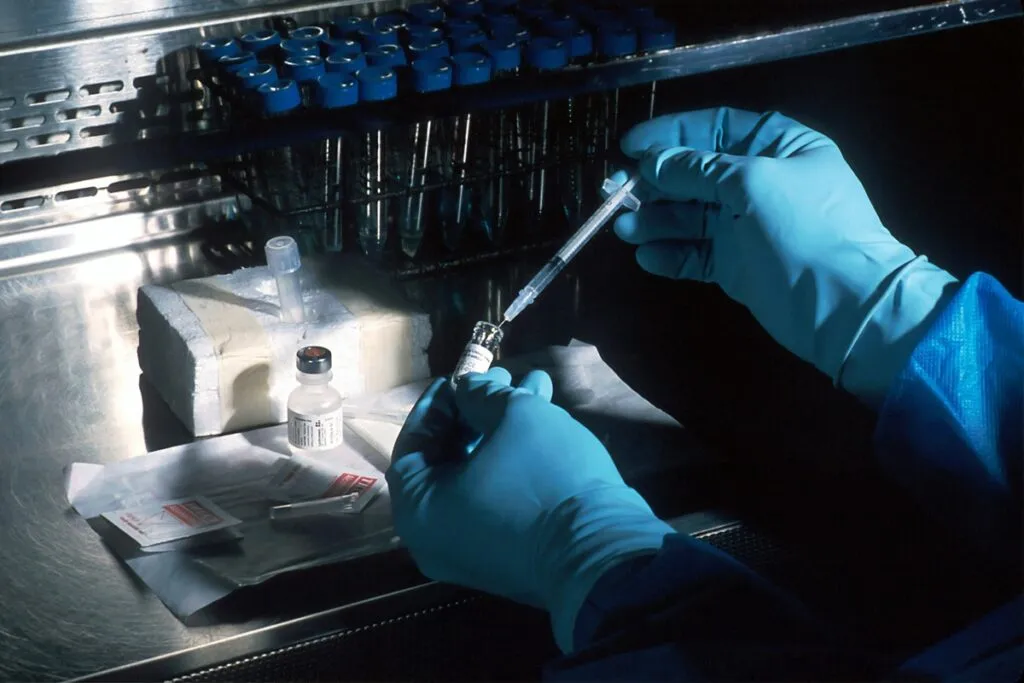
American scientists have used artificial intelligence to create entirely new, functional viruses that replicate under laboratory conditions. This is the first time AI has designed complete genomes - not fragments, not variations on something existing, but complete instructions for life.
Sixteen new viruses were created that attack bacteria exclusively and are not dangerous to humans. The achievement has been described as a scientific turning point that could open up new avenues of treatment. At the same time, experts warn that algorithm-designed viruses raise urgent biosecurity questions.
The language of life
The technology works much like large language models. Except that the models, called Evo1 and Evo2, don't predict words but what scientists call the "language of life". They were trained on vast collections of genetic code from viruses, bacteria, plants and humans, then fine-tuned to generate bacteriophages - viruses that attack only certain bacteria.
The numbers show the distance between an idea and a result. Of the 302 most promising designs synthesised in the lab, only 16 managed to destroy the E. coli bacterium. Doctoral student Samuel King described spotting the first signs in the early hours of the morning: "We started noticing clear clean spots and we were incredibly excited."
Where the line is and who guards it
Brian Hie of Stanford University said this is "a big step in the complexity of what generative artificial intelligence can design". On the other side, in a commentary in the journal Science, Dr Thomas Inglesby and Dr Moritz Hanke of the Johns Hopkins Center for Health Security wrote that the findings raise "urgent biosecurity questions". The question, they say, is no longer whether generative design of viral genomes exists, but whether it can be used without "serious harm".
The safeguards exist and are concrete: the training databases were purged of viruses attacking complex organisms, the work used phages rather than viruses dangerous to humans, and the research took place in tightly secured laboratories. Hie argues the existing measures are sufficient. The question that remains isn't whether his laboratory is safe - it's whether the next one to repeat this will be.
From bits to atoms
Viruses aren't considered living beings, so creating an actual living organism would require another scientific leap. The difference is one of scale: the genetic code of a phage runs to about 5,400 base pairs, the smallest living cell about 500,000, and the human genome three billion. Hie says an attempt to create a simple organism "would probably require significant effort, but it isn't impossible", and that this direction interests them.
Professor Marc Güell of the synthetic biology laboratory at Spain's Pompeu Fabra University called the study "a very significant turning point", because "for the first time in history we are beginning to design biology on a computer". Professor Patrick Cai of the biotechnology institute in Manchester added that the significance goes beyond phages: the models are learning design principles built in by evolution itself.
Some will read this as a promise of drugs against antibiotic-resistant bacteria. Others will read it as an instruction manual. Technology doesn't choose how it gets read - laboratories, regulations and states do. And the regulation, as usual, will arrive after everyone has already learned how it's done.
The latest 10 news from this category

The American plan calls for disarmament and withdrawal. Both sides agree on the steps - and disagree entirely on who...

Not over the Donbas, but at one of Europe's largest cargo airports. This time the difference between an incident and...

Thirteen settlements are already on the strictest regime, and the Paks nuclear plant is being cooled with floating pumps. When...

The first reactor at Cernavoda is already shut down for lack of water. The minister calculated that blowing up the...

The Paris Agreement's 1.5-degree limit falls before 2030 if the pace holds. For the first time the acceleration is proven,...

Hungary was millimetres from closing Paks, Romania is blasting rocks in the riverbed to feed water to Cernavodă, and at...

Frontex says the border was never at risk, Madrid demands the checks be lifted immediately, and the barrier stays down...

Hypersonic Zircon missiles, a demagnetised hull and near-silent propulsion - the sixth of twelve planned. Russia has an interest in...

The same sea, the same week, three figures that differ eightfold. And Europe's first concrete move is Italy closing its...
Ghana, Senegal, Libya, Uganda... and Montenegro. The two Balkan countries knocking loudest on the EU's door are being considered as...
This site uses cookies - is that okay? Learn more
Be the first to know when Metla launches something new
Leave your email and we will write when there is a new guide or something new on Metla.