Six Years of Fake Licence Categories Issued From an Interior Ministry Desk: Six Charged, 21 More Under Investigation
21.09.2026


21.09.2026
21.09.2026

21.09.2026

21.09.2026

21.09.2026
21.09.2026

21.09.2026

20.09.2026

20.09.2026

21.09.2026

21.09.2026

20.09.2026

21.09.2026

21.09.2026

21.09.2026

21.09.2026

20.09.2026

19.09.2026

21.09.2026

21.09.2026

21.09.2026
21.09.2026
21.09.2026

21.09.2026

09.03.2026

27.02.2026

19.02.2026

21.09.2026

21.09.2026
20.09.2026

23.04.2026

23.04.2026

12.04.2026

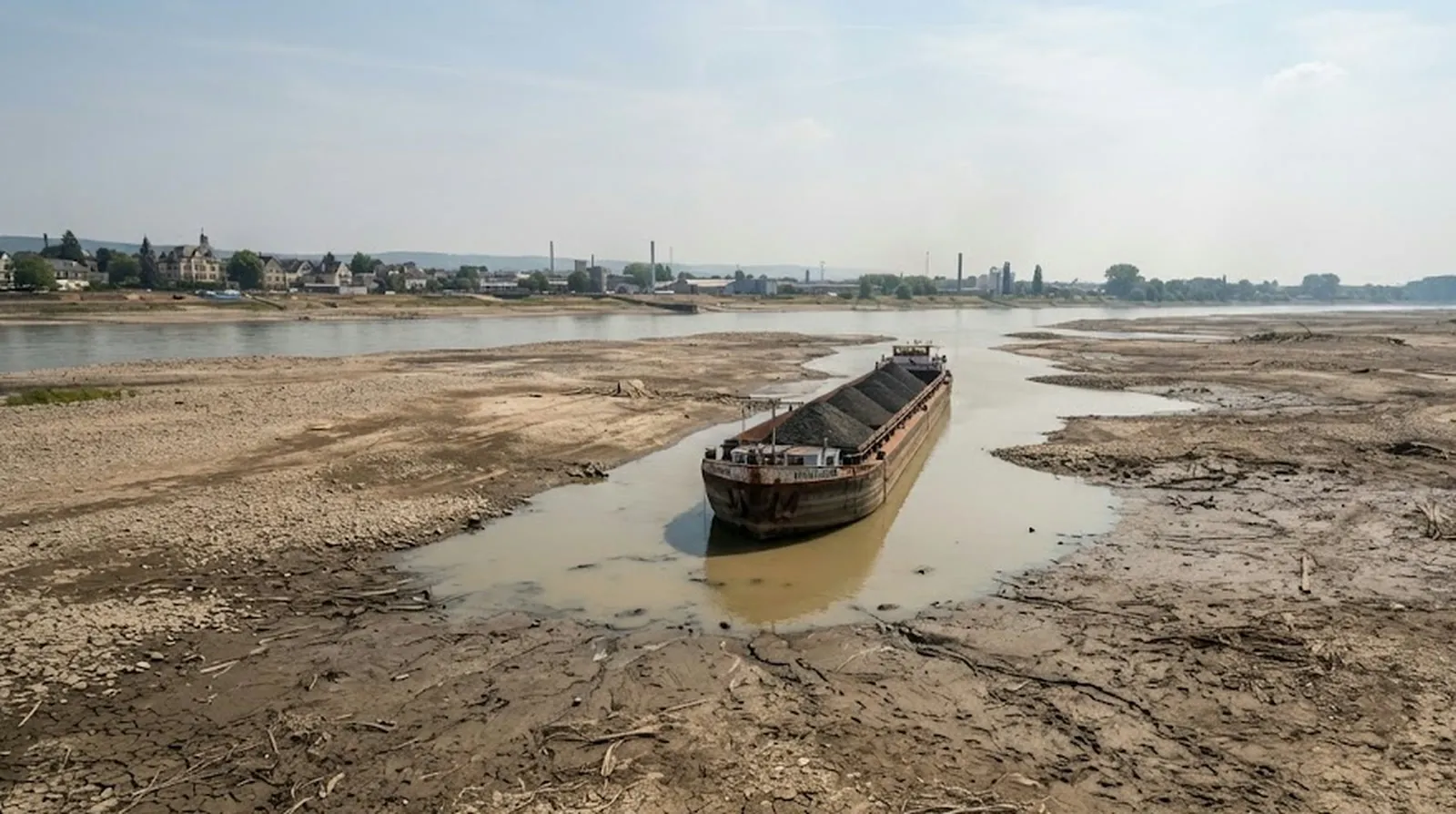
The Rhine at Kaub: 24 centimetres. That is what is left of the river that carries German industry. The lowest level since measurements began in 1880 - the lowest in roughly a century and a half, and forecasts say it could fall to seventeen by Saturday. The German transport minister called an emergency conference of experts in Bonn for Thursday, with participants still being confirmed. When a meeting gets scheduled faster than the guest list gets compiled, that is not planning. That is reaction.
And the Rhine is only the western end of the story.
The Danube is pulling water out of the reactors themselves
Hungary reached a controlled shutdown at the Paks nuclear plant for the first time in its history. Prime minister Péter Magyar said the country was millimetres away from closing the plant entirely, but the water level rose by a centimetre and a half overnight and the last turbine kept running. A centimetre and a half. That is the difference between a working nuclear plant and one standing still.
Romania, meanwhile, detonated rocks in the Danube riverbed and sank barges to channel water towards Cernavodă - the country's only nuclear plant. When a state starts blowing up its own river to let a power plant breathe, the vocabulary of the crisis changes. This is no longer a drought. This is an engineering intervention on geography.
And in our part of the basin - same river, same problem
At Bezdan, where the Danube enters Serbia, the reading was minus 139 centimetres - within a few centimetres of the lowest level recorded more than a hundred years ago, in 1909. Ships are sailing at twenty-five to thirty percent of capacity. Tugs with a two-metre draught simply cannot get through. The Romanian lock at Iron Gate 2 has been out of service since 17 July, so all transit goes through the Serbian one.
Hydrologists are not promising rescue. Over the next fifteen to twenty days, no significant rain is expected in Serbia or in the countries upstream.
The river is infrastructure, we just don't call it that
This is the part that gets missed most easily. The Danube and the Rhine are not scenery - they are roads. Fuels, coal, grain and raw materials travel along them, and more cheaply than by any other route. According to reports by financial agencies, the cost of shipping diesel from Rotterdam to Karlsruhe has reached its highest level in twenty years. When the river narrows, the freight does not disappear - it climbs onto trucks and trains, and somebody pays the difference.
There is not a single minister in Europe who voted for this. No budget approved it, no tender was rigged for it. The river simply receded, and every system built around the assumption that it would always be there - navigation, reactor cooling, transport prices - showed at the same moment how thin it is.
The question nobody is asking out loud
If Paks was saved by a centimetre and a half, what happens if two are missing next year? The nuclear plants on the Danube were designed on twentieth-century hydrological data. The river in 2026 does not behave like the river in those tables. Either the plan changes, or next time there will be no centimetre and a half to spare.
Europe has spent years talking about the energy transition as a choice between technologies. This week the river showed it there is a third variable, and that this one is not up for negotiation.
The latest 10 news from this category

Three options on the table in Washington - military pressure, economic strangulation or a deal - and the president frames...
The party of Adenauer and Kohl slid to the electoral threshold in Mecklenburg, the AfD is already demanding the chancellor's...
Two prime ministers in the same Union, the same month, completely opposite diagnoses of who is provoking whom. There is...
A broken aircraft in a field usually ends up in a police note. This one ended up with federal investigators,...
Beijing will easily find another supplier. The harder question is what Washington is actually testing: whether private Chinese companies will...
The law lets Washington hit the five biggest buyers of Russian oil with tariffs of up to 100 per cent....
Measures imposed over the war in Ukraine are now being offered as currency in an entirely different dispute. If the...

A smaller dose and more needles does not mean a safer vaccine, it means an ineffective one. Science has had...

Harald designed the sarcophagus himself, and it is shaped like a ship. The stone is 400 million years old and...

Von der Leyen proposed a status that does not exist in European law, the Canadians distanced themselves, and Washington announced...
This site uses cookies - is that okay? Learn more
Be the first to know when Metla launches something new
Leave your email and we will write when there is a new guide or something new on Metla.