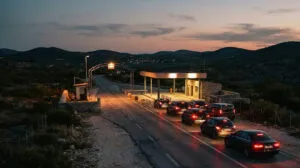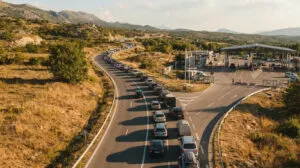
The Stone Dolls Had Their Own Toll Booth: Detention for the Woman Who Seized Kuklica
05.08.2026


05.08.2026

05.08.2026

05.08.2026

05.08.2026

04.08.2026

04.08.2026

05.08.2026

05.08.2026

04.08.2026

05.08.2026

05.08.2026

05.08.2026

05.08.2026

04.08.2026

03.08.2026

05.08.2026

05.08.2026

05.08.2026

05.08.2026

05.08.2026

05.08.2026

09.03.2026

27.02.2026

19.02.2026

05.08.2026

04.08.2026

03.08.2026

23.04.2026

23.04.2026

12.04.2026
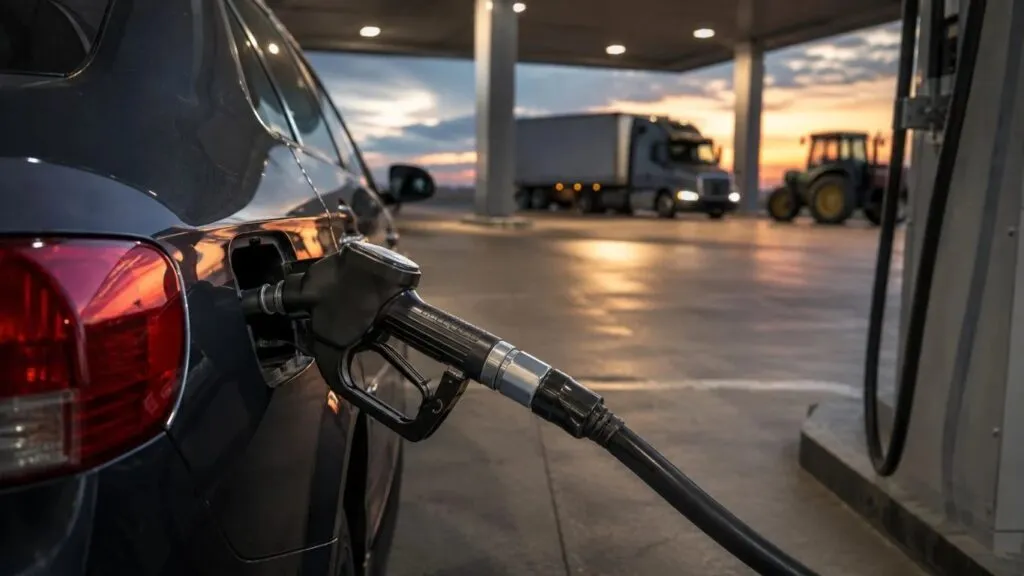
From midnight, diesel costs 99.50 denars per litre. Fifty deni below the three-digit mark. The Energy Regulatory Commission adopted a decision raising diesel by one denar, while both petrol grades fall by two denars each - EUROSUPER BS-95 is now 91 denars, and EUROSUPER BS-98 is 93 denars.
Formally, the average price of petroleum products is down 1.24 percent compared with the decision of 27 July. Formally, then, fuel is cheaper. In practice, for anyone driving diesel - and that is most of the freight and agricultural fleet in this country - the bill is once again higher.
Why petrol falls while diesel climbs
Reference prices on the world market diverged: petrol fell by 2.069 percent, while diesel jumped by 4.806 percent. The denar-to-dollar exchange rate rose by 0.1423 percent. The regulator applied a reduced excise of 2 denars per litre for petrol and 4 denars per litre for eurodiesel - without those excise cuts the price at the pump today would look rather different.
Extra-light heating oil for households is now 98.50 denars per litre, an increase of 50 deni. Mazut M-1 NS is 46.419 denars per kilogram, cheaper by 1.68 denars.
The psychological threshold and the real one
A lot will be written about what happens when diesel crosses the 100-denar mark. That makes a good headline and poor economics. The difference between 99.50 and 100.50 denars is one denar. The difference between diesel a year ago and diesel today is the one that is actually felt - in the costs of a haulier, of a bakery distributing bread, of a farmer driving a tractor out to the field.
Every diesel increase travels down the entire chain and finally stops at the consumer, because transport is a cost every business passes on. Petrol falling by two denars is good news for drivers of passenger cars. Diesel rising by one denar is good news for nobody - it goes into the price of everything that gets transported.
The new prices apply from 5 August. In two weeks the regulator does the maths again.
The latest 10 news from this category
Measured by purchasing power, Macedonia jumps from 24th to 16th place and overtakes seven EU countries. The net minimum wage...
Ohrid up 41 percent, Skopje up 29.5. ACI Europe confirms the figures, but nobody publishes what the subsidies behind them...

The hardest ten kilometres open in the coming months. Nikoloski's admission that one project swallows four fifths of his ministry...

The EU has already cut its forecasts for sunflower, maize and potatoes. What burned in the Mediterranean in July will...

Michael Burry argues the rally feeds itself through leverage. The same mechanism that pushes records up also accelerates the fall.

Ракетната фирма заработи 7,8 милијарди во еден квартал, а речиси 2 милијарди од нив дојдоа од дата центри изградени за...

Компанијата не пропадна - има 480 милиони приход и 500.000 клиенти. Само престана да вреди толку колку што некој напишал...
Уредите беа во сефови и банкарски трезори. Хакерите не мораа да ги обиваат - научија како самиот уред прави лозинки,...

8,369 transactions, 351.7 million euros in turnover, 28,352 construction pre-registrations. And 47 families in Debar who got a key for...
The Romanian navy is blasting rocks to redirect water towards a reactor. On the Macedonian exchange, power is already trading...
This site uses cookies - is that okay? Learn more
Be the first to know when Metla launches something new
Leave your email and we will write when there is a new guide or something new on Metla.