Smugglers Dragged a Police Officer With Their Vehicle at Blace: the Second Car Is What Tells You This Wasn't an Accident
14.09.2026


14.09.2026

14.09.2026
14.09.2026

14.09.2026

13.09.2026

12.09.2026

14.09.2026

14.09.2026

13.09.2026

14.09.2026

14.09.2026

14.09.2026

14.09.2026

13.09.2026

12.09.2026

14.09.2026

14.09.2026

14.09.2026

14.09.2026

14.09.2026
13.09.2026

09.03.2026

27.02.2026

19.02.2026

23.04.2026

23.04.2026

12.04.2026

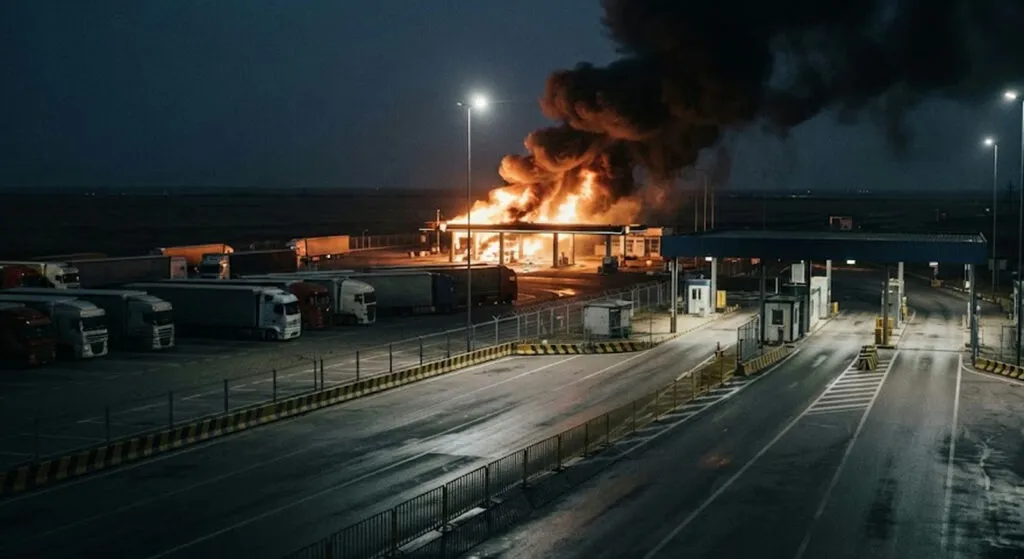
A Russian drone hit a petrol station last night at the international Yagodin border crossing, on the border between Ukraine and Poland. The fire engulfed the building and freight lorries parked nearby. Footage from the scene shows tall flames and several lorries burning. There is no information so far on any casualties.
Yagodin is not a minor dot on the map. It is an international road crossing and one of the key links between western Ukraine and the European Union - a place through which goods, lorries and the entire trade line of a country at war pass. Ukrainian Foreign Minister Andrii Sybiha confirmed that the Russian drone targeted the Ukrainian-Polish border specifically, and said the Russian strike is now arriving right up against the border of the EU and NATO.
The warning came days earlier - and it happened anyway
What gives the attack particular weight is the timing. Polish Prime Minister Donald Tusk had warned only days earlier that Warsaw expected attempts to strike the crossings between Ukraine and Poland, with the aim of further disrupting Ukrainian trade and logistics. The warning was public, the target was named, and the strike landed regardless. What is an accurate prediction worth if no protection follows from it?
The attack at Yagodin was part of a far broader operation. According to Ukrainian air force data, Russia launched 453 drones of various types from the evening of 12 September. The Ukrainian side says air defences shot down or jammed 405 of them, with impacts recorded at 13 locations. That is a calculation in which even the best interception rate looks small - because the forty-eight that got through still land somewhere.
The strikes are moving west
Explosions were reported in Ternopil, Ivano-Frankivsk and the Khmelnytskyi region. One person was injured in Ivano-Frankivsk, and the railway station and public transport were temporarily halted because of the danger. In the Khmelnytskyi region drone debris started a fire on the premises of a business. New strikes were reported in the Lviv region.
Because of the strikes so close to the border, on 13 September Poland raised the readiness of certain air defence elements and scrambled a military helicopter to monitor the situation. Warsaw says the measures are preventive.
This is not the first crossing to burn
The Yagodin attack comes just days after a strike on another important Ukrainian international crossing - Starokozache, on the border with Moldova, where on 9 September two people were killed, three injured, and traffic was temporarily halted.
The pattern is legible without a military analyst: the strikes are systematically closing in on Ukraine's western exits - the railway, the road corridors and the border crossings through which the country maintains its links to the European Union. It is not the front being targeted. It is the way out.
And on the other side of those crossings stands the European Union, which for now is raising readiness and scrambling helicopters to monitor. The Balkans know this scene by heart: first it burns near the border, then someone says it was predictable.
The latest 10 news from this category
The train was empty, the locomotive damaged, nobody hurt. But Boris Johnson and a group of European security advisers had...

Trump's son-in-law told an audience in Kyiv the deal is done - if Ukraine withdraws. And added that the battlefield...

A barren volcanic rock in the middle of a strait 28 kilometres wide changed the oil market in a single...
Hostomel, Odesa, Kryvyi Rih - targets that are not the front line but the supply chain. A war against the...

We don't want war with Europe, but here is exactly how that war would start. He said both sentences in...

When an army recalls its special forces with a 12-hour deadline, that is not a rota but a signal. The...

Port infrastructure in Makhachkala and the theatre building caught fire, the governor said. Moscow claims it shot down 448 drones...
Tehran says it hit around ten ships, Washington says it destroyed five Iranian tankers and that its own vessel is...
Residential buildings, a kindergarten and an Orthodox church damaged in Russia's largest Black Sea port. Four dead and 29 injured...
When there are no air-to-air missiles left, what remains is a 20mm cannon - and that means the pilot has...
This site uses cookies - is that okay? Learn more
Be the first to know when Metla launches something new
Leave your email and we will write when there is a new guide or something new on Metla.