Three of Four Sensors Were Dead: Skopje's Vodno Cable Car Ran Fifteen Years Without a Real Service
17.09.2026


17.09.2026

17.09.2026
17.09.2026
17.09.2026
17.09.2026
17.09.2026
17.09.2026
16.09.2026
15.09.2026
17.09.2026

17.09.2026
16.09.2026
17.09.2026
17.09.2026
17.09.2026
17.09.2026

16.09.2026
15.09.2026

17.09.2026

17.09.2026

17.09.2026
17.09.2026

17.09.2026

17.09.2026

09.03.2026

27.02.2026

19.02.2026

23.04.2026

23.04.2026

12.04.2026

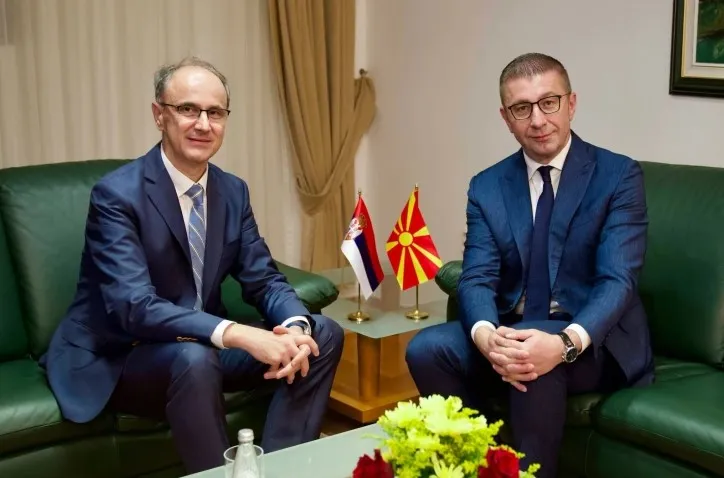
Two days after surviving a no-confidence vote in the Serbian parliament, Serbia's prime minister Gjuro Macut arrived unannounced in Ohrid for talks with Hristijan Mickoski. There was no official announcement of the visit. The public found out from Mickoski's Facebook post.
That is the sequence of events, and on its own it says more than the statements that followed. A prime minister who has just walked out of a confidence vote does not travel unannounced to a neighbouring country to exchange pleasantries.
What the two sides announced
Mickoski wrote that in an „open and constructive conversation“ they exchanged views on current regional challenges, opportunities for deepening bilateral cooperation, economic relations, infrastructure connectivity and joint initiatives. They also confirmed a shared commitment to advancing friendly relations based on mutual respect and good-neighbourly cooperation.
That is a sentence you could move from any meeting between any two prime ministers, in any month. The specifics came from the other side.
Macut listed them: modernising the rail corridor connecting Serbia, Macedonia and Greece; work on implementing the gas interconnector between Serbia and Macedonia; opportunities to expand cooperation in oil infrastructure; agricultural cooperation and conditions for a greater flow of people, goods and services.
The delegation's composition reveals the subject
Three ministers came to Ohrid with Macut - for mining and energy, for construction, transport and infrastructure, and for agriculture. The meeting was held one-on-one first, then continued with the delegations.
When an unannounced visit brings precisely those three portfolios with it, „an exchange of views on regional challenges“ means energy, transport and food. Those are the three things currently troubling everyone in the Balkans: electricity, corridors and prices.
The context matters. Serbia is facing a declared state of crisis, the Danube's water level is extremely low, and Hungary is shutting down part of its power generation for lack of cooling water. Under those conditions, a gas interconnector and a rail corridor are not long-term visions - they are questions about this coming winter.
What went unanswered
Macut said Belgrade sees Macedonia as a reliable partner and friend, and that cooperation will rest on regular political dialogue, mutual trust and concrete projects delivering direct benefit to citizens.
A fine sentence. But after a meeting attended by three ministries covering energy and infrastructure, the citizens of both countries deserve something more precise than „concrete projects“: what stage the gas interconnector is at, when it is expected to come online, and what exactly was agreed about the rail corridor.
Until then, the most informative part of the entire visit remains the fact that it was not announced - and the three ministers who came along with it.
The latest 10 news from this category

Of 340 million denars, only 40 million came from private money - the rest came from the State Lottery. Prosecutors...
The State Audit Office already warned that withholding the points makes favouritism possible. The rulebook requiring them to be published...
Two senior officials announced progress, the two largest parties denied it the same day. The amendments sit blocked behind 13,500...
The police acted on their own knowledge, without the PM filing anything at all. The same mechanism exists for every...
The Electoral Code is the one unfulfilled reform obligation, and the working group does not even know when it will...
It was supposed to cost "zero denars". Now the opposition wants an investigation, and the timeline - David Guetta announced...
Five negations in one sentence, pension growth "16 times higher" with not a single figure beside it, and a third...
One side waits for a letter, another waits for a different commission, a third waits for consent. In those same...
The commission's chairman says it only checked whether the documents were complete. The public call says something else entirely -...
Three candidates, two of them lawyers, one of them employed by the very municipality he is running for. The line...
This site uses cookies - is that okay? Learn more
Be the first to know when Metla launches something new
Leave your email and we will write when there is a new guide or something new on Metla.