

They Rode In on Scooters, Torched the Shops and Left: The Fire in Shuto Orizari Burned for Three Hours, Setting It Took Fifty Seconds
13.09.2026


13.09.2026

13.09.2026

13.09.2026

13.09.2026

13.09.2026

13.09.2026

13.09.2026

12.09.2026

11.09.2026

13.09.2026

13.09.2026

12.09.2026

13.09.2026

13.09.2026

13.09.2026

13.09.2026

12.09.2026

11.09.2026

13.09.2026

13.09.2026

13.09.2026

13.09.2026

13.09.2026

12.09.2026

09.03.2026

27.02.2026

19.02.2026

13.09.2026

12.09.2026

11.09.2026

23.04.2026

23.04.2026

12.04.2026

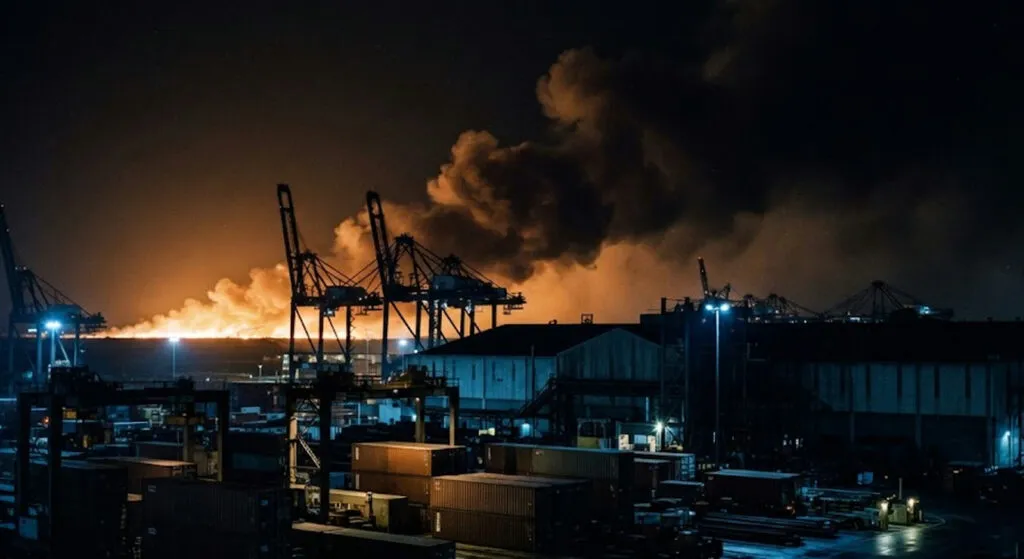
Kyiv and the area around the Ukrainian capital came under heavy Russian strikes overnight, and among the main targets was a large logistics centre in Hostomel. After one of the hits in Kyiv itself a major fire broke out - footage published by local channels shows industrial buildings engulfed in flames while fire crews are still working on the ground.
The Russian Defence Ministry said a logistics centre had been struck in Hostomel which, according to Moscow, was used for storing and distributing cargo connected to Ukrainian military needs. The Russian side claims components for unmanned aerial vehicles were also held at the complex. This is the Russian version and is worth reading as such - the Ukrainian side has so far not published a final tally of the consequences.
Logistics is the new front line
Hostomel, northwest of Kyiv, is once again at the centre of the strikes because of its position and the concentration of storage and transport infrastructure. The same night, attacks were also recorded in Vasylkiv in the Kyiv region. The wider area around the capital was therefore hit at several points at once.
Then came the second round. According to the statement from Moscow, enterprises of Ukraine's metallurgical industry were hit in Zaporizhzhia, Dnipropetrovsk and Kryvyi Rih. Metallurgy has particular significance for military production - steel, alloys and the materials needed for armoured vehicles, ammunition and missile parts. When you strike a smelter, you are not striking a smelter, you are striking what comes out of it six months from now.
Odesa and the sea
A large part of the night operation was directed at the Odesa region, where according to Moscow port infrastructure facilities were destroyed along with an important transport facility that enabled the unloading and storage of cargo. The Russian side claims a significant share of the foreign weapons and ammunition intended for Ukraine passed through those facilities.
Black Sea ports have a dual role - a large part of Ukrainian exports goes through them, but Moscow claims the same infrastructure also serves military shipments. That is why strikes on ports are increasingly combined with attacks on warehouses, railway lines and substations. If you cannot stop the cargo at the border, you stop it at the quay.
A war against the schedule
What is visible in this one night is not a battle for territory. This is a systematic campaign against the enemy's very ability to sustain supply - something slower than a front line and harder to photograph, but with a longer-lasting consequence. Metallurgy, port, warehouse, railway: what is being targeted is the opponent's calendar, not his map.
That is also why every conversation about a ceasefire drags on. The side destroying the other's infrastructure is in no hurry - every smelter hit shifts the balance in negotiations that have yet to begin. And the Black Sea, with all its ports and grain corridors, is closer to the Balkans than most maps suggest.
The latest 10 news from this category

A barren volcanic rock in the middle of a strait 28 kilometres wide changed the oil market in a single...

We don't want war with Europe, but here is exactly how that war would start. He said both sentences in...

When an army recalls its special forces with a 12-hour deadline, that is not a rota but a signal. The...

Port infrastructure in Makhachkala and the theatre building caught fire, the governor said. Moscow claims it shot down 448 drones...
Tehran says it hit around ten ships, Washington says it destroyed five Iranian tankers and that its own vessel is...
Residential buildings, a kindergarten and an Orthodox church damaged in Russia's largest Black Sea port. Four dead and 29 injured...
When there are no air-to-air missiles left, what remains is a 20mm cannon - and that means the pilot has...

In public - constructive talks. In private, according to an MP in the Verkhovna Rada, the envoys arrived with tougher...
Witkoff and Kushner spent three hours in the Kremlin and came out with an agreement in principle. November was not...

At two in the morning phones in Tulcea received a message telling people to go down to the cellar. When...
This site uses cookies - is that okay? Learn more
Be the first to know when Metla launches something new
Leave your email and we will write when there is a new guide or something new on Metla.
