


They Rode In on Scooters, Torched the Shops and Left: The Fire in Shuto Orizari Burned for Three Hours, Setting It Took Fifty Seconds
13.09.2026


13.09.2026

13.09.2026

13.09.2026

13.09.2026

13.09.2026
13.09.2026
13.09.2026

12.09.2026

11.09.2026
13.09.2026
13.09.2026

12.09.2026

13.09.2026

13.09.2026

13.09.2026
13.09.2026

12.09.2026

11.09.2026

13.09.2026

13.09.2026

13.09.2026

13.09.2026

13.09.2026

12.09.2026

09.03.2026

27.02.2026

19.02.2026

13.09.2026

12.09.2026

11.09.2026

23.04.2026

23.04.2026

12.04.2026

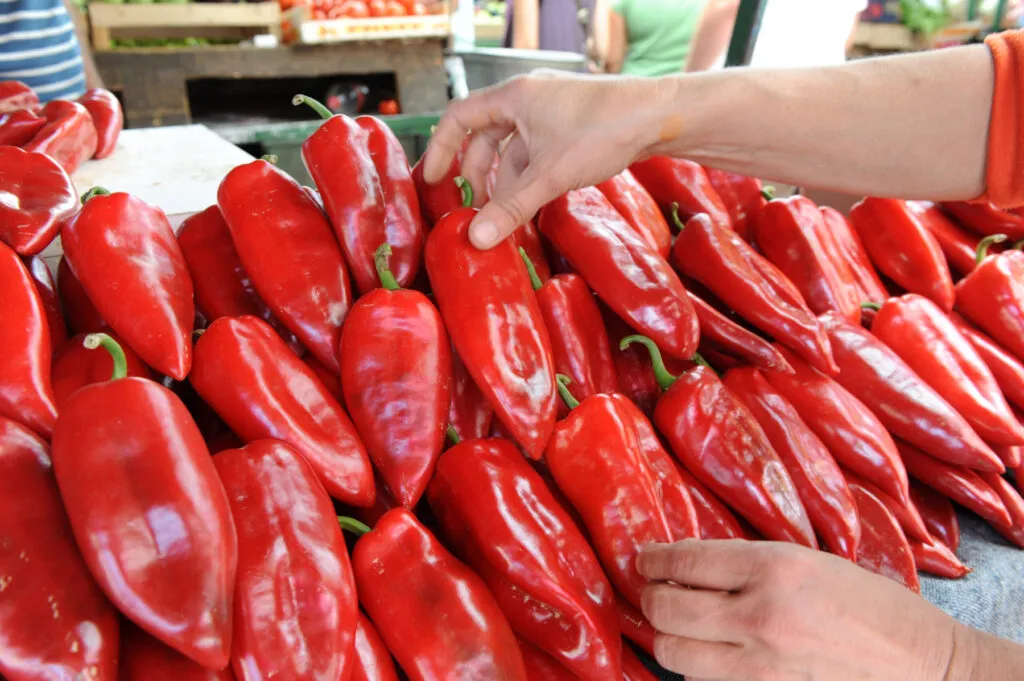
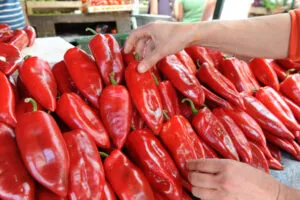
The production cost of one kilogram of peppers is 26 denars. Those 26 denars cover the seed, the fertiliser, the treatments, the irrigation, the fuel and the labour. The purchase price at some collection points is 15 denars.
So for every kilo handed over, the farmer loses 11 denars. And that is why, instead of going to market, part of this year's crop ends up under the tractors - farmers are ploughing their own fields with the peppers still in them.
Especially the "kurtovska kapija" variety, where under previously agreed prices first class was supposed to be bought at 40 denars a kilo. On the ground, growers say, even the best-quality pepper is being taken for 15 to 18 denars.
The mechanics of the squeeze
Farmers from Pelagonia describe it without a single technical term: "At the collection points they know the farmers' peppers will rot, so they keep the price down. In a month, when there are no peppers left, then they'll give you 80 denars a kilo, but by then you'll have no peppers and it's no use to you."
That is the whole story in three sentences. The goods are perishable, the clock is merciless, and the other side knows it. The farmer has no option to wait - the pepper does not wait. The buyer has every option.
Gjorgji Karakashev, president of the National Agricultural Network, adds the next part: beyond the low price, buyers will not take the lower classes at all, which are left to rot in the fields. Purchasing is haphazard and not continuous.
In his view, the state is also failing to deal with what he calls the "running wild" of buyers and traders who do not respect the agreed price of 40 denars for first class and 30 for first-second.
Sixty denars across the border
In neighbouring countries red peppers are bought at around one euro, or roughly 60 denars a kilo. Four times more than at some of the domestic collection points.
Growers explain the gap by the higher subsidies paid out in the countries of the region - among them Albania, Serbia, Greece and Bulgaria - which makes it harder for the Macedonian farmer to compete on foreign markets.
There is a second pressure too. As an example they point to Bulgaria, which they say uses CEFTA mechanisms to restrict imports of Macedonian produce. In the latest case nine tonnes of Macedonian peppers were turned back, and together with the 11.6 tonnes returned earlier, the total reached around 20 tonnes.
So: the price inside is half the cost, the price outside is four times it, and the road out is closed. That is not a market - it is a narrow corridor in which one side knows the other has to pass through.
What they are asking for
The growers' demand is more modest than the story suggests. They are not asking for a higher price than the agreed one - they are asking for the agreed one to be honoured. Forty denars for first class, exactly as the minister went out and said.
"Let him go around the villages, let him walk the collection points, and then we'll see whether the finest pepper is 40 or 15 denars," the farmers say.
When an agreement between the ministry, the growers and the buyers exists on paper, but a different price applies at the collection point, the question is not an economic one. The question is who has the authority to turn up at that collection point - and why it has not happened yet.
The latest 10 news from this category

The deficit target raised from 3.5 to 4.1 percent of GDP, spending growing faster than revenue, and the growth forecast...

On euro loans with a variable rate, the rise comes due at the next reset. On fixed ones, it does...
A Skopje company owes 14.87 million euros and there is nothing to recover it from. In one month the total...
223,711 tourists and 795,083 overnight stays in July. Turkey still leads with 50,955 guests, but its number fell by 7.6...

When the two biggest firms in an industry ask for rules on how fast anyone may run, the rules rarely...

Not a single password fell. What fell was the assumption that a request from a government domain is automatically a...
The board voted, the founder kicked the administrators out of Slack and held out for three days. What does a...
An announcement is not an adopted tariff. A lower bill is good news only if its cost has not been...
The Balkans have a long tradition of producing something valuable and selling it under someone else's name. The difference between...
Buildings from the fifties and sixties, one in Bitola dating to the 18th century. The 56 percent energy saving is...
This site uses cookies - is that okay? Learn more
Be the first to know when Metla launches something new
Leave your email and we will write when there is a new guide or something new on Metla.
