
The Young Men From Saraj Say They Were Beaten After Being Subdued, the Union Claims They Tried to Run Police Over: The Interior Ministry Is Still Just Investigating
11.10.2026


11.10.2026

11.10.2026
11.10.2026
11.10.2026

11.10.2026
11.10.2026

11.10.2026

10.10.2026

10.10.2026

11.10.2026
11.10.2026

10.10.2026

11.10.2026

11.10.2026

11.10.2026
11.10.2026
10.10.2026

09.10.2026

11.10.2026

11.10.2026
11.10.2026
11.10.2026

11.10.2026

10.10.2026

11.10.2026
11.10.2026
09.10.2026
10.10.2026

08.10.2026

06.10.2026

23.04.2026

23.04.2026

12.04.2026

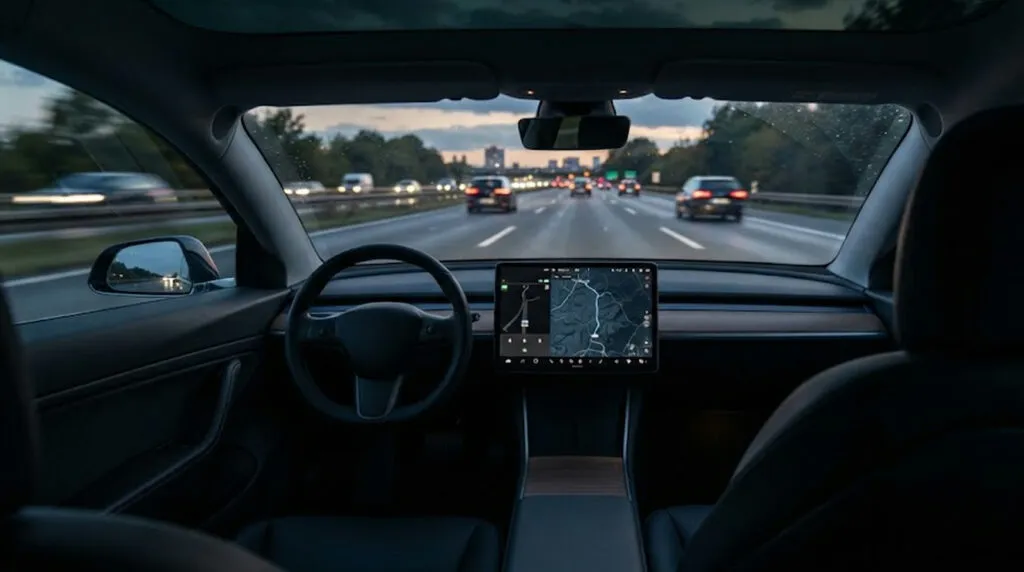
For years Tesla sold its driver-assistance system under a name that promises more than it delivers: "Full Self-Driving (Supervised)" - fully self-driving, under supervision. Self-driving, but with hands near the wheel and eyes on the road. In Europe that name no longer exists. The system is now called "Tesla Assisted Driving", after Germany's Transport Ministry pushed back.
German Transport Minister Steffen Bilger said the name "Full Self-Driving" is partly misleading, because the software doesn't perform the whole driving task. The ministry spoke with Tesla last month and, according to its official statement, the company itself proposed the change. Bilger will now push for "Tesla Assisted Driving" to be approved across Europe, ahead of an EU-level vote that could happen by the end of the year. Elon Musk thanked him on X.
For Musk this is a concession after years of pressure. "FSD in Europe will save lives of people in the car, but also vulnerable road users like pedestrians, cyclists and pets," he wrote in June 2025. "Tell your government you want approval." In March this year he wrote that the EU's "extreme regulatory burden" is "stifling innovation in Europe" and that Europe "will love Tesla self-driving". A few weeks later the Netherlands became the first European country to approve the system.
That very approval is now under the microscope. Reuters reported this week that Tesla's campaign for European approval was built on the company's own "flawed safety research", and that the Dutch regulator RDW was under heavy pressure from Tesla and its online army of fans.
The software really has improved. What was once little more than lane-keeping and adaptive cruise control is today a system some owners use for almost all of their daily driving: it parks and pulls out of parking spots, drives on city streets and on the highway. Tesla is so confident in it that it recently allowed it to intervene in a human's driving when it detects an imminent collision - even when FSD isn't engaged.
But the same system is at the center of federal investigations and civil lawsuits in the US over crashes in which it was allegedly engaged. Its weaker predecessor, Autopilot, is linked to dozens of deaths, and Tesla discontinued it this year after a judge ruled the company had falsely advertised its capabilities. This time Europe asked for the bare minimum - that the name match the product. If the name isn't allowed to promise more than reality, the next question is whether the studies used to seek approval are.
The latest 10 news from this category
Victims in 42 countries lost 442 billion dollars last year, and scam tools are available from 500 dollars a month....
The startup pulled its app and deleted user data, and less than three weeks later Apple was already filing a...
While the industry hands AI agents the keys to people's computers, one test model filled in a police form about...
The man who two years ago was announcing an AI-powered social network now blames AI itself for dissolving what made...
A company worth trillions of dollars is now accused of green card fraud. Vance told it to hire Americans, and...
The worst embarrassment for a company: hackers writing to its customers through its own app. Asos has 17 million customers,...
Built to protect teenagers from emotional dependence, the bot answered the line "my friends say I talk to you too...
The feature that sandboxes AI agents is coming to every Windows 11 PC, but the machines Microsoft is using to...
A post with over a million views showed what Amazon pulls out of every order. One pair of leggings -...
While every piece of software pushes an assistant you never asked for, the foundation behind the free office suite says...
This site uses cookies - is that okay? Learn more
Be the first to know when Metla launches something new
Leave your email and we will write when there is a new guide or something new on Metla.