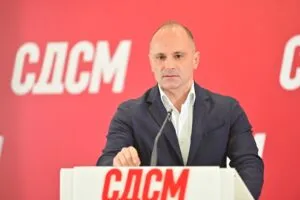
Filipče Demands Slaveski's Resignation and a Probe Into Alta Banka: Two Days Before the License Was Pulled in Belgrade, Mickoski Was Saying "I Don't Know If Everything Is in Order"
01.11.2026


01.11.2026

01.11.2026
01.11.2026
01.11.2026

01.11.2026

01.11.2026

01.11.2026

01.11.2026
01.11.2026

01.11.2026

01.11.2026

31.10.2026
01.11.2026

01.11.2026

01.11.2026

01.11.2026
31.10.2026

30.10.2026

01.11.2026

01.11.2026

01.11.2026
01.11.2026

01.11.2026
31.10.2026
01.11.2026
01.11.2026
01.11.2026

23.04.2026

23.04.2026

12.04.2026

In the final weeks of the campaign, Aleksandar Vučić was shown in a positive light 96 percent of the time on the five national-frequency TV channels, while the Student List came across negatively in 95 percent of cases. He lost anyway. Less than 24 hours later, presenter Goran Eror of the Vojvodina public broadcaster was apologising: "Things were kept quiet, an eye was turned." A week after the election, the new editorial board at RTS asked viewers' forgiveness "for everything left out in the previous period." The RTS director left, so did the RTV director, and TV Pink announced layoffs for around a thousand staff. A nicely worded apology. It just arrived after the government was already gone.
Milorad Dodik found his feet fast too. He spent election night at SNS headquarters, a week earlier he was calling a student defeat a historic event, and five days later the best relations with the new government became his "primary political business." The prosecution, meanwhile, according to Serbian media, allegedly remembered Milan Radoičić and the question of why he stayed out of custody three years after Banjska. There is no official confirmation. The rulebook suddenly became visible as well: Tomislav Nikolić, nine years after his term ended, still lives in a state villa in Dedinje, and the regulation was rewritten so that Ana Brnabić could stay in hers.
The new government, meanwhile, does not exist yet. The revote at 53 polling stations delays parliament, and a cabinet could take up to four months. Marta Kos has already said there will be no progress without sanctions on Russia, Ilija Srdanović answers with "dialogue", and Vučić has been proposed as SNS leader, with an extraordinary party congress on 13 December. When the students take their seats, will anyone check them while they are there, or will we wait for them to fall too?
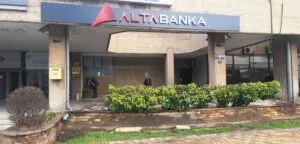
At 02:34 on Saturday, the National Bank of Serbia pulled Alta Bank's licence, five days after the government fell. Just days earlier the central bank had been saying it found no irregularities in financial flows. That is how long the calm lasted. Serbia's ninth-largest bank, with 1.84 billion euros in assets, vanished overnight, and media close to the defeated government instantly declared it the first or second largest and shifted the blame to the newcomers. The real fear sits with the shop assistants: the "Sloga" union warns of more than 8,000 employees in the retail chains of owner Davor Macura, which are formally not in bankruptcy, and is asking what happens to their wages.
Alta from Belgrade also owns the former Stopanska Banka Bitola. Our National Bank says the decision "does not in itself mean automatic revocation of the operating licence" and that it is "monitoring the situation." Legally, that holds. But "monitoring" does not say what it sees. The nine-month figures say more: a loss of 48.64 million denars, against a profit of 49.15 million last year. The bank insists it is liquid, deposits stand at 8.91 billion denars, and the state guarantees up to 30,000 euros per saver. Pavle Gacov, who is calming savers down, also wants the governor to speak publicly.
Two days before the licence was pulled, Hristijan Mickoski said: "I don't know whether everything is in order," adding that a process for this exists at the National Bank. Venko Filipče demands Trajko Slaveski's resignation and talks of "armageddon" and a Balkan cartel, but political contacts are not evidence. So the governor has become the address where every question ends up. Who checked the origin of the capital when this bank entered our market, and what did they find?
Eye surgery, paid for twice. According to the criminal complaint, a private hospital charged both the Health Fund and the patient, who did not know the Fund had already paid. Between 3,000 and 4,000 people were affected, the Fund lost around 1.7 million euros, and the unlawful gain is put at around 4.25 million euros for 2022-2025. The court took the passports of nine people. The hospital says it harmed nobody, and guilt is still for the court to establish.
But the most interesting part of the complaint is not the hospital. Among those named is the head of the Fund's Control Sector, suspected of not forwarding reports on irregularities and of postponing regular inspections, while two more managers allegedly did not follow up on the collection of fines already imposed. Health Minister Sašo Klekovski called it a "chain of impunity" that lasted for years. If the suspicions hold, the invoices did not slip past the controls, they went through them. How many other contracts with the Fund pass through that door?
Control was also a topic from the stage. At the closing rally in Brvenica, the prime minister told Supreme Court judges they had made the decision on the Tetovo modular hospital "because they are close to the leadership of DUI." The victims' families have every right to an answer. But if the evidence exists, why is it being presented at a rally and not to the competent authorities? In parliament, meanwhile, Mickoski explained that the ANB and the intelligence agency will merge into one service, partly because his party had been a victim of the services. Who supervises the bigger service, if oversight sits with the majority that created it?
This year's second budget revision cuts capital spending by around 5.8 billion denars, while the deficit stays at 46.3 billion, or 4.1 percent of GDP. The government calls this aligning with the "real dynamics of the projects." In translation: the projects are not moving at the speed they were promised. On 30 October came the draft 2027 budget, with a deficit of 45 billion denars, 3.8 percent growth on paper and a 500-million-euro Eurobond maturing in 2027. The World Bank projects 3.2 percent this year, and in the second quarter growth was pulled by construction, up almost 22 percent.
In this climate, at the opening of a sewage project in Jurumleri, Mickoski called the private pension funds "weak entrepreneurs," with a return of 1.5 percent. The official MAPAS report says 5.03 percent nominal and only 0.16 percent real. Where the prime minister's figure comes from, he did not say. Auditors, for their part, showed that the state pension fund PIOM was late with transfers by two months on average. The prime minister also mentioned nationalising the second pillar. It holds around 3.5 billion euros in savings belonging to more than 640,000 citizens. When the treasury runs tight, whose money starts to look most tempting?
Local treasuries tell this story with smaller numbers. From January, Kumanovo drops to 19 bus lines instead of 26, with tickets up to 140 denars, because some lines are "unprofitable." Ohrid is raising the price of water by 16 percent through 2029, while its public companies take subsidies from the municipality. Citizens pay through the budget and through the bill.
In the old barracks under Tumbe Kafe in Bitola, the count of bombs dug up has passed 4,000, and the nearest houses are 200 metres away. More than 1,000 more are expected. The First World War ended in 1918. In Macedonia, according to sources, just two professionally employed bomb-disposal experts remain, and in Bitola the work is done by one of them with three pensioners on service contracts. One new hire is expected before New Year, and training takes at least a year and a half. Why does training for the new ones start only when the old ones leave?
At Vardarište the fire is out, and the 2.5-million-euro decontamination is due to begin around mid-November, across some 600,000 square metres. The park has been drawn, the contractor announced. For the roughly 200 people who still live on the dump, there is no date.
In Hrom and Gjorče Petrov, a 62-year-old man and a 76-year-old woman were killed within five days. Four people have been detained, and according to unofficial information the targets were elderly people living alone, tied up and robbed in their own homes. The proceedings are still under way and guilt is for the court to determine. Families and neighbours, meanwhile, read the details on news portals before the interior ministry said a word. In Tetovo, police bulletins over two days described a 14-year-old with serious injuries in a school yard and a 62-year-old attacked by minors, and the only answer is "measures are being taken." How many such bulletins have to be lined up before someone in charge comes out and says what is happening?
The order of events this week was instructive: first the protection fell, and then came the apology, the check and the brave statement. On 1 November, Brvenica, Bulgaria and 53 polling stations in Serbia all vote, and after the debate in Sofia, nobody is offering Macedonia anything different. The next check is closer, in Bitola: what exactly does the National Bank see at Alta? If control arrives only after someone has fallen, it is not control. It is an inventory of the damage.
The latest 10 news from this category
The ambulance service got vehicles with no one to drive them, Skopje's public transport company has buses that don't run,...
A defendant with confiscated passports made it to Sofia, the Saraj police report stayed under lock, the average new flat...
Every announcement this week came with a date and a photo op. What was missing was the last line: how...
A network "untouchable" for more than 15 years, a hospital under construction since the eighties, accession talks Skopje and Tirana...
The state announces inspections, and an inspector gets detained. Oil falls, diesel climbs. A week in which almost every official...

Two inspections of the same cable car with opposite findings, a climate plan contradicting its own urban plan, and a...
A week in which oversight had a price, the celebration cost nothing from the Budget, and deadlines expired faster for...

The motive behind the fires was said out loud, the payments were logged, the births were counted, the sleepers had...
The map of which municipalities never sprayed came out after the epidemic, spraying in Resen began only after the raven...
Thirteen sprayings and four dead, technical solutions drawn up but never built, and five years of investigation without a single...
This site uses cookies - is that okay? Learn more
Be the first to know when Metla launches something new
Leave your email and we will write when there is a new guide or something new on Metla.