A Pole Drove 164 km/h Where the Limit Is 80: The Camera Caught Him, the Border Stopped Him
23.08.2026


23.08.2026
23.08.2026
23.08.2026

23.08.2026
22.08.2026

22.08.2026

23.08.2026

23.08.2026

22.08.2026

23.08.2026

23.08.2026

23.08.2026
23.08.2026

22.08.2026

21.08.2026
23.08.2026

23.08.2026

23.08.2026

23.08.2026

23.08.2026

22.08.2026

09.03.2026

27.02.2026

19.02.2026
23.08.2026
23.08.2026
22.08.2026

23.04.2026

23.04.2026

12.04.2026
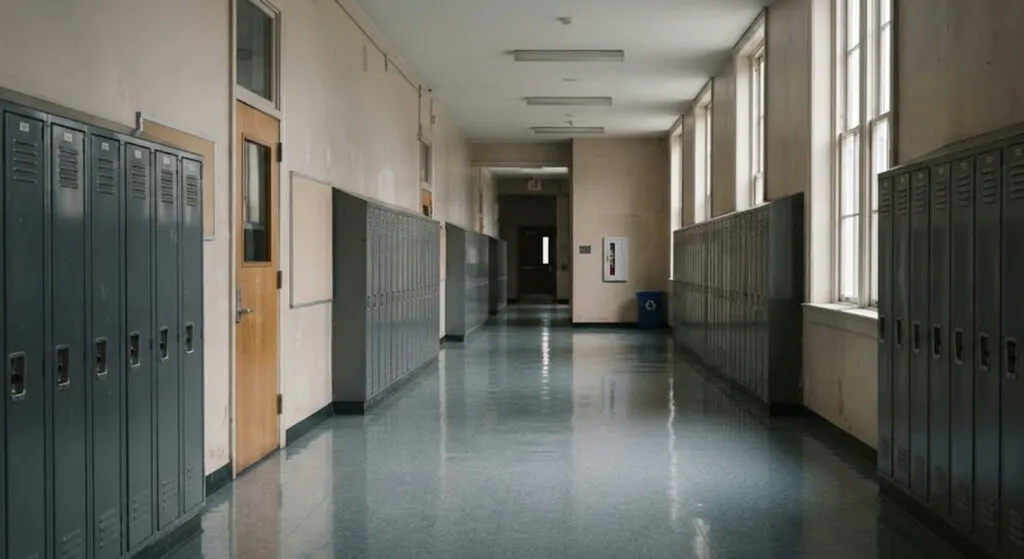
An eighteen-year-old former pupil walked into the Brinell secondary school in Fagersta, northwest of Stockholm, carrying a sword and wearing a helmet. One person was killed. Two teenage girls were seriously injured, and a third person was taken to hospital with injuries of unknown severity.
Police received the call at 14:06. "We got the call at 14:06 and sent every available unit to the school," a police spokesperson said. The attacker was shot by police and is in custody.
According to Swedish public television, citing unnamed sources, the man arrested was a former pupil at the same school and already had a previous conviction for assault. Which means the system had him in its records. It had him, it knew him, and he still walked through the door of a school with 450 pupils aged between sixteen and twenty.
One year after Orebro
This happens exactly one year after the school shooting in Orebro, in central Sweden, where the attacker killed ten people before killing himself. That was the deadliest mass attack in Swedish history.
"A serious incident occurred in Fagersta right at the start of the new school year. We still do not know what motivated this act, but we know the police are working intensively on the case," said Swedish Prime Minister Ulf Kristersson.
The wording is standard. We hear it every time, in every country, after every day like this. What we rarely hear is what specifically changed since the last time.
The country that counted as the safest
For decades Sweden was the model of safety and social stability - the country others pointed to when they wanted to show how it is done. Today, in that country, schools and public buildings in one town were closed and evacuated because of a single attack with a sword.
Did the model give way, or did we simply stop looking at what happens beneath the surface? The Nordic image of order and calm is something the Balkans are often sold as the goal to aim for. It is worth asking which version of that image we are actually heading towards.
The latest 10 news from this category
A coup, a default, the Kursk, Georgia, the poisoning of Navalny - all in August. This summer: smoke over refineries...

First a threat to attack the interests of anyone joining the American pressure campaign. Then - talks with Oman and...
Not a fault, not a storm - an attack from a distance. For four days the plant stood dead, and...

A Washington ally duly waited for Russian clearance to sail along the Arctic coast. Brussels is unhappy, but the ship...

The court called the publisher's costs exceptionally high - and then ordered Harry to pay them. Forty million for one...
The Israeli military admits serious failures but concludes there is no criminal liability. The blame exists as a concept, but...
Finland published the exact figures on the violation of its airspace and summoned the Russian ambassador within a day. How...

Defending the Daily Mail cost 40.22 million euros. The court called that exceptionally high - and then refused to set...
Either you are with us or against us, the US Treasury Secretary said. Iran has been under sanctions for almost...
Kurdish becomes an official language for the first time since 1946. At the same moment, government forces took over the...
This site uses cookies - is that okay? Learn more
Be the first to know when Metla launches something new
Leave your email and we will write when there is a new guide or something new on Metla.