

They Rode In on Scooters, Torched the Shops and Left: The Fire in Shuto Orizari Burned for Three Hours, Setting It Took Fifty Seconds
13.09.2026


13.09.2026

13.09.2026

13.09.2026

13.09.2026

13.09.2026

13.09.2026

13.09.2026

12.09.2026

11.09.2026

13.09.2026

13.09.2026

12.09.2026

13.09.2026

13.09.2026

13.09.2026

13.09.2026

12.09.2026

11.09.2026

13.09.2026

13.09.2026

13.09.2026

13.09.2026

13.09.2026

12.09.2026

09.03.2026

27.02.2026

19.02.2026

13.09.2026

12.09.2026

11.09.2026

23.04.2026

23.04.2026

12.04.2026

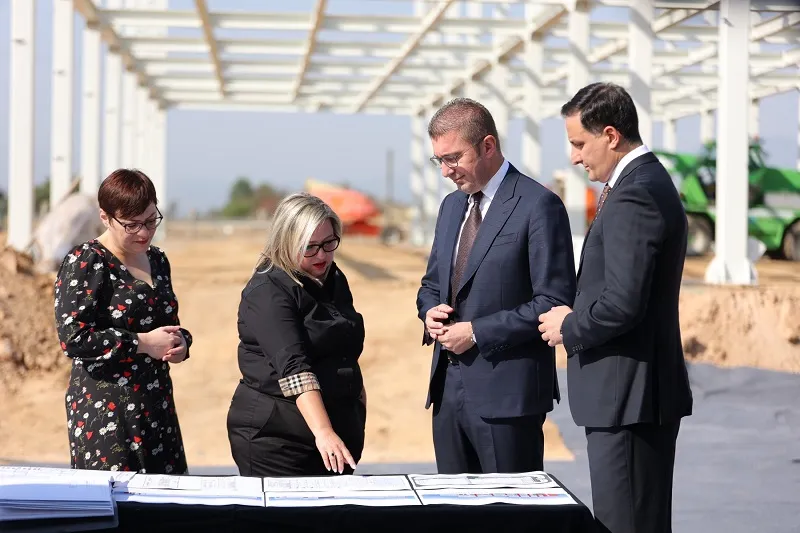
In September 2024, at the ceremonial laying of the foundation stone, stood Prime Minister Hristijan Mickoski and Finance Minister Gordana Dimitrieska-Kocoska. The investment was announced at 65 million euros, with 1,000 new jobs and 60 million euros of exports over three years.
Less than two years have passed. Germany's BMZ, a manufacturer of lithium-ion batteries, has announced it is closing the Ilinden plant entirely and moving all production to Poland. It affects 89 employees.
1,000 promised, 89 laid off
In a statement on its website, the company wrote that the decision followed a comprehensive economic analysis and that the transition will be phased, from August to December 2026. Customer supply continues - just from Poland, where BMZ already works to the same specifications and quality standards.
That is the technical part. The political part is that of the 1,000 announced jobs, the plant reached 89 by the time it closed. The gap between those two numbers is not a failure of the company - it is delivering batteries just as before. The gap is between what was promised from a podium and what was actually built.
Third in a row
BMZ is not alone. Before it, the Irish-American Aptiv left the „Bunardzik” free economic zone, and the American firm Dura has already shut its plant. The zone authority announced it would seek the return of the state aid given to Dura. The country's largest exporter, Britain's Johnson Matthey, has announced staff cuts.
The authority says an existing investor wants to take on some of BMZ's workers, and that a new EU investor who might take over the plant is also expected. Neither is named. Nor is it known what sector they operate in.
The question nobody asks
Every time a foreign company arrives, there is a ceremony to film. Every time one leaves, there is a statement to publish. Between those two events sit state aid, exemptions from levies inside a technological-industrial zone, and political capital spent on numbers that are never checked retroactively.
Will anyone be asked to account for the difference between 1,000 and 89? Or is the model simply that the next ceremony erases the last one?
The latest 10 news from this category
The deficit target raised from 3.5 to 4.1 percent of GDP, spending growing faster than revenue, and the growth forecast...

On euro loans with a variable rate, the rise comes due at the next reset. On fixed ones, it does...

The agreed price for first class is 40 denars. At the collection points they pay 15 to 18. Across the...
A Skopje company owes 14.87 million euros and there is nothing to recover it from. In one month the total...
223,711 tourists and 795,083 overnight stays in July. Turkey still leads with 50,955 guests, but its number fell by 7.6...

When the two biggest firms in an industry ask for rules on how fast anyone may run, the rules rarely...
Not a single password fell. What fell was the assumption that a request from a government domain is automatically a...
The board voted, the founder kicked the administrators out of Slack and held out for three days. What does a...
An announcement is not an adopted tariff. A lower bill is good news only if its cost has not been...
The Balkans have a long tradition of producing something valuable and selling it under someone else's name. The difference between...
This site uses cookies - is that okay? Learn more
Be the first to know when Metla launches something new
Leave your email and we will write when there is a new guide or something new on Metla.
