
"That's not my job": the trial of the 13 Puls police officers restarted from scratch, and witnesses describe help being refused
22.09.2026


22.09.2026
22.09.2026

22.09.2026

22.09.2026
22.09.2026

22.09.2026
22.09.2026

21.09.2026

20.09.2026

22.09.2026

22.09.2026

21.09.2026

22.09.2026

22.09.2026

22.09.2026
22.09.2026

21.09.2026

20.09.2026

22.09.2026

22.09.2026

22.09.2026
22.09.2026

22.09.2026

22.09.2026

09.03.2026

27.02.2026

19.02.2026
22.09.2026

21.09.2026

21.09.2026

23.04.2026

23.04.2026

12.04.2026

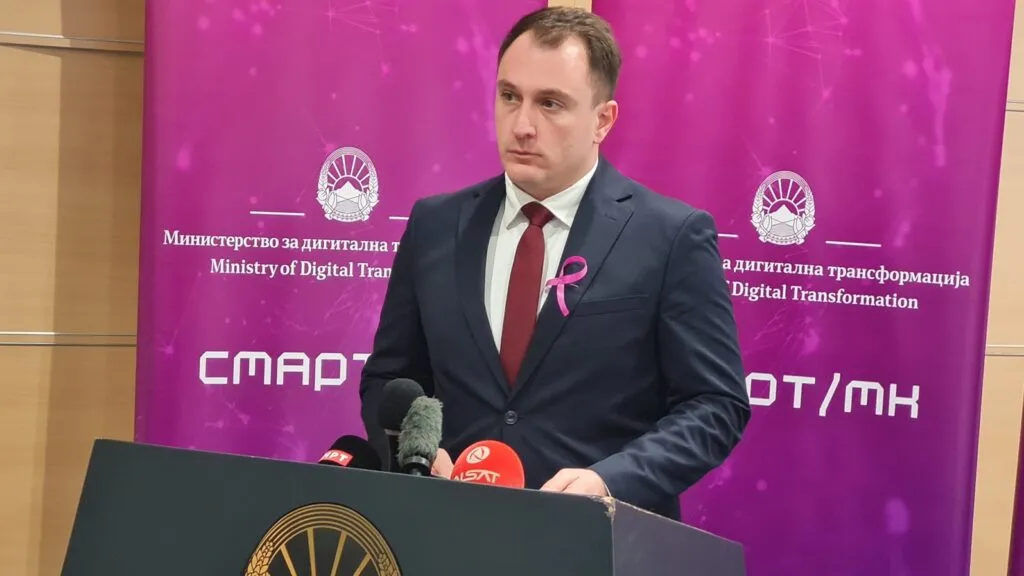
When a party cannot persuade its own councillors to vote for its own government's project, that is not a rebellion. That is an admission the project was never explained. Which is exactly what happened in Pehčevo, where VMRO-DPMNE councillors did not vote for the land-use change the data centre needed.
Digital transformation minister Stefan Andonovski did not try to defend the project. Quite the opposite - he took their side. In his view, the Pehčevo investment was not clear enough to the people being asked to vote on it: there was no concrete project, no study, no data on what the building would look like, how much electricity it would consume or how it would connect to the grid.
Read that sentence again. Councillors were called to vote on rezoning land for a facility, and nobody had told them how many megawatts it would pull. Andonovski says their doubts were legitimate and sincere. He is right. But the question nobody asked is who prepared that agenda item, and with which documents.
The national data centre: location and price
In parallel, the minister denied that a permit had been issued or a contract signed for a 100-megawatt data centre that would draw water from the Vardar. The cooling water, he says, is technical water obtained by drilling into the inner layer of the earth, and he has no information that river or lake water is being used. He also says no construction decision will be taken if there is any awareness that it would damage the environment.
The national data centre, according to the announcement, will be built near Skopje by the free economic zones, on infertile state-owned land. A feasibility study has been approved, the value is estimated at around 20 million euros, and the foundation stone is expected next year. Andonovski says construction will run until the end of this government's term.
The employment figures he gave are specific and worth remembering: a 50-megawatt facility would create between 50 and 100 permanent jobs for engineers and cyber-security specialists, plus 300 to 400 temporary construction jobs over two to three years.
Andonovski also has advice for municipalities: present the plan to citizens transparently and in good time, and do not rezone land from high agricultural categories. Sensible advice. All the more so since it arrives after one municipality has already said no - with votes from the governing party itself.
The latest 10 news from this category

The video has no room, no table, no flags. In the same week the State Department redirected 52 million dollars...

The right to an opinion is not in dispute. The problem is that in certain offices the line between personal...

America sees us as a close friend, the prime minister says. A 200-billion portfolio, six data-centre companies, Chebren and Galishte....

Eight days of invitations to a joint test, then "report your dealers", then a criminal complaint over photographs and the...

From Washington, the prime minister asks for a third party at the table so the dispute stops being bilateral. Brussels...

Mickoski lays out the chain from Washington: pipeline, power, data centres, artificial intelligence. The order of the announcements runs backwards...

Marta Kos listed the countries getting a timetable. We are not on it. What remains is the condition we know...
Monitoring by the All for Fair Trials coalition: hearings twice a year, proceedings running up to 33 months, and young...

Of 340 million denars, only 40 million came from private money - the rest came from the State Lottery. Prosecutors...
The State Audit Office already warned that withholding the points makes favouritism possible. The rulebook requiring them to be published...
This site uses cookies - is that okay? Learn more
Be the first to know when Metla launches something new
Leave your email and we will write when there is a new guide or something new on Metla.