
Six reports in 24 hours: violence in the Macedonian family runs on a schedule, and the institutions arrive last
29.08.2026


29.08.2026

29.08.2026

29.08.2026

29.08.2026
29.08.2026

29.08.2026
29.08.2026
28.08.2026

27.08.2026

29.08.2026

29.08.2026

28.08.2026

29.08.2026

28.08.2026

27.08.2026

29.08.2026

29.08.2026

29.08.2026

29.08.2026

29.08.2026

28.08.2026

09.03.2026

27.02.2026

19.02.2026

28.08.2026

27.08.2026

26.08.2026

23.04.2026

23.04.2026

12.04.2026
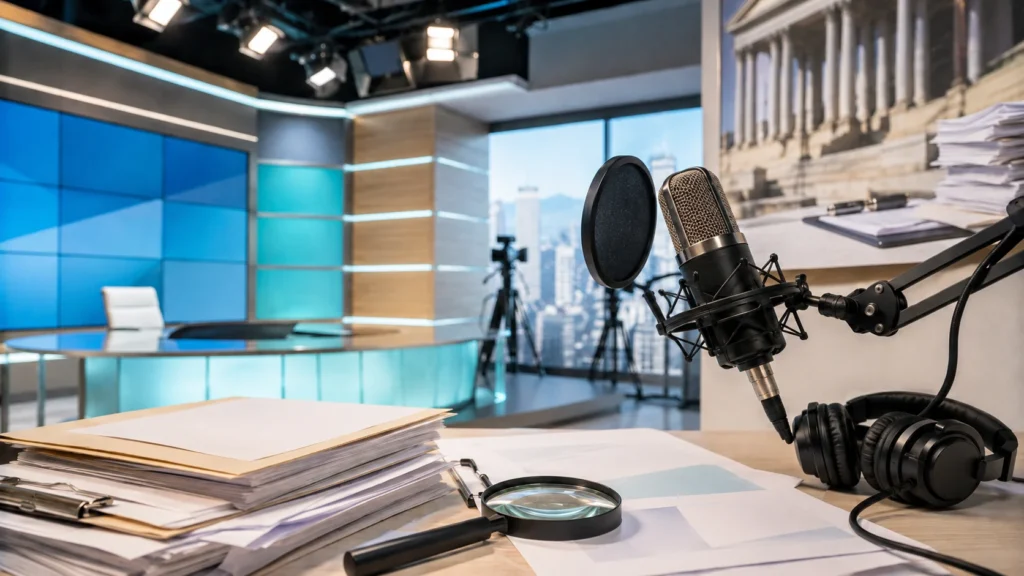
When the financial police walk into a media transaction, it usually means somebody has stopped believing the story about clean money. The Financial Police Directorate is checking the origin of the capital with which Belgrade's Alo Media System, through its Skopje-registered company, was supposed to buy Nasa TV and Radio RFM. The Agency for Audio and Audiovisual Media Services has meanwhile halted the procedure for the change of ownership structure.
The difference in wording matters, and it is not accidental. On 20 August the agency announced only that the deadline for a decision was being extended. Today the word is different - the procedure has been halted. Institutions stepped in between those two words.
The Financial Police Directorate confirmed it is working on a case and examining all the indications raised in public, while at the same time appealing for people not to speculate with unverified information. The appeal is understandable. But the appeal comes after a case has already been opened - which means the indications were not merely speculation.
Who is asking what
The opposition SDSM put the ball in play first. Spokeswoman Bogdanka Kuzeska said that "Mickoski, following Vucic's recipe, is running an operation for media blackout in Macedonia too", claiming that the entry of Serbia's Alta Banka creates a mechanism for channelling state funds towards a bank linked to media financing and influence.
A day earlier, the five national television stations and the public broadcaster MRT had already warned that the channels Arena M1, M2 and M3 Premium are operating without the required domestic licences. The agency rejected those claims, explaining that the channels are treated as foreign programme services - a technically correct answer to a question nobody asked in that form.
The Commission for Protection of Competition, for its part, approved the concentration notifications back on 22 July. So one institution has already said "yes", another now says "wait", and a third is checking where the money is from. Three jurisdictions, three different speeds.
Foreign capital is not the problem
This needs saying plainly: foreign capital in a media outlet is not in itself proof of illegality. Media companies are bought and sold everywhere. The questions are the origin of the money, whether the conditions for the transaction are met, and whether the limits on concentration are respected - exactly what the institutions now have to establish.
Which means the answer will not come from party press releases, nor from appeals to stop speculating. It will come from a report. The question is when, and whether some other contract will already have been signed before then.
The latest 10 news from this category
When the party of a sitting minister publicly pays tribute to a convicted war criminal, asking whether that is the...
Колку аплицирале, колку излегле на тестирање, колку поминале. МВР ги има тие податоци во истата евиденција од која излегле 310-те...
Three weeks of hospital treatment, a return to Skopje Prison on 26 August, and already an emergency transfer back. The...
The party claims the Pehchevo initiative failed because an opposition figure was behind it. The council there voted unanimously.
Tetovo Clinical Hospital sits under the health ministry. The director says there is nothing political about it - and in...
The fire was out, there was not a trace of it for a full day - then it flared again....
The isotope is brought from Istanbul, and talks are underway with Sofia. Filipche demands an immediate fix, VMRO-DPMNE answers with...
Legally the denial holds - Article 22 applies to every employer. But the question that created the story is not...
Grubi took his seat in the dock. The lottery's director has been on the run for two years, and the...
Prosecutors have closed the pre-investigation into the procurement. For the fire-safety failures there are already convictions - but nobody has...
This site uses cookies - is that okay? Learn more
Be the first to know when Metla launches something new
Leave your email and we will write when there is a new guide or something new on Metla.