

Studeničani: 35-year-old dies after being electrocuted while washing his car with a pressure washer
18.09.2026


18.09.2026
18.09.2026

18.09.2026

18.09.2026

18.09.2026
18.09.2026
18.09.2026

17.09.2026
16.09.2026
18.09.2026

18.09.2026

17.09.2026

18.09.2026

18.09.2026

18.09.2026
18.09.2026

17.09.2026

16.09.2026

18.09.2026

18.09.2026

18.09.2026

18.09.2026

17.09.2026

17.09.2026

09.03.2026

27.02.2026

19.02.2026

18.09.2026
17.09.2026
16.09.2026

23.04.2026

23.04.2026

12.04.2026

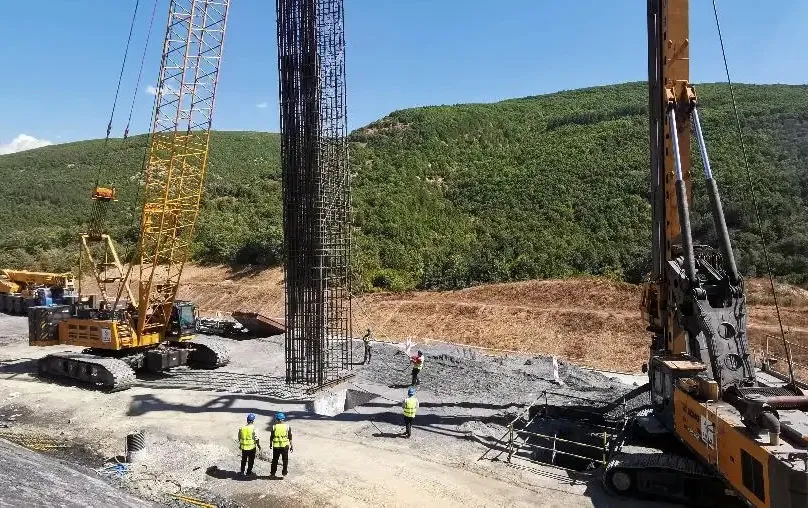
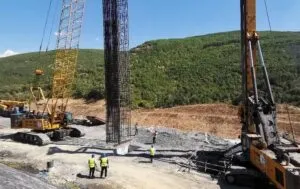
Three machines weighing 130 tonnes each are digging up to 28 metres underground near the village of Botun. Reinforcement cages of 30 tonnes each are lowered into the excavations and then filled with concrete. Between them run pipes and steel cables tying them to one another.
The result is a structure nobody will ever see. Which is precisely why the authorities wanted to show it now.
The ground that cannot be changed
Transport Minister and Deputy Prime Minister Aleksandar Nikoloski and the director of the state roads company, Koce Trajanovski, inspected the stabilisation works at Botun.
"There are things we can do and things we cannot change. What we cannot change is the ground. All around you, you can see this is black graphite soil, the most unstable soil that can be found anywhere. On top of that there is a lot of water here, which you can tell from the vegetation, and when the water combines with the graphite it turns to slurry and there is no stability at all," Nikoloski said.
The depth of 20 to 28 metres, he said, is equivalent to the height of a seven to eleven storey building. Except this building goes downward.
250 locations, 163 of them at Botun alone
Solutions like this will be applied at a total of 250 points along the Kičevo - Ohrid motorway. Of those, 163 are at Botun, the rest on other sections of the route, including near Kneževo.
The ratio says everything. Almost two thirds of all the points requiring this kind of work sit in one place. Botun is not "another difficult section" - Botun is the problem.
Trajanovski explained that on the basis of geological surveys, two key stabilisation designs were produced - one with galleries, the other with concrete columns. At Botun the concrete column technology is being used, to a design by GIM, in cooperation with engineers from Sinohydro.
Nikoloski pointed out that domestic experts and professors were engaged as far back as 2024, working with foreign scientists who had applied similar solutions elsewhere in the world.
37 built, 34 in use, 57 in total
Of the total length of 57 kilometres, 37 have been built so far and 34 kilometres are in use. In the next two months, Nikoloski says, the most complicated section should open too - the tunnels at Preseka, the longest in the country. One tunnel bore is 2.1 kilometres long, the other 1.9 kilometres. That section also has five galleries, four of them already finished.
The expectation is that the motorway will be fully operational in the first half of 2027.
One question that was not asked at the inspection
The geology at Botun has not changed since 2024. The black graphite soil was there when the section was routed, when the contract was signed, and when the first calculations for deadline and price were made.
The engineering solution is impressive and evidently necessary. But the question that was not asked at the inspection itself is simpler: when exactly was it established that the ground here is like this, and what was done about it then.
The answer to that question is not underground. It is in an archive.
The latest 10 news from this category
State Audit Office review: 95.36 percent of the sum was collected by force, through bailiffs. Idrizovo prison spent about a...

A smaller crop after frost, higher daily rates for pickers, two years of unpaid subsidies - and a price cut...

When a model learns to lie and the same company that caught it decides how much we get to see....
An eight-year-old firm that started out mining crypto has tripled its value in ten months. It did not discover anything...

The German regulator spent years on an investigation to get one screen changed. The question is not whether the rule...

In January it was "excellent news from Brussels". In September the same minister says the dialogue is bearing no serious...

Both claims can be true at the same time - and that is the most uncomfortable part. What is missing...

Dozens of institutions calculate salaries under their own rulebooks, and nobody has the full picture of what the state pays...

Three days to check the most aligned model yet: the evaluators want a law, not an essay from the CEOs.
The price of uranium has jumped 75 percent in five years, and the list of countries that mine it reads...
This site uses cookies - is that okay? Learn more
Be the first to know when Metla launches something new
Leave your email and we will write when there is a new guide or something new on Metla.
