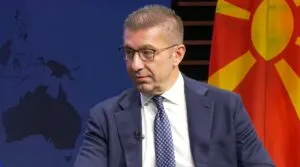
Mickoski Said the Sentence Sofia Doesn't Want to Hear: "We Have a Bilateral Dispute"
27.09.2026


27.09.2026

27.09.2026

27.09.2026

27.09.2026

27.09.2026
27.09.2026

27.09.2026

27.09.2026

27.09.2026

27.09.2026

27.09.2026

26.09.2026

27.09.2026

27.09.2026

27.09.2026

27.09.2026

26.09.2026

25.09.2026

27.09.2026

27.09.2026

27.09.2026

27.09.2026

27.09.2026

27.09.2026

09.03.2026

27.02.2026

19.02.2026

27.09.2026

27.09.2026

26.09.2026

23.04.2026

23.04.2026

12.04.2026


On the night of September 2 to 3, incendiary devices were thrown from a car onto a construction site next to the headquarters of two German defense companies in Munich - Helsing and Rohde & Schwarz. Two of the devices ignited, the third didn't go off. Major damage was avoided and no one was hurt. Police soon arrested a 28-year-old woman and a 38-year-old man, both Bulgarian nationals.
German investigators are now checking whether the two were just the last link in a wider network tied to Russia's military intelligence service, the GRU, German media report. The targets speak for themselves. Helsing makes military drones and supplies them to Ukraine, while Rohde & Schwarz develops military electronics, communication systems, radars and equipment for detecting, tracking and jamming drones. That's exactly why the investigation is checking whether the attack is directly linked to support for Kyiv.
It's worth being precise: so far there is no publicly released conclusive evidence that the GRU ordered the attack. That's the investigation's working theory, and Moscow rejects accusations that it is behind sabotage in Europe. The problem is that Munich isn't an isolated case.
At the same time, according to the same reports, sabotage was being prepared against the factory of Ukrainian drone maker Skyeton in the Slovak town of Haniska. Slovak prosecutors said at the end of August that there had been an attempt to set the factory on fire, but the attack was foiled. Two Latvian nationals and one Ukrainian national were arrested. German security services suspect a dedicated GRU unit responsible for special operations abroad is behind some of the sabotage across Europe.
Berlin had earlier accused Russia of attempted sabotage at Leipzig/Halle airport, where in August a drone carrying explosives was found near a Ukrainian An-124 transport plane. On September 1 the German authorities officially linked that case to Russia, and Moscow denied that too. According to reports, German services are also examining links between Leipzig and other sabotage suspects across Europe, including leads that point to Poland and Serbia.
In Munich - Bulgarian nationals. In Slovakia - Latvians and a Ukrainian. In the Leipzig investigation - leads to Serbia. Hybrid war isn't fought with tanks, but with people throwing incendiary devices from cars at night, while no one can say for sure who gave them the order. German investigators are now trying to establish whether Munich, Slovakia and the earlier cases are parts of the same network or separate operations. How many threads of that network run through the Balkans?
The latest 10 news from this category

One sentence from the White House was enough for the EU energy commissioner to warn of a "very, very bad"...

Girls of around ten stole on the metro and at Disneyland, and if they brought back too little, they were...

The American host claims Ukrainians are "hostages" of their president and that the war only goes on thanks to US...

From the UN podium, Zelensky announced that two North Korean prisoners had been transferred to South Korea - and South...

Beijing wants Washington not just to not support Taiwan's independence, but to openly oppose it, while a 14-billion-dollar arms package...

Northern lights and snowy forests for the cameras; an air wing, a brigade and conscripts on the schedule. Felipe and...

Red carpet, anthems, flowers - and two B-1 bombers over the guests' heads. Trump showed Xi both his hospitality and...

Altman, Amodei and Delangue told the UN that artificial intelligence could escape human control. When the alarm is raised by...

Delcy Rodríguez promised the General Assembly there will be elections in Venezuela, but gave no date. Washington wants a vote,...

The King carried the coffin together with her five children, and the politician who led NATO for ten years spoke...
This site uses cookies - is that okay? Learn more
Be the first to know when Metla launches something new
Leave your email and we will write when there is a new guide or something new on Metla.