

They Rode In on Scooters, Torched the Shops and Left: The Fire in Shuto Orizari Burned for Three Hours, Setting It Took Fifty Seconds
13.09.2026


13.09.2026

13.09.2026

13.09.2026

13.09.2026

13.09.2026

13.09.2026
13.09.2026

12.09.2026

11.09.2026

13.09.2026

13.09.2026

12.09.2026

13.09.2026

13.09.2026

13.09.2026
13.09.2026

12.09.2026

11.09.2026

13.09.2026

13.09.2026

13.09.2026

13.09.2026

13.09.2026

12.09.2026

09.03.2026

27.02.2026

19.02.2026

13.09.2026

12.09.2026

11.09.2026

23.04.2026

23.04.2026

12.04.2026

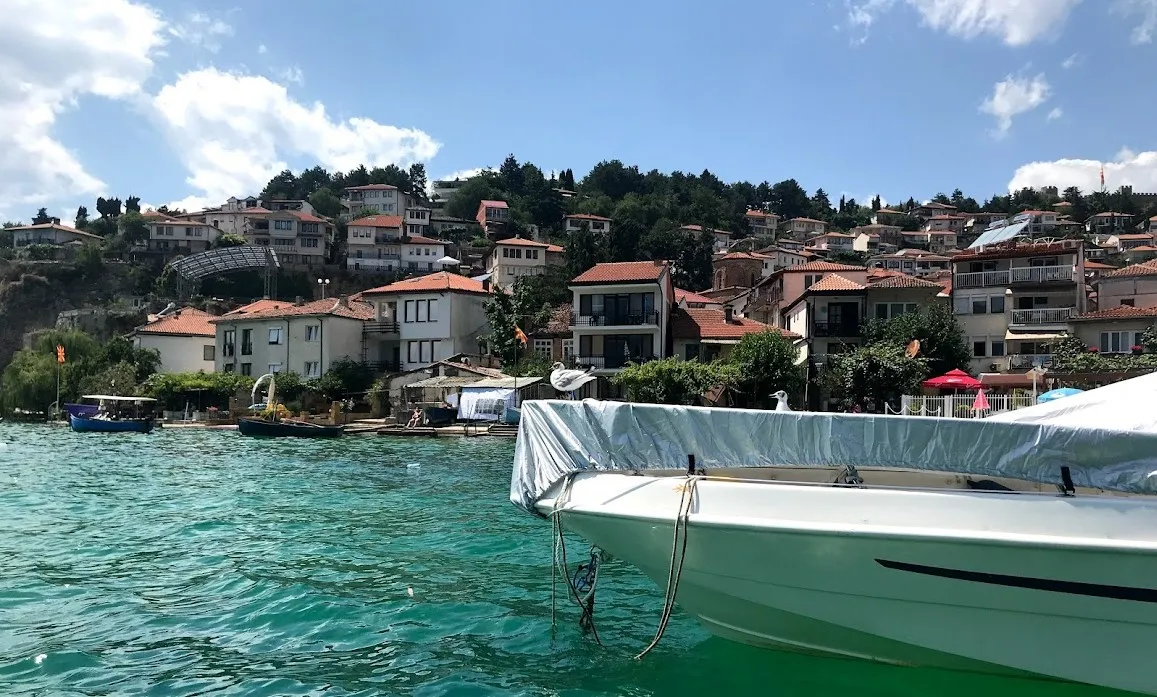
The Ohrid Region will not be added to the List of World Heritage in Danger. UNESCO's World Heritage Committee decided to give Macedonia and Albania another five years to implement its recommendations. The government called it a significant diplomatic success. Formally, that is true. In substance, this is a suspended sentence, not an acquittal.
What actually happened in Busan
The decision was taken at the Committee's 48th session, held in Busan, South Korea, from 19 to 29 July. The draft decision prepared before the debate said something rather different - the World Heritage Centre and the advisory bodies found that the conditions for listing the Ohrid Region as endangered were still met, and proposed exactly that. The outcome changed after an amendment tabled during the session itself. Sixteen of the Committee's 21 members voted to keep Ohrid off the list.
In other words, Ohrid staying off the danger list does not mean the problems are solved. It means diplomacy managed to postpone the listing on the strength of a signed letter of commitments from the government and the municipalities. A new progress report is due by 1 February 2027.
The number that explains the whole story
In 2024 the State Audit Office established that Ohrid has 4,847 illegally constructed buildings, including apartment blocks and hotels. Of the 456 final and enforceable demolition orders issued between 2019 and 2024, not one has been carried out. Not one. That is not a backlog, that is a decision - it just does not have anyone's signature on it.
After the vote, Foreign Minister Timcho Mucunski said illegal buildings should be removed, not only in Ohrid but everywhere, and done so "in the appropriate and lawful manner". Nobody is going to argue with that sentence. The question is why institutions needed six years and one international threat before someone said it out loud, and what makes it any different from every previous statement with the same content.
The list has not changed in a decade
UNESCO's objections are not new and surprise nobody. The documents once again point to weak management, uncontrolled urbanisation, illegal construction, infrastructure projects, tourism pressure, pollution, waste water and insufficient cross-border coordination between Macedonia and Albania.
The demands are concrete: legal protection for Lake Ohrid as a natural monument, declaring the Studenchishte Marsh a nature park, aligning urban plans with protection regimes, and actually removing the structures that damage the site. Not one of these requires new technology or an unprecedented budget. All of them require something harder - an institution willing to act on its own ruling.
Why five years go by fast
UNESCO status does not apply to individual landmarks. This is not just about the lake, or Samuel's Fortress, or Plaoshnik, or the old bazaar taken separately. The protection covers the natural and cultural landscape as one indivisible whole - the lake with its endemic species, the historic town, the early Christian sites, the medieval churches and the long human presence on these shores. That is why a hotel in the wrong place or waste water discharge is not an isolated utilities problem. It changes the very reason the region was recognised.
The extra time is worth something only if it becomes a calendar of obligations with deadlines, named responsible institutions, public reporting and independent oversight. Without that, five years slip by in new strategies, inter-ministerial meetings and responsibility being passed between the government, the municipalities and the public utilities. That is precisely what happened over the past decade.
The hardest test will be the most uncomfortable one: does the law apply equally to a building with no political or ownership protection and to one that has it? The score so far is 456 orders, zero enforcements. If that ratio does not change, the Committee's next session will not be voting for another amendment.
The latest 10 news from this category

Ivanovska recalls why Vodno was forested in the first place. Gerasimovski says the court annulled the old plan and a...

Three Bulgarian ministries, MPs from different parties and flags inside the medical centre. MAEI asks why a check-up in a...

Flowers were laid in Bitola for Stefan Naumov and Dimitar Bogoevski. Behind the anniversary stand two biographies that ended at...

Eighty children do not simply appear out of nowhere. The question no ceremony answers is whether there are enough instruments...

When you buy honey from the man who tells you which village it came from, you bypass the entire trade...
Any citizen can submit a nomination. That is exactly where these competitions either come alive or become an internal affair...
The minister answered that pupils are not a risk group because the youngest patient was 25. The MP had asked...
For five years after the promise, the dump stayed a dump. The two neighbouring parks tell the story that comes...
The most visited historic space in Skopje waited fifty years for someone to replace the pipe under the cobblestones. The...

There is a route, there is a presentation and there is agreement that the road is needed. There is no...
This site uses cookies - is that okay? Learn more
Be the first to know when Metla launches something new
Leave your email and we will write when there is a new guide or something new on Metla.
