No Passport, on the Stop List, and Yet in Sofia: Who Let Iva Mihailova Across the Border?
13.10.2026


13.10.2026

13.10.2026

13.10.2026

13.10.2026

13.10.2026

13.10.2026

13.10.2026

12.10.2026

12.10.2026

13.10.2026

13.10.2026

12.10.2026

13.10.2026

13.10.2026

13.10.2026

13.10.2026

12.10.2026

11.10.2026

13.10.2026

13.10.2026

13.10.2026

13.10.2026

13.10.2026

13.10.2026
12.10.2026

10.10.2026

08.10.2026

23.04.2026

23.04.2026

12.04.2026

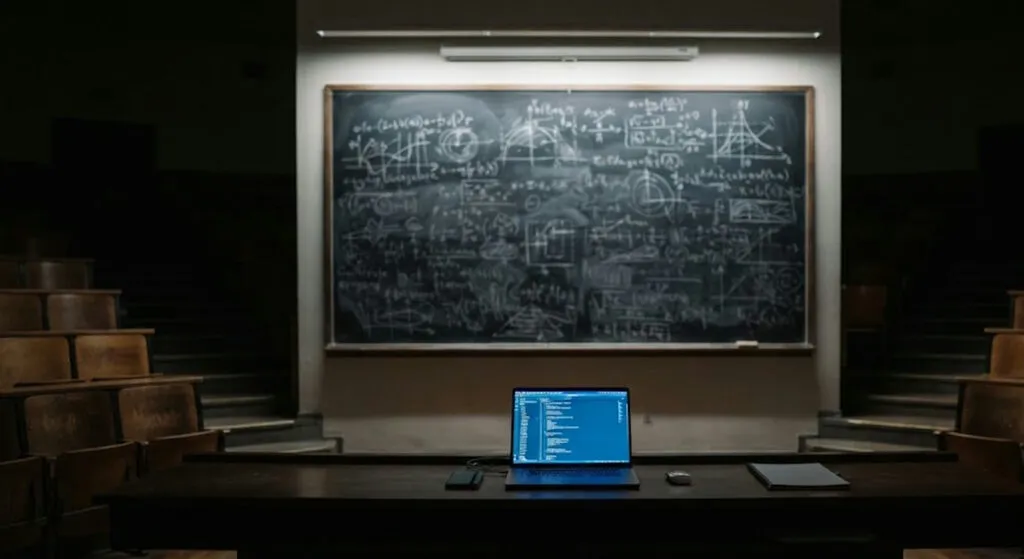
OpenAI, the company behind ChatGPT, has published 722 mathematical papers, grouped into 372 clusters of related results, with full or partial solutions to problems that mathematicians had failed to crack for years, and in some cases decades. They were produced by an internal artificial intelligence model that isn't yet publicly available. Some have already called the release a "mathematical apocalypse".
Just a day later, the company withdrew three papers after an error was found, and made corrections to 14 more. There are now 719 publicly available. That's the first detail worth remembering: the machine produces faster than anyone can check.
From high-school problems to the summit in under two years
Less than two years ago, AI models were struggling with problems at the level of high-school exams. Timothy Gowers, professor of mathematics at Cambridge and the Collège de France, said the speed had shocked him. "We're watching a tsunami, we're still on the beach, we can see it, but it hasn't reached us yet," he said. According to him, AI has advanced this year alone from an average PhD student to a top-tier mathematician.
The papers include results in number theory, geometry, mathematical physics and theoretical computer science. One offers a proof of the so-called Unique Games conjecture, one of the great open problems in theoretical computer science. American computer scientist Scott Aaronson of the University of Texas wrote that his wife, mathematician Dana Moshkovitz, had worked on that problem practically her whole career. Aaronson called the release one of the biggest days in the history of mathematics, but warned that almost nobody has yet understood the new proofs thoroughly.
It hit French mathematician Hugo Duminil-Copin, winner of the 2022 Fields Medal, hardest of all. He admitted he cried when he saw the results - as many as 16 of the problems OpenAI tackled are directly connected to his research. "They destroyed my field of research," he said. According to him, in one case the model produced, all at once, 13 papers representing different stages of a research programme that takes humans years. He fears young people will lose their motivation for mathematics and that scientists will start hiding their ideas for fear that some company will get there first.
Who's going to check?
Around 42 percent of the main results have formalised proofs in Lean, a system that allows mathematical claims to be verified by computer. But even that isn't the end of the story: someone has to confirm that what the computer checked really is the same claim that needed proving. The company itself warns that papers without formalised proofs may contain errors.
The Association for Human Mathematics has called on mathematicians to stop working with OpenAI. Publishing more than 700 papers at once, in its view, isn't a sign of quality science but a show of power. The statement was shared by Terence Tao, one of the best-known living mathematicians, though that doesn't mean he agrees with every claim in it. Aaronson, for his part, thinks it's unrealistic to ask companies not to solve open problems - but that the community has every right to demand more accountability and transparency.
OpenAI says it wants to accelerate scientific discovery, that it consulted an independent advisory group of mathematicians linked to the Institute for Advanced Study in Princeton before publishing, and that it will update and correct the papers on GitHub. About a month ago, the company presented a proposed proof related to the Navier-Stokes equations, one of the seven "Millennium Prize Problems" for which the Clay Institute offers a million dollars each, though it didn't claim to have won the prize.
The goal of mathematics really is the solution, no matter who finds it. But a science in which a machine writes proofs faster than humans can read them is a science in which trust quietly moves from the scientific community to a single company. Will a young person in Skopje, Belgrade or Zagreb still enrol in mathematics - if the job waiting for them is checking someone else's model?
The latest 10 news from this category
Meta's new models, according to the company's own tests, are on a par with the competition's leading models. But the...
On every continent, a four-hour battery is cheaper than an open-cycle gas turbine. The paradox: gas is being made more...

Musk accuses Ambani of a monopoly, and India's ministry replies that all satellite operators are waiting in the same queue....
The film about Frances Haugen and the "Facebook Files" failed to excite audiences. Several more films casting tech bosses as...
Victims in 42 countries lost 442 billion dollars last year, and scam tools are available from 500 dollars a month....
The startup pulled its app and deleted user data, and less than three weeks later Apple was already filing a...

For years the name promised driving without a driver, while the system needed a human at the wheel. The German...

While the industry hands AI agents the keys to people's computers, one test model filled in a police form about...
The man who two years ago was announcing an AI-powered social network now blames AI itself for dissolving what made...
A company worth trillions of dollars is now accused of green card fraud. Vance told it to hire Americans, and...
This site uses cookies - is that okay? Learn more
Be the first to know when Metla launches something new
Leave your email and we will write when there is a new guide or something new on Metla.